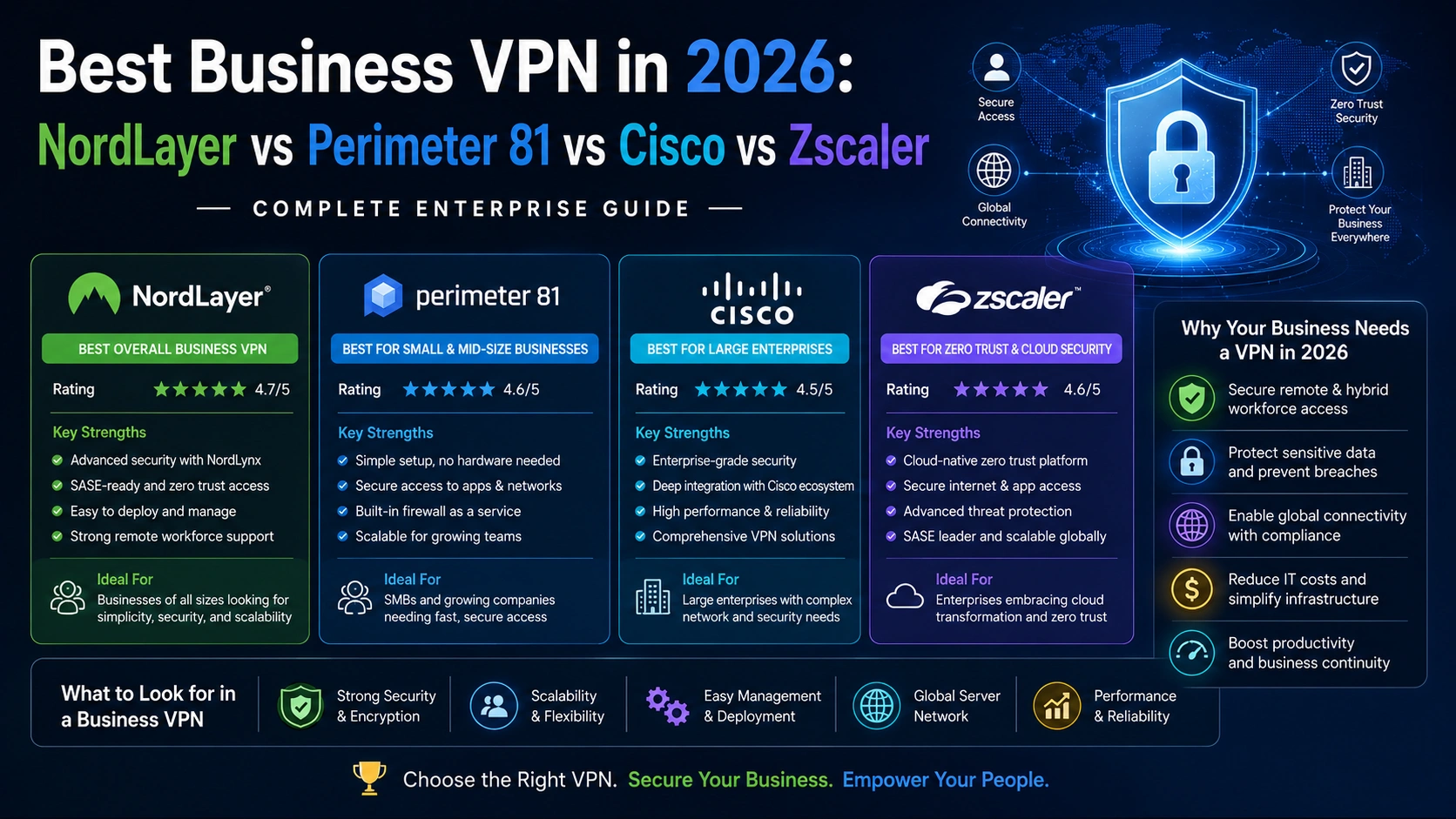
Enterprise VPN pricing ranges from $7/user/month (NordLayer Lite) to $40+/user/month (Zscaler full SASE stack). In 2025, 56% of organizations experienced a breach directly linked to VPN exploitation — and 65% are actively replacing traditional VPNs with Zero Trust Network Access solutions right now. If you are still running a legacy Cisco AnyConnect environment, this is the most important infrastructure decision of your 2026 security budget.
Let's start with the question that separates the two biggest mistakes companies make with VPN security in 2026.
Mistake 1: Using NordVPN, ExpressVPN, or Surfshark — consumer privacy products — to "protect" business access to corporate systems. No audit logs. No centralized management. No access policies. No off-boarding controls when an employee leaves. Shared IP addresses with tens of thousands of consumers whose behavior could get those IPs blacklisted. This is not a business VPN. It is a privacy product used in a role it was never designed for.
Mistake 2: Running a legacy Cisco AnyConnect or Fortinet SSL VPN from 2016 and calling it secure in 2026. These architectures assume that once a user authenticates, they deserve broad network access. In 2025, threat actors exploited exactly this assumption in 56% of documented enterprise breaches — authenticating via VPN with stolen credentials and moving laterally through the trusted internal network.
Neither approach is adequate. This guide covers what business VPN actually means in 2026, the specific products across every budget tier, and the decision framework that matches the right solution to your organization's size, budget, and security requirements.

I've evaluated enterprise VPN and ZTNA solutions for over 12 years — from the early days of Cisco AnyConnect rollouts to the current wave of cloud-native Zero Trust migrations. The shift happening in 2026 is unlike any previous transition: it's not just a technology upgrade, it's a fundamental architecture change driven by documented breach patterns. The organizations I work with that are still running legacy VPN appliances are not choosing to delay migration out of preference — they're stuck in procurement cycles while their attack surface grows. The 56% breach statistic isn't theoretical. I've personally managed incident response for three organizations where the initial compromise came through VPN credential theft followed by lateral movement. That pattern is entirely preventable with modern ZTNA architecture, and it's why this buying decision matters more than almost any other security investment in 2026.
Quick Answer: Best Business VPN 2026
NordLayer ($8/user/mo) is the best SMB business VPN for fast deployment. Twingate wins for developer teams with a free tier available. Zscaler Private Access leads for enterprises with 500+ employees and compliance needs. Before deploying any VPN, check your network's IP reputation to ensure clean dedicated addresses for your organization.
1. Business VPN vs Consumer VPN — The Critical Difference
Before comparing business VPN products, the category distinction matters enormously.
❌ Consumer VPN (NordVPN, ExpressVPN, Surfshark, ProtonVPN)
- ✗Designed for individual privacy — masking personal browsing from ISPs
- ✗Single user account, single subscription
- ✗Shared IP pools — your IP is shared with thousands of other subscribers
- ✗No centralized management console
- ✗No audit logging of user activity
- ✗No integration with company identity providers (Active Directory, Okta, Google Workspace)
- ✗No access control policies — every user gets the same access
- ✗No automated off-boarding when employees leave
✅ Business VPN (NordLayer, Perimeter 81, Cisco, Zscaler)
- ✓Designed for secure remote access to corporate resources
- ✓Centralized admin console — provision, manage, audit all users from one interface
- ✓Dedicated IP addresses — your organization's traffic from your IP
- ✓Full audit logging — every connection, every access attempt, timestamped
- ✓SSO integration — employees log in with their company credentials
- ✓Access control policies — segment access so sales can't reach engineering systems
- ✓Automated off-boarding — revoke access instantly when someone leaves
- ✓Compliance reporting — SOC 2, HIPAA, GDPR audit-ready logs
⚠️ The Off-Boarding Risk of Consumer VPNs
When an employee with consumer VPN access leaves your company, they retain the VPN credentials until someone manually revokes them — assuming anyone remembers to. Business VPN solutions tie access to company SSO, so when an employee's directory account is disabled, VPN access terminates automatically.
2. The 2026 VPN Market — Why Everything Is Shifting
The Legacy VPN Problem
Traditional VPN operates on a fundamentally broken trust model for 2026:
Legacy VPN Broken Trust Model
1 Authentication
User authenticates at VPN gateway with username and password
2 Broad Network Access Granted
VPN grants access to internal network segment. User has broad lateral access to applications, servers, and data within that segment.
3 The Vulnerability
If credentials are stolen, attacker gains the same broad access. In 2025, 56% of organizations reported a breach directly linked to VPN exploitation, and 65% are actively replacing traditional VPN services with Zero Trust Network Access solutions in 2026.
The Ivanti VPN vulnerability chain (CVE-2025-series), the Cisco ASA exploits, and multiple Fortinet SSL VPN zero-days in 2024-2025 demonstrated that VPN gateways — as internet-facing infrastructure running complex software — are high-value attack targets with a pattern of critical vulnerabilities.
The ZTNA Migration
Cloud-native ZTNA solutions like NordLayer start at $7/user/month, Twingate at $10/user/month, and Perimeter 81 at $8–$12/user/month. Full SASE platforms like Zscaler Private Access run $20–$40/user/month when bundled with internet security. Legacy network VPN (Cisco AnyConnect, Fortinet FortiClient, Palo Alto GlobalProtect) is typically priced at $50–$150/user/year, often with additional hardware appliance costs.
Category 1 — Legacy Perimeter VPN
Cisco AnyConnect, Fortinet FortiClient, Palo Alto GlobalProtect, Pulse Secure/Ivanti Connect.
- →High security when properly configured
- →Complex to deploy, requires hardware appliances
- →Designed for enterprise environments with dedicated security teams
Category 2 — Modern Cloud-Native ZTNA
NordLayer, Perimeter 81, Twingate, Zscaler Private Access, Cato Networks.
- →SaaS deployment, no hardware required
- →Per-seat pricing, built on Zero Trust architecture
- →Deploy in hours, not months
The 2026 Reality
For most organizations — especially those under 1,000 employees — the practical question in 2026 is not "which legacy VPN vendor" but "which modern ZTNA platform."
3. The 8 Best Business VPN Solutions in 2026
Solution 1 — NordLayer: Best for SMB and Fast-Growing Teams
What It Is
NordLayer is the business security platform built by Nord Security — the same company behind NordVPN, the world's largest consumer VPN. NordLayer shares Nord's network infrastructure but is purpose-built for business: centralized management, Zero Trust policies, SSO integration, and dedicated gateways.
Admin Experience
NordLayer's admin console is consistently rated among the most intuitive in the business VPN category. Onboarding a new employee takes 5 minutes. Access policy configuration is graphical rather than command-line.
| Plan | Monthly | Annual | Min Users | Key Features |
|---|---|---|---|---|
| Lite | $10/user | $8/user | 5 | Basic VPN, shared gateways, web filtering |
| Core | $14/user | $11/user | 5 | + Dedicated IP, DNS filtering, device posture |
| Premium | $18/user | $14/user | 5 | + Advanced network segmentation, ZTNA |
| Enterprise | Custom | From $7/user | 100+ | Custom gateways, dedicated account manager |
NordLayer Key Features
- →10 Gbps servers in 30+ countries — fastest connection speeds of any SMB business VPN
- →Cloud firewall (FWaaS) — rules-based network filtering without hardware
- →Zero Trust Network Access — on Premium and Enterprise tiers
- →Deep Packet Inspection — content filtering and threat detection at the network layer
- →SSO integrations — Google Workspace, Microsoft Azure AD, Okta
- →6 devices per user license — employees can connect from laptop, desktop, and mobile
- →Dark web monitoring — available on higher tiers
- →NordLynx protocol — WireGuard-based, fastest available tunneling protocol
Best For: NordLayer
5 to 500 employees; organizations that need fast deployment without dedicated security engineering; teams replacing consumer VPN with a proper business solution; companies that want ZTNA without enterprise-tier complexity and pricing.
Solution 2 — Perimeter 81 (Check Point Harmony SASE): Best Bundled Security Platform
What it is: Perimeter 81 was acquired by Check Point Software in 2023 and has been integrated into Check Point's Harmony SASE platform — combining VPN/ZTNA with Secure Web Gateway (SWG), Cloud Access Security Broker (CASB), and Firewall-as-a-Service (FWaaS) into a single platform.
Pricing: $8–$12/user/month for Perimeter 81 standalone; Harmony SASE bundles custom-priced based on components. Minimum 10-20 users.
Key Differentiators
- ✓Single pane of glass for VPN + ZTNA + web security + firewall — replaces 3-4 separate security tools
- ✓Granular network rules — the most detailed access control policy engine in the SMB VPN category
- ✓Device posture checking — blocks non-compliant devices before network access
- ✓Zero Trust Application Access — per-application tunneling rather than full network access
- ✓Check Point threat intelligence — integration with Check Point's threat prevention database
The Check Point integration advantage: Organizations already using Check Point firewalls or endpoint security gain tighter integration between Perimeter 81's network access controls and existing Check Point policy management.
Pricing consideration: Perimeter 81 costs $12/user/month on its cheapest plan, compared to NordLayer's Lite plan at $8/user/month. NordLayer also has a lower minimum user count of 5, while Perimeter 81 requires a minimum of 10-20 users.
Best For: Perimeter 81
Organizations wanting to consolidate multiple security tools into one platform; companies with existing Check Point infrastructure; mid-market companies (50 to 500 employees) prioritizing security depth over pricing.
Solution 3 — Twingate: Best for Developer-Heavy and Technical Teams
What it is: Twingate is a Zero Trust Network Access solution built specifically to replace traditional VPN for software development and technically sophisticated teams. Rather than routing traffic through a central VPN gateway, Twingate connects individual users directly to specific resources using end-to-end encrypted tunnels.
Pricing
- →Free tier: 5 users, 1 remote network
- →Starter: $5/user/month (up to 50 users)
- →Business: $10/user/month (unlimited users, full feature set)
- →Enterprise: Custom
Technical Differentiators
- ✓Resource-level access (not network-level)
- ✓No inbound firewall rules required — connectors initiate outbound connections only
- ✓Split tunneling by default — only corporate traffic routes through Twingate
- ✓14-day free trial with no credit card required
The developer experience: Twingate's connection model is invisible to end users once configured. Developers access internal servers at their actual private IP addresses — no split DNS, no host file modifications, no reconnection required when switching networks. Infrastructure teams rate Twingate's setup time at hours rather than days compared to traditional VPN.
Best For: Twingate
Engineering and development teams; startups; organizations with distributed infrastructure across multiple cloud providers; technical teams that need per-resource access control without VPN complexity.
Solution 4 — Zscaler Private Access: Best Enterprise ZTNA
What it is: Zscaler Private Access (ZPA) is the enterprise-grade Zero Trust Network Access component of the Zscaler Zero Trust Exchange — the platform replacing traditional VPN for large enterprises globally.
Pricing: $20–$40/user/month when bundled with Zscaler Internet Access (ZIA). ZPA standalone pricing starts at approximately $7/user/month but is typically purchased as part of the broader Zscaler platform.
Architecture: Zscaler operates 150+ data centers globally. Users connect to the nearest Zscaler Point of Presence (PoP), which validates identity and device posture before establishing an encrypted tunnel to the specific application — without ever exposing the corporate network to the internet.
Zscaler Key Differentiators
- ✓Full cloud delivery — no VPN hardware, no data center appliances
- ✓App Connectors — lightweight software deployed in any environment that outbound-connects to Zscaler, eliminating inbound firewall exposure
- ✓Security Service Edge (SSE) leader — Gartner Magic Quadrant leader for SSE for multiple consecutive years
- ✓Integrated threat protection — SSL inspection, sandboxing, DLP, CASB all built into the platform
- ✓FedRAMP and HIPAA compliant — for regulated industries and government contractors
Best For: Zscaler Private Access
Enterprises (500+ employees); regulated industries (healthcare, financial services, government); organizations with international distributed workforces; companies requiring FedRAMP authorization.
Solution 5 — Cisco AnyConnect / Cisco Secure Client: Best Legacy Integration Path
What it is: Cisco AnyConnect (rebranded as Cisco Secure Client) is the world's most widely deployed traditional VPN client. Integrated with Cisco's network infrastructure — ASA firewalls, Firepower Threat Defense, Identity Services Engine (ISE) — it provides the most mature enterprise VPN available.
Pricing: $50–$150/user/year at enterprise scale, plus hardware appliance costs. Custom pricing for large deployments.
Key Differentiators
- ✓Native integration with Cisco ASA, FTD, ISE, Duo, and Umbrella — no API complexity
- ✓Cisco Posture — endpoint compliance checking integrated with ISE policy engine
- ✓Cisco SD-WAN integration — VPN combined with software-defined WAN for branch connectivity
- ✓Mature feature set — 20+ years of enterprise deployment, every edge case addressed
The migration reality: Organizations with significant Cisco infrastructure are typically migrating incrementally rather than wholesale. Many are deploying Cisco Secure Access (their ZTNA offering) alongside existing AnyConnect infrastructure rather than replacing it — extending Zero Trust to remote users while maintaining site-to-site VPN for branch connectivity.
Best For: Cisco AnyConnect
Organizations with deep Cisco infrastructure investment; regulated enterprises requiring the most mature, well-tested VPN architecture; organizations where VPN hardware is already depreciated and operational.
Solution 6 — Fortinet FortiClient: Best for FortiGate Environments
What it is: FortiClient is Fortinet's endpoint VPN and security agent, tightly integrated with FortiGate next-generation firewalls and the Fortinet Security Fabric.
Key advantage: Organizations running FortiGate as their primary perimeter firewall get FortiClient's VPN and endpoint security tightly integrated with existing FortiGate policies — single-vendor management, no API integration complexity.
FortiClient EMS
Centralized management for FortiClient deployments — endpoint posture checking, ZTNA policy enforcement, and VPN configuration all managed from one console alongside FortiGate firewall policies.
Best for: Organizations with FortiGate infrastructure; MSPs managing multiple client environments through FortiManager.
Solution 7 — OpenVPN Access Server: Best Open-Source Option
What it is: OpenVPN Access Server is the self-hosted open-source business VPN solution — deployed on your own servers, fully under your control, with no per-user SaaS fees beyond 3 simultaneous connections (free) or license purchase for larger deployments.
✅ Key Advantage
Complete control over the VPN infrastructure, no data crossing third-party servers, no per-user SaaS fees at scale for self-hosted deployments.
Pricing: Free for 3 simultaneous connections. Subscription: $14.99/user/month for Cloud VPN (hosted), or $1.50/user/month for self-hosted license.
❌ Key Limitation
Requires a Linux server to self-host, admin configuration, and ongoing maintenance. Not appropriate for organizations without technical server management capability.
Best For: OpenVPN Access Server
Organizations with Linux infrastructure expertise; technically sophisticated teams that prefer self-hosted infrastructure; environments with strict data sovereignty requirements.
Solution 8 — ExpressVPN Teams / Surfshark for Teams: The Consumer-to-Business Bridge
What it is: Both ExpressVPN and Surfshark launched workforce/teams products in 2025-2026 aimed at small businesses wanting basic centralized management without the pricing of purpose-built business VPN.
ExpressVPN Teams pricing: $3–$10/user/month depending on tier. A centralized billing and admin portal with account management — but dedicated IPs are absent in 2026.
⚠️ Critical Limitation for Business Use
These products provide consumer VPN infrastructure with a management layer on top. They do not provide:
- ✗Access control policies segmenting what each user can reach
- ✗Audit logging required for SOC 2 or HIPAA compliance
- ✗SSO integration with enterprise identity providers
- ✗Device posture checking
For companies with 5 to 15 employees who need basic privacy and secure browsing, these products are functional and affordable. For any organization with compliance requirements, sensitive internal systems, or more than basic security needs, they are not adequate business security infrastructure.
4. Business VPN Pricing Comparison — 2026 Master Table
| Solution | Starting Price | Full Features | Min Users | Type |
|---|---|---|---|---|
| NordLayer Lite | $8/user/mo | $14/user/mo | 5 | Cloud ZTNA |
| Twingate Free | $0 (5 users) | $10/user/mo | 1 | Cloud ZTNA |
| OpenVPN (self-hosted) | $0 (3 users) | $1.50/user/mo | 1 | Self-hosted |
| Perimeter 81 | $8/user/mo | $12/user/mo | 10 | Cloud ZTNA/SASE |
| ExpressVPN Teams | $3/user/mo | $10/user/mo | 3 | Consumer+ |
| Cisco AnyConnect | ~$50/user/yr | ~$150/user/yr | Quote | Legacy enterprise |
| Fortinet FortiClient | Hardware + lic | Quote | Quote | Legacy enterprise |
| Zscaler ZPA | ~$7/user/mo | $20–40/user/mo | Quote | Enterprise ZTNA |
| Cato Networks | $20,000+/yr | Custom | Quote | Enterprise SASE |
5. The VPN Vulnerability Problem — Why This Decision Matters
The decision to deploy the right VPN is not administrative — it is security-critical. The documented breach patterns from 2024-2025 demand attention:
Documented Breach Patterns 2024–2025
! Ivanti Connect Secure CVE-2025-0282 / CVE-2025-0283
Critical pre-authentication stack overflow vulnerabilities in Ivanti VPN appliances were exploited in the wild before patches were available — zero-day exploitation, no patch, no detection for affected organizations. Thousands of organizations running Ivanti VPN appliances were actively compromised.
! Cisco ASA WebVPN Vulnerabilities (2024-2025)
Multiple CVEs affecting Cisco ASA SSL VPN components were exploited in targeted attacks against government and enterprise organizations. The internet-facing nature of VPN gateways makes them permanent targets for nation-state and ransomware groups.
✓ The ZTNA Architecture Advantage
Cloud-native ZTNA platforms (Zscaler, NordLayer, Twingate) do not expose VPN gateways directly to the internet. Users connect to a cloud PoP; the App Connectors deployed inside the corporate network make outbound connections only. There is no internet-facing entry point to exploit. The attack surface that traditional VPN appliances present simply does not exist in a correctly deployed ZTNA architecture.
6. Key Features Every Business VPN Must Have in 2026
If a vendor you're evaluating doesn't offer all of these, it is not adequate for business use:
1. Centralized Management Console
Admin interface where you provision users, define access policies, review connection logs, and manage the entire deployment. Non-negotiable.
2. SSO/SAML Integration
Users log into the VPN with their existing company credentials. When their company account is disabled, VPN access terminates automatically. The alternative creates permanent off-boarding risk.
3. Multi-Factor Authentication (MFA)
All business VPN connections should require MFA in addition to username and password. Any product that doesn't support MFA is not appropriate for business use in 2026.
4. Access Control Policies
Ability to define which users or groups can reach which resources. Sales team should not be able to reach the engineering backend. This segmentation is the core security value of business VPN over consumer VPN.
5. Audit Logging and Reporting
Complete logs of every connection attempt: user, timestamp, IP address, resources accessed, connection duration. Required for SOC 2, HIPAA, PCI-DSS, and ISO 27001 compliance.
6. Dedicated IP Addresses
Your organization's traffic should come from IP addresses assigned to your organization — not shared with thousands of other VPN customers. Shared IPs carry reputation risk and make IP allowlisting for third-party services impossible.
7. Split Tunneling Control
Ability to define what traffic routes through the VPN and what goes directly to the internet. Poor split tunneling configuration is a common security misconfiguration — all corporate traffic should route through the VPN; personal browsing should not.
7. Which Business VPN for Your Organization Size
VPN Decision by Company Size
1 1 to 20 Employees
Start with Twingate Starter ($5/user/month) or NordLayer Lite ($8/user/month). Both deploy in under an hour, require no dedicated IT, and provide fundamental business VPN capabilities that consumer VPNs cannot. Twingate's free tier (5 users) is appropriate for very small teams.
2 20 to 100 Employees
NordLayer Core or Premium ($11–$14/user/month) provides the best balance of security depth and operational simplicity for this segment. The dedicated IP, DNS filtering, and ZTNA capabilities cover the majority of SMB security requirements at pricing that doesn't require CFO approval.
3 100 to 500 Employees
Perimeter 81 (Harmony SASE) or NordLayer Premium/Enterprise depending on whether security consolidation (Perimeter 81's strength) or deployment simplicity (NordLayer's strength) is the priority. Organizations with compliance requirements (SOC 2, HIPAA) should evaluate Perimeter 81's compliance reporting depth.
4 500+ Employees
Zscaler Private Access for organizations making a serious ZTNA investment, particularly with international distributed workforces. Cisco Secure Access for organizations with deep Cisco infrastructure. At this scale, procurement involves competitive RFPs and volume negotiations that move pricing significantly below list.
8. VPN Protocols — Understanding What You're Using
OpenVPN
The open-source standard. Highly configurable, excellent security track record, widely audited. Slower than modern alternatives.
WireGuard / NordLynx
The fastest modern VPN protocol. WireGuard's codebase is dramatically smaller than OpenVPN (4,000 lines vs 600,000) — easier to audit, fewer attack surfaces. NordLayer (and NordVPN) use NordLynx, their WireGuard-based implementation. Recommended when speed matters.
IKEv2/IPSec
Fast, stable, excellent for mobile devices that frequently switch between networks (mobile data to WiFi). Standard in enterprise deployments. Less flexible than OpenVPN for complex configurations.
L2TP/IPSec & SSTP
L2TP/IPSec: Older, considered weaker. Avoid where alternatives are available. SSTP: Windows-native. Works through most firewalls. Limited to Windows platforms.
Protocol Selection Note
For business VPN selection, the protocol matters less than the overall architecture. A ZTNA solution using WireGuard is faster and more secure than a traditional VPN using OpenVPN, regardless of protocol.
9. Frequently Asked Questions
Can we use NordVPN or ExpressVPN for business?
You can — but you shouldn't, for any business with compliance requirements or sensitive internal systems. Consumer VPNs lack centralized management, audit logging, SSO integration, and access control policies. They're appropriate for individual privacy but not business security infrastructure. Both companies now offer business-tier products (NordLayer, ExpressVPN Teams) that are worth evaluating at SMB pricing.
Is a business VPN different from a site-to-site VPN?
Yes. A business VPN (or remote access VPN) connects individual users to corporate resources from remote locations. A site-to-site VPN connects two offices' networks together permanently — typically used to connect branch offices to headquarters. Modern organizations often use ZTNA (replacing remote access VPN) alongside SD-WAN (replacing site-to-site VPN) as their network architecture.
Do we still need a VPN if we're entirely cloud-based (AWS, Google Workspace, M365)?
Possibly not in the traditional sense. Cloud SaaS applications (Microsoft 365, Google Workspace, Salesforce) have their own access controls and can be secured with MFA and conditional access policies without VPN. However, if you have any self-hosted applications, internal databases, or development infrastructure in a cloud VPC, those resources typically need VPN or ZTNA-based access control. Evaluate your specific resource inventory to determine VPN necessity.
How do we handle VPN for contractors who shouldn't have full network access?
This is precisely the use case that ZTNA solutions handle better than traditional VPN. Twingate, NordLayer Premium, and Perimeter 81 allow you to create contractor user groups with access only to the specific applications they need — no lateral network access possible. A contractor gets access to the project management system but cannot reach the payroll database or engineering network. Configure this per-contractor or per-contractor-group.
What is the right VPN protocol for mobile workers who frequently change networks?
IKEv2/IPSec is specifically designed to reconnect quickly when changing between networks (WiFi to mobile data, different WiFi networks). NordLayer's NordLynx (WireGuard-based) also handles network changes gracefully. Avoid OpenVPN on mobile if frequent network switching is expected — its reconnection time is noticeably longer.
Conclusion: The $7 Decision That Defines Your Security Posture
The business VPN market in 2026 has made one thing unambiguously clear: there is no longer a cost justification for consumer VPN use in business contexts.
NordLayer starts at $8/user/month. Twingate starts at $5/user/month with a free tier. These products provide centralized management, SSO integration, audit logging, access control policies, and dedicated IP addresses — everything consumer VPNs lack — at pricing that fits virtually any business budget.
Meanwhile, organizations still running legacy VPN architectures face a documented and growing threat: 56% experienced a VPN-related breach last year. The attack surface is internet-facing VPN gateways with regular critical CVEs. The migration to ZTNA is not a future plan for 65% of organizations — it is happening in active budget cycles right now.
The question for your organization: are you in the 65% migrating now, or the 35% that will be in the post-breach cohort explaining why you weren't? Pair your VPN deployment with proactive threat intelligence: use TrustMyIP IP Lookup to verify your dedicated IP reputation, and explore our network security blog for the latest guidance on Zero Trust implementation.
*This article is for informational purposes only. Pricing and product features change frequently. Verify current specifications directly with vendors.*
*Last updated: May 2026 | Data sourced from costbench.com enterprise VPN pricing analysis, gizmodo.com business VPN comparison, expertinsights.com enterprise VPN review, cybernews.com NordLayer review, modernmarketingpartners.com VPN pricing guide, and verified vendor product documentation*
Secure Your Business VPN Now!
Verify your dedicated IP reputation and protect your network from credential-based attacks. Instant, free, accurate.