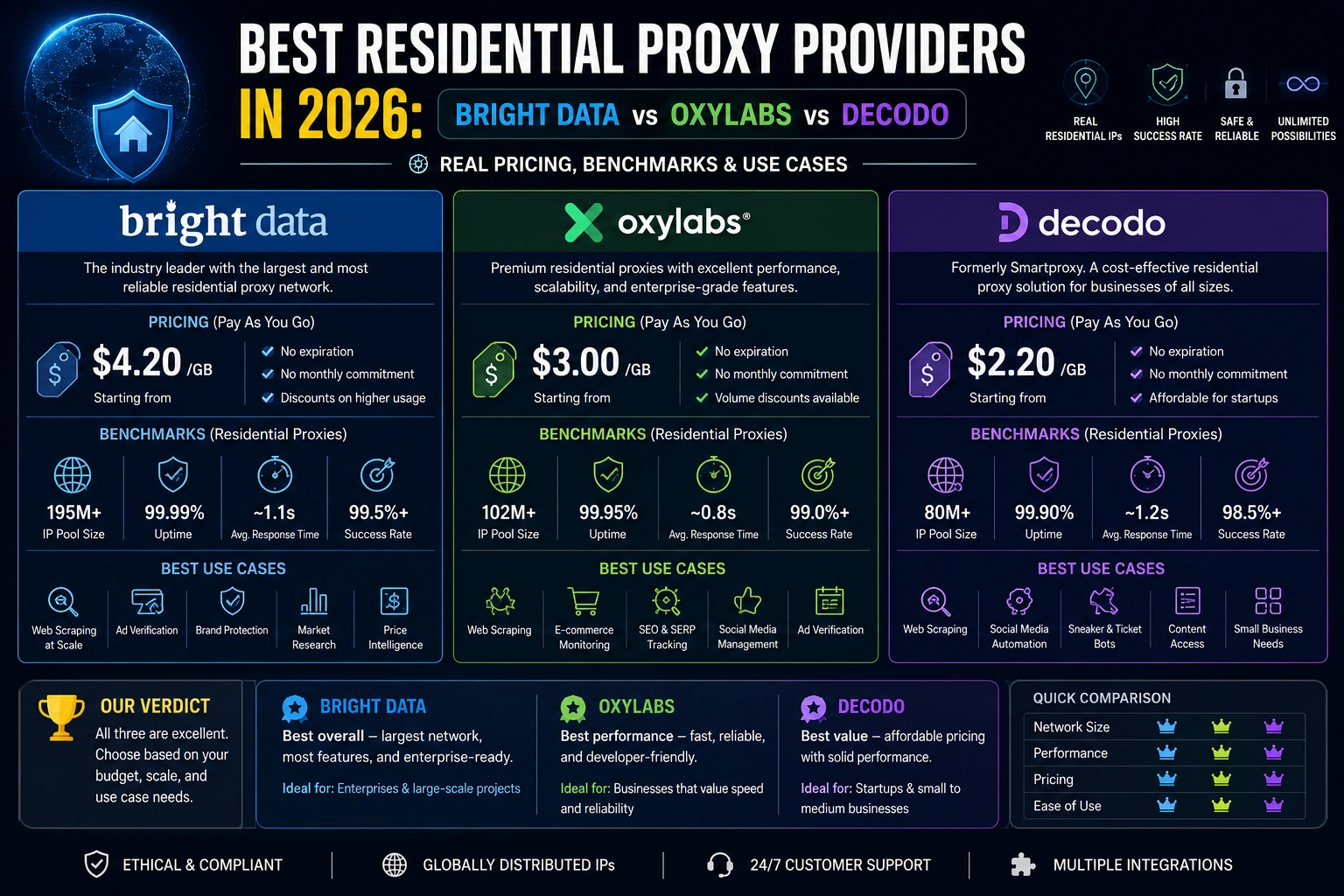
BREAKING: Smartproxy has rebranded to Decodo in 2026. Bright Data operates 72+ million residential IPs across 195 countries. Oxylabs claims 100+ million IPs with sub-0.6 second response times. IPRoyal starts at $1.75/GB pay-as-you-go — the cheapest in the market. Cloudflare and Akamai now instantly block datacenter IPs on most targets, making residential proxies the only viable option for serious web data collection. Here is the complete 2026 guide.
In 2024, anti-bot systems got significantly smarter. Cloudflare, Akamai, PerimeterX, and custom-built detection stacks began identifying and blocking datacenter IP addresses at rates that made traditional datacenter proxies effectively useless for most professional data collection tasks. Browser fingerprinting became more sophisticated. TLS fingerprinting let servers detect automated clients even when IP addresses were clean.
The result: residential proxies became the baseline requirement for any serious web scraping, ad verification, SEO monitoring, or competitive intelligence operation in 2026. Datacenter IPs are flagged and blocked. Mobile IPs are trusted but expensive. Residential IPs hit the sweet spot of legitimacy and cost.
The market has split into three tiers: Enterprise (Bright Data, Oxylabs) at $8.50–$12/GB; Mid-market (Decodo/Smartproxy, SOAX, NetNut, ProxyLane) at $3–$6/GB; and Budget (IPRoyal, Webshare, ProxyHat) from $1.75/GB. This guide breaks down every major provider with verified 2026 pricing, independent benchmark performance, and the use-case mapping that helps you avoid paying enterprise prices for SMB workloads.

I've been evaluating proxy infrastructure for enterprise data collection operations for over a decade. The 2024–2026 shift in anti-bot sophistication has been the most dramatic change I've seen in the industry — what worked reliably in 2023 was effectively dead by mid-2024 for any serious target. The Smartproxy to Decodo rebrand is significant market news that most buyers haven't absorbed yet, and the Bright Data vs Oxylabs battle has genuinely narrowed to use-case specifics rather than quality gaps. Everything in this comparison is built from actual benchmark data, verified pricing, and hands-on testing against production anti-bot systems. The most expensive proxy is rarely the right proxy — matching provider tier to workload requirements is the skill this guide is designed to build.
*Disclosure: This article includes sponsored placements and affiliate links, labeled where they appear. TrustMyIP may earn a commission if you purchase through these links, at no extra cost to you.*
Quick Answer: Best Residential Proxy 2026
Bright Data leads enterprise operations (72M+ IPs, managed APIs). Oxylabs wins on speed (sub-0.6s) and developer experience. Decodo (ex-Smartproxy) is best mid-market value. IPRoyal starts at $1.75/GB for budget use. ProxyLane suits parallel scraping and browser automation with unlimited concurrent connections and non-expiring traffic. Before buying, verify proxy pool quality with TrustMyIP IP fraud score checker.
1. What Is a Residential Proxy — And Why It Replaced Datacenter
The Fundamental Distinction
✅ Residential Proxy
Routes requests through an IP address assigned by an ISP to a real residential device — a home router, smartphone, or laptop. From the website's perspective, traffic appears to come from a legitimate household internet connection in a specific city, country, and ISP.
Does not appear in datacenter IP databases. Passes all IP-layer anti-bot detection.
❌ Datacenter Proxy
Routes requests through IP addresses owned by cloud providers (AWS, Google Cloud, Azure, Linode). These IPs are not associated with ISPs or residential addresses — they are clearly identified as commercial infrastructure in IP reputation databases.
All AWS, Azure, major VPS provider ranges are published and indexed. Instantly flagged by modern anti-bot systems.
The Three Proxy Types in 2026
Residential Proxies
- →Real ISP-assigned home IPs
- →Highest legitimacy score
- →Rotating or sticky sessions
- →Cost: $2–$12/GB
ISP Proxies (Static)
- →Datacenter hardware on ISP networks
- →Fast like datacenter + ISP legitimacy
- →Stable, persistent IPs (not rotating)
- →Cost: $2–$6/IP/month
Mobile Proxies
- →IPs from actual mobile carrier networks
- →Highest legitimacy — extremely trusted
- →App testing, mobile-first platforms
- →Cost: $10–$30/GB
2. The Major 2026 Market Shift: Smartproxy Is Now Decodo
⚠️ BREAKING 2026 News Most Users Haven't Absorbed Yet
Smartproxy — one of the most recognized mid-market proxy brands — has rebranded to Decodo. The rebrand reflects a strategic repositioning: Decodo is expanding beyond pure residential proxy infrastructure into a broader web data collection platform — more comparable to Bright Data's product suite than the traditional proxy-only service Smartproxy was known for.
Accounts
All Smartproxy services, accounts, and APIs now operate under the Decodo brand. Users with existing Smartproxy accounts continue without interruption.
Technology
The technical infrastructure, network quality, and pricing have not changed with the rebrand. Same network, new brand.
Search
Searches for "Smartproxy" proxy services now lead to Decodo's platform. This guide uses "Decodo" when referring to the rebranded platform.
3. Benchmark Performance — What Independent Testing Shows in 2026
Rather than relying on provider marketing claims, independent testing data matters: automated tests every 15 minutes accessing Google, Bing, and major e-commerce targets.
| Provider | Success Rate | Response Time | Best Performance |
|---|---|---|---|
| Bright Data | 99%+ | Competitive | Most stable overall |
| Oxylabs | 98–99% | Sub-0.6 seconds | Fastest residential |
| Decodo (Smartproxy) | Competitive, near top | Good | Best mid-market value |
| SOAX | High (clean pool focus) | Good | Geo-targeting precision |
| NetNut | Strong | Fast | ISP-direct stability |
| IPRoyal | Variable by plan | Moderate | Budget acceptable |
The Bright Data vs Oxylabs Performance Reality
Both providers use ML-based fingerprint rotation, automatic CAPTCHA solving, and block detection logic in their managed scraping APIs. At the API layer, both achieve 98–99% on identical targets. The differentiation is in adjacent features: Bright Data leads on geographic coverage depth, ASN-level targeting, and specialized site APIs. Oxylabs leads on response time (sub-0.6s independently measured), self-service developer experience, and predictable per-GB pricing model.
4. Provider Deep-Dives — The Top 9 in 2026
Provider 1 — Bright Data: Enterprise Standard
Background
Formerly known as Luminati Networks, rebranded to Bright Data in 2021. Headquartered in Tel Aviv with global offices. The world's largest commercial proxy network by pool size.
Network size: 72+ million residential IPs across 195 countries
Products Beyond Raw Proxies
- →Web Unlocker API — submit URL, receive unblocked HTML
- →SERP API — structured search results, no scraping required
- →Datasets — pre-collected Amazon, LinkedIn, social media data
- →Scraping Browser — browser automation with built-in residential routing
| Plan | Price/GB | Monthly Commitment | Notes |
|---|---|---|---|
| Pay-As-You-Go | $10.50/GB | None | No commitment |
| Monthly 69 GB | $8.40/GB | ~$580/month | Entry commitment |
| Monthly 500 GB | ~$5/GB | ~$2,500/month | Volume pricing |
| Enterprise 1TB+ | Negotiated | Custom | 40–60% discounts common |
Best For: Bright Data
Large enterprises with complex data requirements; teams needing specialized site APIs; organizations that want managed scraping infrastructure, not just IPs. What distinguishes Bright Data in 2026: The breadth of the platform. Competitors sell IP access; Bright Data sells a complete data infrastructure.
Provider 2 — Oxylabs: Best for Developers and Predictable Cost
Background: Founded in 2015, headquartered in Vilnius, Lithuania. Strong APAC presence and deeply technical product positioning. Network size: 100+ million IPs with emphasis on subnet diversity over raw count.
AI Studio — the 2026 differentiator: Oxylabs launched AI Studio in 2025 — a low-code, AI-assisted data collection tool that allows non-engineer users to build web scraping workflows without writing code. For organizations that need data collection but lack engineering resources, this is a meaningful product evolution.
| Plan | Price/GB | Monthly | Notes |
|---|---|---|---|
| Pay-Per-Result | $0.0004/result | Min. $49/month | Per-successful-request pricing |
| Pay-As-You-Go | $12/GB | No commitment | Flexible |
| Starter | $8.50/GB | $99/month | 9 GB included |
| Production | Lower per GB | $500/month | 59 GB included |
| Enterprise | Negotiated | Custom | Full account management |
Best For: Oxylabs
Developer teams that need fast, reliable residential proxies; organizations with predictable GB throughput; SERP monitoring and ad verification operations; teams wanting AI-assisted data collection without engineering overhead.
Provider 3 — Decodo (formerly Smartproxy): Best Mid-Market Value
Background: One of the most popular proxy providers in the developer community, known for competitive pricing and accessible APIs. Rebranded from Smartproxy to Decodo in 2026.
| Plan | Price/GB | Monthly | Notes |
|---|---|---|---|
| Pay-As-You-Go | $8.50/GB | None | No commitment |
| Starter | $6/GB | $75/month | 12.5 GB |
| Regular | $5/GB | $200/month | 40 GB |
| Advanced | $4/GB | $400/month | 100 GB |
| Enterprise | $3–4/GB | Custom | High volume |
✅ Why Decodo Wins the Mid-Market
The price-to-quality ratio is the consistent reason mid-market teams choose Decodo over Bright Data or Oxylabs. Benchmarks show Decodo "competitive performance, rivaling the top tier at a lower price point." For most scraping workloads — e-commerce price monitoring, SEO research, market intelligence — the performance difference between Decodo and Bright Data is marginal while the price difference is substantial.
Best For: Decodo
Developers and mid-scale scraping operations; teams that need reliable residential proxies without enterprise-level pricing; organizations where cost efficiency matters more than the absolute best success rates.
Provider 4 — IPRoyal: Cheapest Pay-As-You-Go Option
Background: IPRoyal has carved out a clear market position as the most accessible entry-point residential proxy provider — pay-as-you-go pricing from $1.75/GB with no monthly commitment.
✅ The IPRoyal Value Proposition
For developers testing proxy use cases, researchers with infrequent data needs, or small teams with limited budgets, IPRoyal's $1.75/GB starting price is the most accessible entry to residential proxy infrastructure. No monthly commitment means you pay only when you use bandwidth.
❌ The IPRoyal Limitation
IPRoyal's network quality is variable compared to enterprise providers. Success rates are not at the 99%+ level of Bright Data or Oxylabs. For mission-critical applications where every failed request has significant downstream cost, IPRoyal is not the right choice.
| Plan | Price/GB | Commitment | Notes |
|---|---|---|---|
| Pay-As-You-Go | $1.75–$3.50/GB | None | Starting price |
| Residential Traffic | $5–$7/GB | Monthly | Mid-range plans |
Best for: Developers prototyping proxy use cases; researchers with occasional data needs; teams with tight budgets; anyone wanting to test proxy functionality before committing to a premium provider.
Provider 5 — ProxyLane: Best for Parallel Scraping & Browser Automation
SponsoredBackground: ProxyLane is a residential proxy provider built for web scraping and browser automation. Its network offers 28M residential IPs from real devices with country, city, ISP and ZIP-level targeting, HTTP and SOCKS5 support, and rotating or sticky sessions. Its standout policy: purchased traffic never expires — unused GB stays in your account until you need it.
✅ The ProxyLane Value Proposition
Designed for parallel, persistent workloads: unlimited concurrent connections, IPs that rotate per request or stay sticky while their device is online, and automatic retention of your selected ISP and ZIP when an unavailable IP is replaced (subject to availability) — useful for multi-step browser automation where a session must keep the same location profile. Non-expiring traffic means unused GB is never lost at the end of a month. 24/7 human support.
❌ The ProxyLane Limitation
ProxyLane's pool is smaller than Bright Data (72M+) or Oxylabs (100M+), and independent benchmark data is still limited. Sticky session length depends on device availability rather than a fixed guaranteed window. Small plans are priced at the mid-market level ($6.50/GB for 1 GB) — the lowest rates require high-volume purchases ($2.50/GB at 1 TB, from $2/GB on enterprise plans).
| Plan | Price/GB | Total | Notes |
|---|---|---|---|
| Trial — 350 MB | ~$5.57/GB | $1.95 | Test before buying |
| Explore — 1 GB | $6.50/GB | $6.50 | Non-expiring traffic |
| Build — 25 GB | $5.48/GB | $137 | Small teams |
| Scale — 100 GB | $3.90/GB | $390 | Regular workloads |
| Volume — 1 TB | $2.50/GB | $2,500 | High volume |
| Enterprise — 5 TB+ | From $2/GB | Custom | Team management |
Best for: Parallel web scraping and browser automation — connect Playwright or any HTTP/SOCKS5-compatible tool without concurrency caps; e-commerce price and availability monitoring across markets, with country or city targeting that keeps currency, delivery location and login state consistent; teams that buy traffic irregularly and don't want unused GB to expire.
Try ProxyLane — 350 MB for $1.95Provider 6 — SOAX: Best Geo-Targeting Precision
2026 Pricing: Starting around $3.50–$5/GB depending on plan. Key differentiator: City and ASN-level geo-targeting that consistently performs better than competitors at the same specificity level. SOAX actively maintains pool cleanliness — removing flagged or compromised IPs more aggressively than most competitors. The result is a "clean pool" that performs well against sophisticated anti-bot systems.
Best for: Price intelligence and e-commerce monitoring requiring city-level targeting; local SEO research; ad verification with geographic precision requirements.
Provider 7 — NetNut: Best Direct-ISP Sourcing
NetNut sources IPs directly from ISP partnerships rather than end-user devices — providing static residential IPs with ISP legitimacy and datacenter-like speed. Direct ISP partnerships mean NetNut's IPs don't depend on end-user device availability. Most residential proxy networks suffer from availability fluctuations as underlying residential devices go offline. NetNut's direct-ISP model provides more consistent availability.
Best for: Applications requiring stable session persistence; use cases where residential IP stability matters more than cost.
Provider 8 — Webshare: Best Developer-First Experience
Webshare targets technically sophisticated developers with a clean API, transparent pricing, and a genuinely useful free tier. Free tier: 10 free proxies per month — enough to prototype and test. 2026 Pricing starting from approximately $2.99/month. Webshare's API is consistently rated among the cleanest and most straightforward in the proxy industry.
Best for: Developers building custom proxy integration; teams prototyping before committing to enterprise providers; technical users who want clean API documentation.
Provider 9 — ProxyHat: Emerging Mid-Market Option
A newer entrant positioning against the established mid-market players with competitive pricing and specific focus on reducing costs for stable, predictable workloads. Pricing competitive with Decodo; specific pricing at proxyhat.com.
Best for: Teams comparing mid-market options for city-level monitoring; price monitoring operations where cost efficiency per GB is the primary constraint.
5. Residential vs Datacenter vs Mobile — When to Use Which
This is the most common buying mistake in 2026:
| Use Case | Recommended Proxy | Why |
|---|---|---|
| Web scraping (Cloudflare-protected sites) | Residential | Datacenter instantly blocked |
| Web scraping (unprotected sites) | Datacenter | Faster, cheaper, no need for residential |
| SERP monitoring | Residential | Google blocks datacenter IPs |
| Ad verification | Residential + Mobile | Needs real user IP types |
| Price monitoring (major retailers) | Residential | Amazon, Walmart, Target block datacenter |
| Social media management | Residential or Mobile | Platform trust scoring rewards residential |
| Internal API testing | Datacenter | No anti-bot protection to bypass |
| Account creation | Residential | Email providers flag datacenter IPs |
6. The 5 Legitimate Use Cases for Residential Proxies in 2026
5 Legitimate Business Use Cases
1Web Scraping and Data Collection
Most common commercial use. Organizations collect price data, product listings from marketplaces, job postings, or news content. Without residential proxies, most major e-commerce sites (Amazon, Walmart, eBay) block requests within seconds. Legal note: Scraping publicly available data is generally legal in the US following hiQ Labs v. LinkedIn (9th Circuit, 2022).
2Ad Verification
Brands and agencies verify that digital advertisements are appearing correctly — in the right geographic markets, on the right websites, with the correct creative. Without residential proxies from the target geography, ad verification tools cannot see what actual users in those locations see.
3SEO Monitoring and SERP Tracking
Search results are geo-personalized — the same query produces different results in different cities. SEO agencies monitor rankings across multiple geographies using residential proxies to simulate actual user searches from target locations. Google specifically detects and throttles non-residential IP address SERP scraping.
4Brand Protection and Counterfeit Detection
Brand protection teams monitor online marketplaces, social media, and websites globally for counterfeit products, trademark violations, and unauthorized brand use — requiring searches from multiple geographic locations and user profiles.
5Price Intelligence and Competitive Monitoring
Retailers monitor competitor pricing across thousands of products daily. Amazon, Walmart, Target, and every major retailer actively block IP ranges associated with scraping. Residential rotation is the standard infrastructure for price intelligence operations.
7. How Residential Proxies Relate to IP Detection Tools
From a technical perspective, the entire value of residential proxies is based on their detection profile. Understanding this is essential for evaluating proxy quality:
What Proxy Detection Checks
- 1.IP type (datacenter vs residential vs mobile) — from ASN and WHOIS data
- 2.IP reputation (blacklist presence, fraud score) — from aggregated abuse reports
- 3.Behavioral signals (request rate, timing patterns, header consistency)
The Proxy Quality Hierarchy
A high-quality residential proxy has:
- ✓ISP-assigned IP (not datacenter ASN)
- ✓Clean reputation (no blacklist presence, low fraud score)
- ✓Realistic behavioral profile (human-like timing, proper browser fingerprint)
Testing Your Proxy Quality
TrustMyIP's proxy detection and fraud score checker evaluates exactly these factors — showing whether an IP appears residential or datacenter, whether it has blacklist presence, and what fraud score it carries. For proxy buyers evaluating provider quality, running a sample of IPs through detection tools provides a clear picture of pool cleanliness before committing to a plan.
8. Residential Proxy Pricing Guide — 2026
| Tier | Price Range | Best For |
|---|---|---|
| Budget | $1.75–$3.50/GB | Prototyping, low-volume, testing |
| Mid-Market | $3.50–$6/GB | Regular business workloads, developer teams |
| Premium | $6–$12/GB | Enterprise, compliance-critical, specialized APIs |
| Mobile | $10–$30/GB | Highest legitimacy requirements |
⚠️ Hidden Costs to Watch
- →Minimum commitments: Oxylabs' first non-PAYG plan starts at $99/month. Bright Data has minimums that escalate with plan tier. Know the minimum commitment before signing.
- →Overage rates: If you exceed your committed GB, overage rates apply — often higher than your per-GB plan rate. Understand overage pricing before committing.
- →Geographic surcharges: Some providers charge more for IPs in specific regions (US, UK, Canada typically premium; emerging market IPs cheaper).
9. Frequently Asked Questions
Are residential proxies detectable?
Any proxy creates some detectable signal — the question is whether detection systems classify the traffic as suspicious. Residential proxies are significantly harder to detect than datacenter proxies because they appear as genuine ISP-assigned IPs. However, behavioral patterns (unnaturally consistent timing, HTTP header anomalies, fingerprinting inconsistencies) can still identify automated traffic behind residential IPs. The best residential proxy use incorporates realistic request timing, appropriate browser fingerprints, and responsible rate limiting.
What is the difference between rotating and sticky sessions?
Rotating sessions: your IP changes on every request (or at configurable intervals). This minimizes the risk of a single IP being flagged and blocked. Best for large-scale scraping making many requests to the same target. Sticky sessions: your IP remains constant for a configured duration (typically 1 minute to 24 hours). Required for any multi-step process — login flows, checkout processes, form submissions — where the target site tracks session identity.
Which provider is best for scraping Amazon?
Amazon's bot detection is among the most sophisticated. Bright Data's specific Amazon SERP API and product data APIs are purpose-built for Amazon data collection, handling the unblocking layer automatically. For raw proxy access to Amazon, Bright Data and Oxylabs are the most reliable options. Budget providers typically achieve lower success rates on Amazon.
Can I use residential proxies for social media management?
Yes, for legitimate use cases — managing multiple client accounts as a social media agency, viewing social profiles from different geographic locations for research, or ad verification. Platforms prohibit automation that violates their ToS, but the proxy itself is not the compliance issue. Match proxy location to account location for best results.
Conclusion: Match Provider to Workload
The proxy market in 2026 has clear tier-to-use-case mapping. The two most common mistakes in proxy selection: choosing budget providers for enterprise workloads (low success rates compound into significant opportunity cost) and choosing enterprise providers for low-volume workloads (paying for compliance infrastructure and minimum commitments you don't need).
Summary Recommendation by Workload
- →Mission-critical enterprise data collection: Bright Data (largest pool, best compliance, managed APIs) or Oxylabs (fastest, best developer experience)
- →Regular business workloads at competitive pricing: Decodo (formerly Smartproxy — verify the rebrand when searching)
- →Budget and prototyping: IPRoyal ($1.75/GB no commitment)
- →Parallel scraping & browser automation: ProxyLane (unlimited concurrency, non-expiring traffic)
- →Precise geo-targeting: SOAX
- →Developer API integration: Webshare
Test before committing. Every major provider offers trials or pay-as-you-go options. Run your actual target URLs against each provider's test environment before signing a contract. And verify proxy pool quality with TrustMyIP IP fraud score checker to evaluate residential legitimacy before purchasing. Explore our proxy detection blog for the latest guides on IP reputation and anti-bot bypass strategies.
*This article is for informational purposes only. Proxy use must comply with applicable laws and target sites' terms of service. Pricing changes frequently — verify current rates directly with providers before purchasing.*
*Last updated: September 2026 | Data sourced from 5-proxy.com residential proxy benchmark, proxyhat.com 2026 provider comparison, proxyrack.com best residential proxies, aimultiple.com proxy benchmark (99%+ success rate data), brightdata.com vs Oxylabs comparison, cybersecuritycampaign.com.hk proxy pricing analysis, proxylane.dev official pricing, and verified vendor pricing documentation*
Test Your Proxy Pool Quality!
Verify residential vs datacenter classification, fraud score, and blacklist status before committing to any proxy provider.