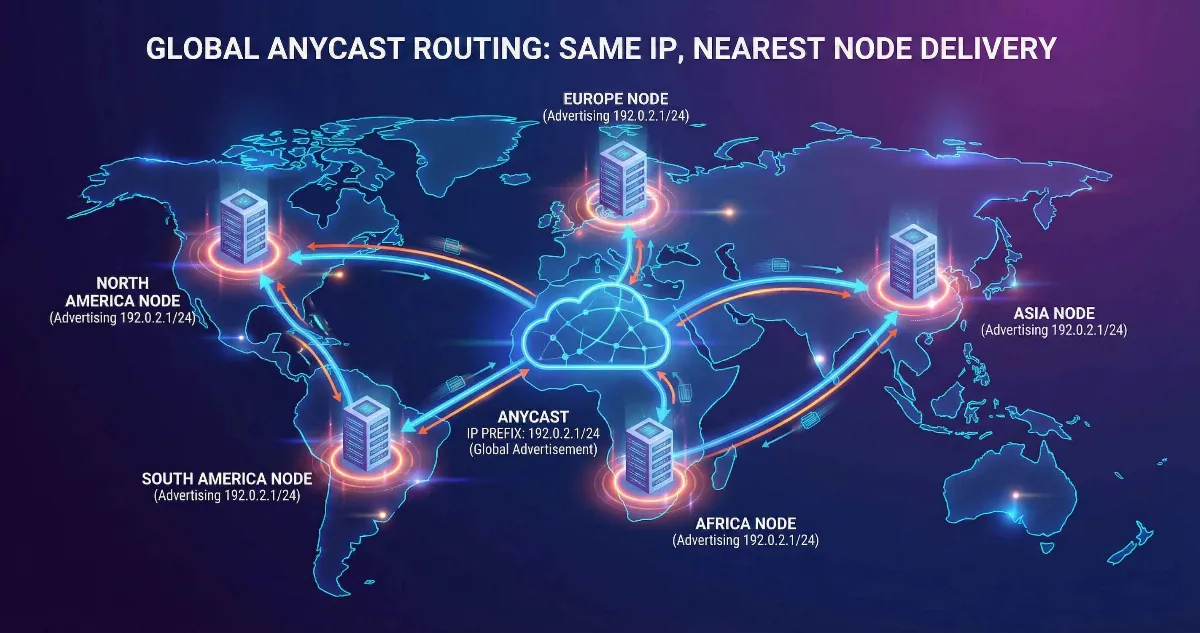
Ever wondered how Google, Cloudflare, or Amazon load instantly, no matter if you are in New York, London, or Tokyo? They don't just have fast servers; they have a "teleportation" logic for data. This is not magic—it is Anycast Routing. In a world where every millisecond of latency costs millions in revenue, Anycast is the backbone of the modern, resilient internet.
"Most people think an IP address is like a home phone—it rings in one place. But Anycast Routing turns an IP into a global help desk. It allows multiple servers across the globe to 'own' the same identity, routing users to the nearest available node. It is the ultimate weapon against latency and DDoS instability."
1. What is Anycast Routing? (The Starbucks Analogy)
In technical terms, Anycast Routing is a routing methodology where a single IP address is assigned to multiple physical nodes. When a user sends a request, the network's routing table directs that request to the "nearest" or most efficient node in terms of network hops.
The Starbucks Analogy:
Imagine you are in a big city and you want a latte. You don't drive to the original Starbucks in Seattle; you go to the one two blocks away. Every Starbucks has the "same menu" (content), and to you, they are all "Starbucks" (the same IP). Anycast is the GPS that automatically finds the branch with the shortest line and the closest distance to your current location.
This is fundamentally different from Unicast, where one IP equals one specific machine. If that machine in Seattle goes down, the connection dies. In Anycast, if the New York node fails, the traffic is instantly rerouted to the next nearest node, like Philadelphia or Boston, without the user ever noticing.
2. How Anycast Routing Works: A Step-by-Step Breakdown
Anycast doesn't happen by accident. It relies on a complex dance between BGP (Border Gateway Protocol) and global routing tables. Here is the technical workflow:
IP Prefix Advertising
Multiple data centers across the world "advertise" the same IP prefix to their upstream neighbors using BGP. Essentially, servers in USA, Europe, and Asia all tell the internet: "I am 1.1.1.1!"
BGP Path Selection
When you make a request, the Border Gateway Protocol looks at the global map. It calculates the "shortest path" based on the number of network hops (routers) between you and the various nodes advertising that IP.
One-to-Nearest Communication
The request is routed to the "nearest" server. This reduces latency significantly because the data doesn't have to travel across an ocean if a local node is available.
Curious about your own network's distance? Use our Ping Test Online to see the latency between your location and various global nodes.
3. Anycast vs. Unicast vs. Multicast: Key Differences
Understanding the difference between anycast and unicast routing is vital for system architects. While they all use the same IPv4/IPv6 space, their delivery logic is worlds apart.
| Routing Method | Communication Type | Target Logic |
|---|---|---|
| Unicast | One-to-One | Routes to a single, specific server interface. |
| Anycast | One-to-Nearest | Routes to the closest node in a cluster based on BGP. |
| Multicast | One-to-Many | Routes to a group of interested receivers simultaneously. |
| Broadcast | One-to-All | Routes to every device on a specific local network. |
4. Why Anycast is Used in CDNs and DNS Providers
If you look at Anycast DNS providers like Cloudflare (1.1.1.1) or Google Public DNS (8.8.8.8), they don't just have one giant server. They have hundreds of CDN edge locations.
DNS Performance Benefits
Standard DNS can involve multiple network hops, adding 100ms+ to every click. With Anycast, your DNS query hits a server in your own city. This latency reduction is the primary reason why Anycast-powered sites feel "snappy."
Global Traffic Management
Anycast acts as a natural load balancing layer. If a data center in London is overwhelmed with traffic, the BGP path "cost" increases, and the network naturally starts sending new requests to the next nearest node in Paris or Frankfurt.
Want to see how your domain records are propagating across these Anycast nodes? Use our DNS Explorer Tool to verify your global record health.
5. How Does Anycast Help in DDoS Mitigation?
In a traditional Unicast setup, a 500Gbps DDoS attack hits one server and kills it instantly. In an Anycast network, the attack is "distributed" and "diluted."
Traffic Scrubbing
The attack traffic is routed to the nearest scrubbing center. Instead of one server handling 500Gbps, 50 servers each handle 10Gbps—a manageable load.
Fault Tolerance
If one node actually goes down due to the attack volume, BGP simply drops that path from the global table. The attack traffic automatically shifts to the next node, keeping the rest of the world online.
Botnet Dilution
Since bots are also geographic, a US-based botnet will only hit US-based Anycast nodes. The European and Asian users will see zero impact, effectively localizing a global attack.
6. Implementation: Is Anycast Routing Difficult?
For a small business, is anycast routing difficult to implement? The answer is: Yes, on your own hardware. To run your own Anycast network, you need your own IP range (ASN), BGP-capable routers, and contracts with multiple Tier-1 bandwidth providers.
However, for most USA-based businesses, the "Implementation" simply means signing up for a CDN like Cloudflare, AWS CloudFront, or Akamai. These providers have already done the heavy lifting, allowing you to "Anycast-enable" your website by simply changing your Name Servers.
7. Anycast Routing vs. Load Balancing: Key Differences
While they both distribute traffic, they work at different layers of the infrastructure stack.
Anycast (Layer 3/BGP)
Decides which Data Center the user should go to. It is based on network topology and path length.
Load Balancing (Layer 4/7)
Decides which Individual Server inside that data center should handle the request. It is based on CPU load and session health.
Anycast FAQ
Does Anycast use more bandwidth?
No. Anycast actually optimizes bandwidth by keeping traffic local. However, it requires announcing the same IP prefix from multiple points, which can increase routing table complexity.
Can Anycast cause connection flapping?
In rare cases, if BGP routes are unstable, a user's request might "flap" between two different nodes. Modern Anycast implementations use "sticky" sessions and BGP dampening to prevent this.
Is Anycast the same as a Virtual IP?
They are related. A Virtual IP often exists inside a data center to move traffic between servers. Anycast is like a "Global Virtual IP" that moves traffic between entire cities.
Do I need IPv6 for Anycast?
No. Anycast works perfectly on both IPv4 and IPv6. In fact, most of the world's most critical Anycast infrastructure still relies on IPv4 BGP peering.
Conclusion: The Future is Anycast
Understanding how anycast routing works is no longer just for network engineers—it is essential for any business operating in the USA or globally. It is the technology that makes the internet feel local, secure, and unbreakable. Whether you are aiming for better DNS performance or preparing for a potential DDoS scenario, Anycast is the gold standard of modern routing.
Audit Your Edge Health
Is your network routing through the right nodes? Use our forensic tool suite to analyze your IP headers and DNS propagation status globally.