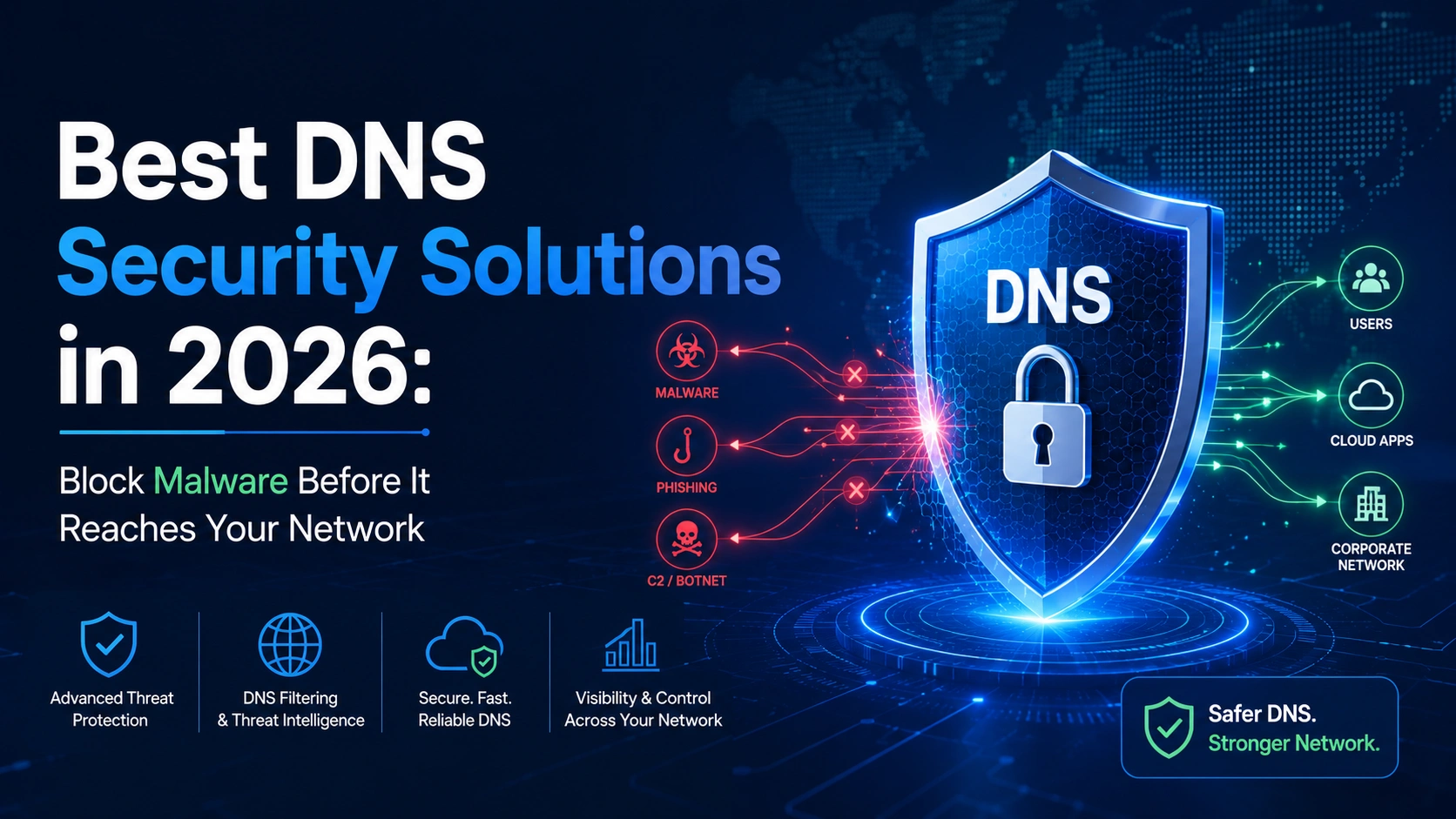
More than 90% of malware uses DNS to communicate with command-and-control servers. The average DNS attack costs organizations $924,000. In 2024, 51% of organizations worldwide suffered at least one DNS attack. Yet DNS filtering remains the most underdeployed security control relative to its cost-effectiveness — Cloudflare Gateway starts free for up to 50 users, and Cisco Umbrella starts at $2.25/user/month. Here is the complete 2026 guide.
Every malware infection, every ransomware deployment, every data exfiltration attempt, and every command-and-control callback has something in common: they nearly all start with a DNS query. Before ransomware encrypts your files, it calls home to its operators to receive encryption keys and instructions. That call home starts with a DNS lookup.
DNS is not just the internet's address book. For attackers, it is the communication backbone of nearly every threat in the modern threat landscape. DNS security filters those queries at the resolver level — before the connection is established, before the payload is delivered, before the damage is done.
This guide covers why DNS security is the highest-ROI security control most organizations are underutilizing, how it works technically, and the seven platforms that dominate the 2026 DNS security market — from Cloudflare's free tier to Cisco's enterprise-grade intelligence network.

I've been working with DNS infrastructure and network security for over 15 years, and the single most consistent finding across every organization I've evaluated is the same: DNS security is massively underdeployed relative to its impact. I've watched organizations spend $200,000 on endpoint detection while their DNS resolver happily resolves known C2 domains without a second thought. The math is straightforward — 90% of malware uses DNS, and blocking at the DNS layer is both the cheapest and the earliest possible intervention point. The tools I evaluate in this guide range from free to enterprise-priced, but every single one delivers ROI that no other security control can match on a cost-per-threat-blocked basis. If you deploy one security control in 2026, make it DNS filtering.
Quick Answer: Best DNS Security 2026
Cloudflare Gateway is free for up to 50 users and the best starting point for any business. Cisco Umbrella leads enterprise deployments with 18.1% market share. DNSFilter wins for SMB value at $1/user/month. Pair DNS security with TrustMyIP IP reputation checks for complete DNS-to-IP threat coverage.
1. Why DNS Is the Most Important Security Layer You're Probably Not Using
The DNS Attack Landscape in 2026
51%
of organizations suffered a DNS attack in 2024 — documented consistently in IDC's Global DNS Threat Report
$924K
average cost of a DNS attack per incident across all organization sizes
90%+
of malware uses DNS to communicate with command-and-control servers
The reason DNS attacks are so prevalent and effective is architectural: DNS was designed for availability and performance, not security. The original DNS specification — written in 1983 — has no authentication mechanism. Any resolver can answer any query. Responses are not signed or verified by default. This fundamental architecture creates the attack surface that modern DNS security tools exist to address.
The 10 Primary DNS Attack Types
10 DNS Attack Types You Must Block in 2026
1DNS Phishing / Malicious Domain Resolution
Most common attack type. Malware communicates with C2 infrastructure through domain names. DNS security blocks resolution of known malicious domains — the malware cannot function.
2Domain Generation Algorithms (DGA)
Advanced malware generates thousands of random-looking domains algorithmically daily. DNS security using ML detects DGA traffic by recognizing statistical patterns of algorithmically generated domain names.
3DNS Cache Poisoning
An attacker corrupts a DNS resolver's cache with fraudulent entries, redirecting legitimate domains to attacker-controlled IPs. DNSSEC cryptographically signs DNS records, preventing cache poisoning.
4DNS Hijacking
Changing DNS records at the registrar or DNS hosting level to redirect traffic. A compromised registrar account allows an attacker to redirect email, web traffic, and VPN access to attacker-controlled infrastructure.
5DNS Exfiltration (DNS Tunneling)
Data exfiltration through DNS queries. Attackers encode stolen data inside DNS query strings. Data leaves the network disguised as legitimate DNS traffic through a protocol that almost no firewall inspects.
6DNS Amplification (DDoS)
Using DNS servers as amplification vectors for DDoS attacks. Amplification ratios of 50:1 to 70:1 turn 1 Gbps of attack bandwidth into 50 to 70 Gbps of DDoS traffic.
7NXDOMAIN Attacks
Flooding a DNS resolver with queries for non-existent domains, consuming resolver resources and causing denial-of-service. DNS security appliances rate-limit and filter NXDOMAIN floods.
8Typosquatting and Lookalike Domains
Malicious domains that visually mimic legitimate ones — `paypa1.com` instead of `paypal.com`. DNS security maintains databases of typosquatted domains and lookalike variations.
9Subdomain Takeover
Abandoned DNS records pointing to cloud resources that no longer exist allow attackers to take over the subdomain. DNS security combined with attack surface monitoring identifies dangling DNS records.
10DNS Over HTTPS (DoH) Evasion
DoH encrypts DNS queries inside HTTPS traffic, allowing malware to bypass DNS filtering by routing queries through public DoH resolvers. Enterprise DNS security solutions that enforce managed DoH resolvers address this technique.
2. How DNS Security Works — The Technical Foundation
DNS security operates at the resolver layer — the point in the network where domain names are translated to IP addresses.
❌ Standard DNS (Without Security)
- 1.Browser needs to reach example.com
- 2.Browser sends DNS query to your ISP's DNS or 8.8.8.8
- 3.Resolver returns the IP address immediately
- 4.Browser connects directly to that IP — no filtering, no policy enforcement, no threat intelligence applied
✅ DNS Security Resolution
- 1.Browser needs to reach example-malicious.com
- 2.Query sent to DNS security resolver (Umbrella, Gateway, etc.)
- 3.Resolver checks against threat feeds, category databases, ML models, and reputation scores
- 4.If malicious: returns block page IP. No connection to the malicious server ever occurs.
The Key Advantage of DNS-Layer Security
The threat is blocked before a single packet is sent to the malicious server. Compare this to:
- →Firewall blocking: The connection is initiated, then blocked at the network edge
- →Endpoint security: The file is downloaded, then detected and quarantined
- →SIEM alerting: The event is logged, then an analyst investigates
DNS filtering stops the threat at the query, before the malicious server even knows you exist.
3. The 7 Best DNS Security Solutions in 2026
Solution 1 — Cisco Umbrella: Best for Enterprise and Cisco Environments
Market Position
Cisco Umbrella holds 18.1% DNS security mindshare (PeerSpot, May 2026) — the largest of any DNS security vendor. Rated 9.2/10 by verified enterprise users. The most widely deployed enterprise DNS security solution globally.
Architecture
Cloud-delivered DNS security with global anycast network. Queries routed to nearest Umbrella PoP, evaluated against Cisco Talos threat intelligence, and either permitted or blocked. No on-premises hardware required.
Key Capabilities
- →Cisco Talos threat intelligence: 500+ full-time researchers analyzing 400 billion DNS requests daily — unmatched intelligence depth
- →Predictive intelligence: ML models identify newly registered domains and DGA patterns before they appear on threat lists
- →Content filtering: Category-based web filtering built directly into DNS filtering with granular category control
- →Secure web gateway integration: Higher tiers include full SSL inspection and layer-7 web filtering
- →CASB integration: Visibility and control over cloud application usage through DNS telemetry
- →100% uptime SLA: The only DNS security vendor with contractual 100% availability
- →400+ third-party integrations: Native integration with Cisco ASA, ISE, Meraki, and Duo
| Tier | Monthly/User | Features |
|---|---|---|
| DNS Essentials | $2.25–$3.70 | DNS filtering, threat intelligence, basic reporting |
| DNS Advantage | $3.50–$4.50 | + Intelligent proxy, file inspection, CASB visibility |
| SIG Essentials | $4.15–$5.50 | + Secure web gateway, cloud firewall |
| SIG Advantage | $5.50–$6.50+ | + Full SWG, DLP, CASB, IPS, remote browser isolation |
⚠️ Limitation
2–3 false positives weekly that require admin review (verified from independent testing). The interface is functional but dated compared to modern rivals. Pricing becomes expensive at scale for SMBs.
Best For: Cisco Umbrella
Enterprises with existing Cisco infrastructure; regulated industries requiring compliance reporting; organizations needing 100% uptime SLA.
Solution 2 — Cloudflare Gateway: Best Free Tier and Zero Trust Integration
Market Position
The most searched DNS security solution among IT professionals in 2026 (PeerSpot data). The fastest-growing DNS security provider globally.
Architecture
Routes DNS queries through Cloudflare's massive global network — the same infrastructure that powers 20% of all internet traffic. Sub-millisecond query resolution from 300+ global data centers.
| Tier | Cost | Users |
|---|---|---|
| Free | $0 | Up to 50 users |
| Zero Trust | ~$7/user/month | Unlimited (includes full Cloudflare One platform) |
| Enterprise | Custom | Large organizations |
✅ The Free Tier Is Genuinely Enterprise-Grade
Cloudflare's free tier for up to 50 users includes DNS filtering, threat blocking, content categories, and basic analytics. For small businesses and startups, this is not a limited trial — it is full DNS security at zero cost.
Key Capabilities
- →Global anycast network: Queries resolve at the closest of 300+ Cloudflare data centers globally — typically under 5 milliseconds
- →Zero Trust integration: Cloudflare Gateway is one component of Cloudflare One — complete Zero Trust platform including ZTNA, SWG, CASB, Email Security, and SASE
- →Modern UI: Consistently rated the cleanest and most modern of any DNS security vendor — policy creation in minutes, not hours
- →DoH and DoT enforcement: Specifically addresses the DoH evasion problem by routing managed DoH traffic through the organization's Gateway instance
Best For: Cloudflare Gateway
SMBs wanting free DNS security (up to 50 users); organizations implementing Cloudflare Zero Trust architecture; teams prioritizing modern UX; developers and technically sophisticated organizations.
Solution 3 — Palo Alto Networks DNS Security: Best Machine Learning Detection
Market position: 8.7% DNS security mindshare. The strongest machine learning-driven DNS security available — specifically excelling at detecting advanced persistent threats, DGA-based malware, and zero-day C2 communications.
Architecture: Delivered as a subscription to Palo Alto NGFW customers. DNS queries pass through the firewall, which sends them to Palo Alto's cloud-based DNS Security service for analysis before passing them to the upstream resolver.
Key Differentiators
- ✓Patented machine learning models: ML models for DGA detection and C2 identification built from analysis of petabytes of DNS traffic and years of threat research
- ✓Real-time analysis: No signature updates required. ML models analyze DNS characteristics in real-time without relying on pre-compiled blocklists
- ✓NGFW integration: DNS security data feeds into broader Palo Alto XDR and SIEM integration
- ✓Customizable signature categories: 2026 update allows custom DNS Security Signature Categories for precise policy tailoring
⚠️ Limitation
Only available as an add-on to Palo Alto NGFW customers. Not available as a standalone DNS filtering product for organizations without Palo Alto firewalls. Pricing is bundled with firewall licensing.
Best For: Palo Alto DNS Security
Organizations running Palo Alto NGFWs; advanced threat environments requiring ML-based zero-day detection; high-value targets (financial services, healthcare, critical infrastructure).
Solution 4 — DNSFilter: Best Ease of Use and SMB Value
Market position: The fastest-growing DNS security vendor in the SMB and MSP segment. Known for transparent pricing and the cleanest admin experience in the market.
Architecture: Cloud-native DNS filtering with a global anycast network. Setup involves changing DNS resolver settings to DNSFilter's resolvers — 5-minute deployment, no hardware or agent required.
Pricing
- ✓Basic: $1/user/month — Core threat blocking
- ✓Pro: $2.20/user/month — + Advanced filtering, reporting
- ✓MSP: Custom — Multi-tenant management
Key Differentiators
- →Transparent pricing: Published per-user pricing — no "contact sales" required
- →AI-powered categorization: Categorizes new domains in real-time
- →Roaming client: Agent-based filtering that follows employees off-network
- →MSP console: Multi-tenant management from one interface
Best For: DNSFilter
SMBs and mid-market; MSPs managing multiple clients; organizations wanting quick deployment at accessible pricing.
Solution 5 — Infoblox BloxOne Threat Defense: Best Enterprise Hybrid Deployment
Market position: 12.4% DNS security mindshare (PeerSpot). The market leader for organizations with complex hybrid DNS architectures — on-premises DNS infrastructure combined with cloud security.
Architecture: Infoblox's enterprise DDI (DNS, DHCP, IPAM) platform extended with security. Organizations using Infoblox for DNS infrastructure management add BloxOne Threat Defense as a cloud security layer, maintaining existing on-premises investment while adding cloud threat intelligence.
Key Differentiators
- ✓DDI integration: For enterprises that manage DNS infrastructure with Infoblox, BloxOne adds security to existing infrastructure without migration
- ✓Hybrid deployment: Protects both on-premises DNS traffic and cloud/remote users through a unified policy
- ✓IPAM intelligence: Correlates DNS threats to specific devices on the network for precise remediation
- ✓SOC integration: Deep SIEM integration through prebuilt connectors for Splunk, IBM QRadar, and Microsoft Sentinel
Best For: Infoblox BloxOne
Enterprises using Infoblox DDI; organizations with complex on-premises DNS infrastructure; regulated enterprises requiring detailed IPAM-correlated DNS security.
Solution 6 — Akamai Secure Internet Access Enterprise: Best Carrier-Grade Scale
Market position: Akamai operates one of the world's largest internet networks — their DNS security leverages carrier-grade scale and visibility.
Architecture: DNS security delivered through Akamai's globally distributed edge network. The same infrastructure serving streaming video and DDoS mitigation for global enterprises provides DNS filtering with sub-millisecond response times worldwide.
Key Differentiators
- ✓Internet scale threat intelligence: Akamai processes 15-30% of all global internet traffic — the widest possible view of internet threats
- ✓DDoS resilience: The same infrastructure that absorbs the world's largest DDoS attacks also provides DNS filtering
- ✓Branch connectivity: SD-WAN integration provides DNS security for distributed branch offices without backhauling through headquarters
Best For: Akamai Secure Internet Access
Large enterprises with global distributed infrastructure; organizations requiring combined DNS security and DDoS protection; retail chains and distributed branch environments.
Solution 7 — NextDNS: Best for Small Teams and Individual IT Professionals
Architecture: Cloud-native DNS security with remarkable configuration flexibility and transparent operation. Particularly popular among technically sophisticated IT professionals who want granular control over DNS filtering without enterprise pricing.
2026 Pricing: Free tier (300,000 queries/month), then $19.90/year for unlimited queries.
Key Differentiators
- ✓Extreme configurability: 50+ blocklist sources, custom allow/block lists, per-device profiles, query log inspection
- ✓Privacy-preserving logging: Options to anonymize logged queries — valuable for organizations with privacy requirements
- ✓DoH/DoT support: Full support for encrypted DNS protocols
Best For: NextDNS
Individual IT professionals and power users; very small businesses (under 20 employees); security researchers; organizations wanting maximum configuration control at minimal cost.
4. DNS Security Pricing Comparison — 2026
| Solution | Free Tier | Starting Price | Enterprise |
|---|---|---|---|
| Cloudflare Gateway | Yes (50 users) | ~$7/user/month (platform) | Custom |
| DNSFilter | No (free trial) | $1/user/month | Custom |
| NextDNS | Yes (300K queries) | $19.90/year | N/A |
| Cisco Umbrella | No | $2.25/user/month | $6.50+/user/month |
| Palo Alto DNS Security | No | Bundled with NGFW | Custom |
| Infoblox BloxOne | No | Quote required | Custom |
| Akamai Secure IA | No | Quote required | Custom |
5. DNSSEC — Why Cryptographic Signing Matters
DNS Security Extensions (DNSSEC) cryptographically sign DNS records, allowing resolvers to verify that DNS responses are authentic and haven't been tampered with. Without DNSSEC, a cache poisoning attack can redirect your domain's traffic without you or your users knowing.
How DNSSEC Works
1Cryptographic Signing
Your domain registrar or DNS provider creates cryptographic signatures for your DNS records
2Signature Verification
When a resolver receives a DNS response, it verifies the cryptographic signature against the published public key
3Tamper Detection
If the signature doesn't match, the resolver rejects the response as potentially tampered. DNSSEC adoption in 2026: approximately 35–40% of top-level domains support DNSSEC. Most major cloud DNS providers (Cloudflare, AWS Route 53, Google Cloud DNS) support DNSSEC signing.
6. DNS Over HTTPS (DoH) and DNS Over TLS (DoT) — Privacy vs Security
✅ What They Are
DoH and DoT encrypt DNS queries, preventing ISPs, network operators, or attackers from monitoring which domains you're resolving. A legitimate privacy enhancement.
❌ The Enterprise Security Problem
When employees use public DoH resolvers on their devices, they bypass your organization's DNS security filtering. Modern malware increasingly uses DoH to communicate with C2 infrastructure, deliberately bypassing corporate DNS filtering.
The Solution
Enterprise DNS security platforms force DoH traffic through managed resolvers, not public ones. Cloudflare Gateway, Cisco Umbrella, and DNSFilter all support managed DoH deployment — employees get encrypted DNS queries, but those queries still pass through your organization's security policy.
7. How DNS Security Connects to IP Intelligence
DNS security and IP intelligence are two sides of the same coin — the domain name resolves to an IP address, and both layers carry threat intelligence:
The DNS-to-IP Threat Chain
A malicious domain resolves to a malicious IP address. Organizations using both layers catch threats that evade one but not the other: fast-flux attacks change the IP rapidly — DNS blocking at the domain level catches it; IP-based C2 without domain names bypass DNS security — IP reputation blocking catches it.
IP Reputation in DNS Policy
Advanced DNS security platforms (Cisco Umbrella, Cloudflare Gateway) incorporate IP reputation into DNS response filtering. Even if a domain is newly registered and not yet on threat lists, if the IP it resolves to has poor reputation from prior abuse, the DNS resolution is blocked.
The TrustMyIP Connection
TrustMyIP's IP lookup and blacklist checker provides the IP-layer intelligence that complements DNS-layer security. A domain that passes DNS security filtering might still resolve to a suspicious IP — running that IP through TrustMyIP's fraud score and blacklist check adds an additional verification layer.
8. Frequently Asked Questions
Can DNS security replace a firewall?
No — DNS security is a complementary layer, not a firewall replacement. DNS filtering blocks threats at the resolution stage; firewalls block at the connection stage. DNS security misses IP-based threats that don't use domain names. Firewalls miss threats in encrypted DNS. A complete security architecture uses both, with DNS security as the first line and firewall as the second.
Does DNS filtering slow down internet access?
With modern DNS security platforms using anycast global networks (Cloudflare, Cisco Umbrella, Akamai), the latency impact is typically 1–5 milliseconds per query — imperceptible in normal browsing. DNS queries are resolved many times per second in normal operations; the filtering evaluation adds negligible time to a process already measured in milliseconds.
How does DNS security handle HTTPS traffic?
DNS filtering blocks the domain before any HTTPS connection is established. If a user attempts to visit a blocked site over HTTPS, the DNS resolution is blocked — the browser never connects to the server. No SSL decryption is required for this level of protection. For deeper content inspection of HTTPS traffic, a Secure Web Gateway (SWG) is needed in addition to DNS security.
Is free DNS security (Cloudflare Gateway free tier) adequate for a small business?
For basic threat blocking and malicious domain filtering, Cloudflare's free tier provides enterprise-grade DNS security at zero cost. The free tier includes threat intelligence from Cloudflare's global network, category filtering, and logging. For organizations under 50 employees that primarily need malware blocking and basic content filtering, it is genuinely adequate. The paid tiers add advanced features that most small businesses don't require.
What is the difference between DNS security and secure web gateway?
DNS security filters at the domain level — blocking the resolution before any connection is made. A Secure Web Gateway (SWG) sits inline with web traffic and inspects at the URL and content level — it can block specific URLs within a permitted domain, inspect downloaded files, and enforce DLP policies. DNS security is faster and requires no traffic decryption; SWG is more powerful but requires SSL inspection infrastructure. Most enterprise security architectures use both.
Conclusion: DNS Is Your First Line of Defense — And It's the Cheapest to Reinforce
If you stop 90% of malware at the DNS query — before the connection, before the payload, before the damage — you have dramatically reduced your breach risk for as little as zero dollars per month (Cloudflare free tier) or $1 per user per month (DNSFilter Basic). That math is impossible to ignore. A 50-person company spending nothing on DNS security and $924,000 on recovering from a DNS attack has made a catastrophically inefficient security investment decision.
The Implementation Hierarchy for 2026
- 1.Immediate (free): Deploy Cloudflare Gateway free tier — 5-minute setup, point your DNS to Cloudflare, get enterprise-grade threat blocking at zero cost for up to 50 users
- 2.SMB (under $100/month for 50 users): DNSFilter or Cloudflare Zero Trust — add roaming client for off-network employees, detailed reporting, content filtering
- 3.Mid-market: Cisco Umbrella DNS Essentials — deeper threat intelligence, compliance reporting, 400+ integrations
- 4.Enterprise with Cisco infrastructure: Cisco Umbrella Advantage or SIG — full SWG, CASB integration, 100% SLA
- 5.Enterprise with Palo Alto NGFW: Add Palo Alto DNS Security — ML-based detection integrated with existing security fabric
The first malware command-and-control request your DNS security blocks pays for its entire annual cost. For most organizations, that happens within the first week of deployment. Pair your DNS security deployment with TrustMyIP IP reputation checks for complete DNS-to-IP coverage, and explore our network security blog for the latest DNS threat intelligence updates.
*This article is for informational purposes only. Pricing, features, and product specifications change frequently. Verify current details directly with vendors.*
*Last updated: May 2026 | Data sourced from PeerSpot DNS Security mindshare data (May 2026), ifeeltech Cisco Umbrella review 2026, cyberpress.org DNS filtering solutions, zipdo.co DNS security comparison, IDC Global DNS Threat Report, and verified vendor product documentation*
Block Malware Before It Starts!
Check if your IP resolves to malicious infrastructure. Instant DNS-layer threat intelligence at your fingertips.