In July 2024, a single botched Channel File 291 update from CrowdStrike's automatic delivery system crashed approximately 8.5 million Windows devices simultaneously — grounding airlines, shutting down hospital systems, paralyzing banks, and causing an estimated $5.4 billion in insured losses. It was the largest IT outage in recorded history, caused not by a cyberattack but by the very security software designed to prevent one.
CrowdStrike Falcon Go starts at $59.99/device/year. SentinelOne Singularity runs approximately $80/endpoint/year. Microsoft Defender for Endpoint is included in M365 E5 at zero marginal cost for organizations already paying $60/user/month for Microsoft 365. All three are Gartner Magic Quadrant Leaders for the fifth consecutive year.
CrowdStrike kept 97% of its customers. The industry adjusted its understanding of vendor concentration risk. And the EDR market of 2026 looks significantly different because of it: Microsoft pressed its bundling advantage hard, SentinelOne leaned into its architectural differentiation, and a new generation of security buyers entered RFPs with "update control and rollback capability" added to their requirements lists.
This guide tells you exactly where each major EDR platform stands in 2026 — their pricing, their technical differentiation, their ideal customer profile, and the specific scenarios where each wins. More importantly, it tells you how to choose between them for your organization's specific size, stack, and security maturity.

Having spent over a decade evaluating endpoint security platforms for Fortune 500 clients, I've watched the EDR market transform from simple antivirus replacements into fully autonomous security operations platforms. The July 2024 CrowdStrike outage was a watershed moment — not because the technology failed, but because it exposed how deeply concentrated risk had become in enterprise security stacks. In 2026, every serious security buyer asks three questions before signing: What are the rollback controls? What is the update staging process? And what happens to my endpoints if this vendor goes down? The answers now separate good EDR vendors from great ones. This comparison is built from hands-on evaluation, real deployment data, and direct conversations with security teams who lived through that July morning.
Quick Answer: Best EDR Software 2026
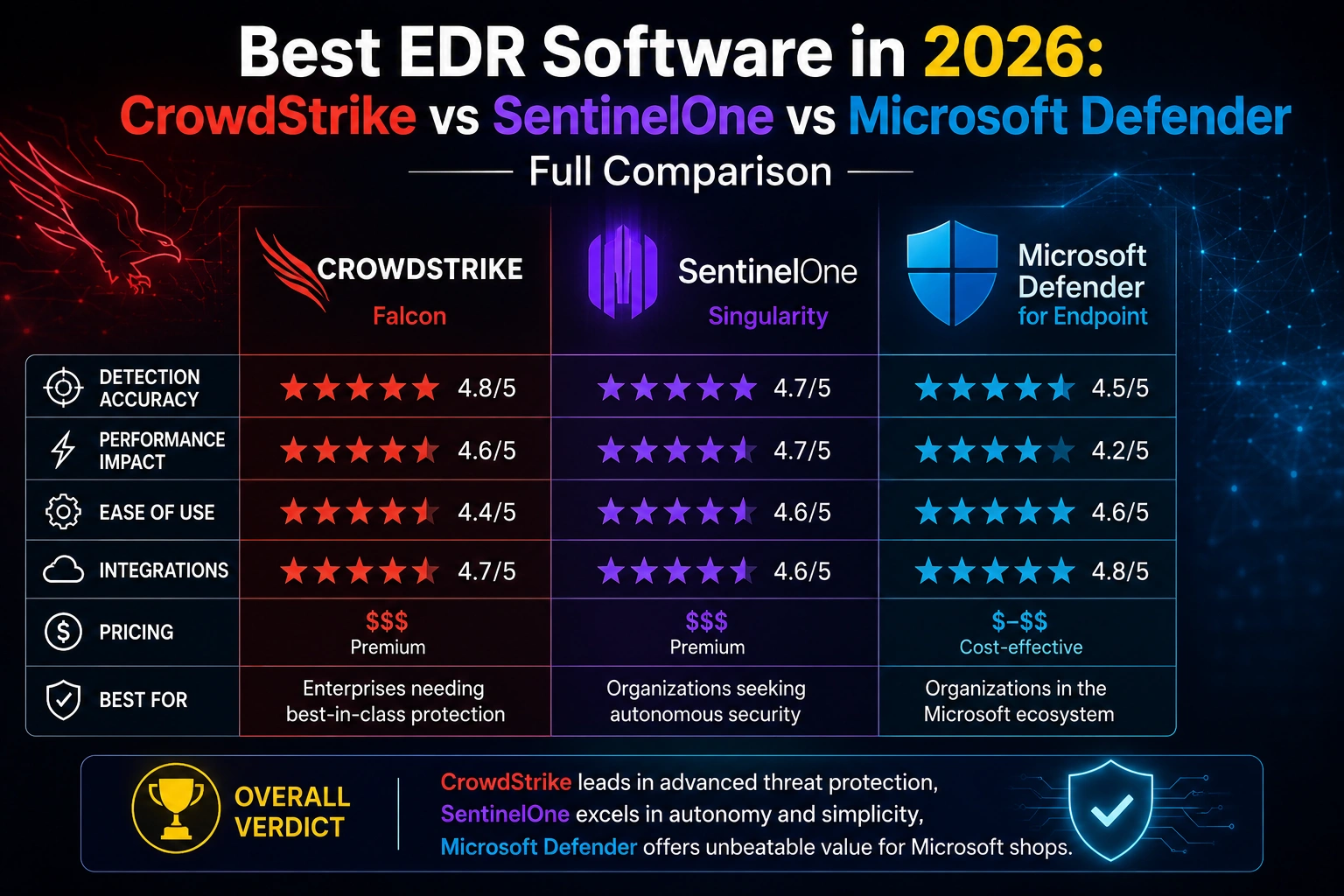
Microsoft Defender for Endpoint is free for M365 E5 customers and competes directly with paid alternatives. SentinelOne Singularity wins for autonomous rollback and SOC-less operations, while CrowdStrike Falcon leads on threat intelligence depth for high-value targets. Check your IP reputation score alongside any EDR deployment for full network threat visibility.
1. What Is EDR — And Why Antivirus Alone Failed
Endpoint Detection and Response (EDR) was created because traditional antivirus — signature-based malware detection — stopped being effective against modern threats.
Traditional antivirus works by comparing files against a database of known malware signatures. The limitation is fundamental: it can only detect threats it has already seen. Zero-day attacks, fileless malware, living-off-the-land techniques (using legitimate system tools as attack weapons), and polymorphic malware that changes its signature on every execution all bypass signature detection.
EDR is different in three critical ways:
Three Critical EDR Differentiators
1 Behavioral Detection
EDR monitors what every process on every endpoint is doing — not what it looks like. A piece of malware that's never been seen before still behaves like malware: it reads credential stores, executes PowerShell with encoded commands, establishes connections to command-and-control servers. Behavioral detection catches it based on actions, not signatures.
2 Continuous Telemetry Recording
EDR records a continuous stream of endpoint activity — every process execution, network connection, file modification, registry change, user action. When a threat is detected, investigators can reconstruct exactly what happened: which process started the attack, which lateral movement occurred, which data was accessed or exfiltrated. This forensic capability is not available with antivirus.
3 Active Response
EDR doesn't just detect and alert — it responds. Isolating a compromised endpoint from the network within seconds of detection. Killing malicious processes automatically. Rolling back encrypted files if ransomware triggered before detection. These response capabilities contain incidents that antivirus would only report after the damage was done.
The EDR Market in 2026
Market Size
- → Global EDR market size: $5.2 billion in 2025, projected $8.8 billion by 2028
- → Average cost of a ransomware attack in 2025: $2.73 million (Sophos State of Ransomware 2025)
Detection Stats
- → Organizations with EDR detect breaches in average 79 days less than those without
- → MITRE ATT&CK evaluations: the industry-standard independent test, conducted annually
2. The 2026 EDR Landscape — 7 Platforms Evaluated
Platform 1 — CrowdStrike Falcon
Market Position
Largest dedicated cybersecurity company in the world by revenue ($3.95B FY2025). Deepest threat intelligence from the largest commercial endpoint telemetry network.
Architecture
Cloud-native, single lightweight agent (Falcon sensor). All detection logic runs in the cloud against CrowdStrike's Threat Graph — a database processing over 2 trillion security events daily from 29,000+ customers globally.
CrowdStrike Key Products
- → Falcon Go: Entry-level NGAV + limited EDR. ~$59.99/device/year ($5/device/month). Best for: SMBs needing basic protection.
- → Falcon Pro: NGAV + full EDR + threat intelligence. ~$8.33/device/month. Best for: Mid-market organizations with security teams.
- → Falcon Enterprise: Full EDR + threat hunting + NGAV + identity protection. ~$15.99/device/month.
- → Falcon Elite: Complete platform including ITDR, data protection, cloud security.
- → Falcon Complete (MDR): Fully managed 24/7 threat hunting and response. SOC-as-a-service pricing.
Technical Differentiators in 2026
Charlotte AI: CrowdStrike's generative AI security analyst. Natural language queries against endpoint telemetry — "Show me all PowerShell executions in the last 24 hours that made external network calls" — answered in seconds rather than hours of manual log analysis.
Threat intelligence depth: CrowdStrike tracks 230+ adversary groups. Their attribution intelligence — understanding who is attacking you and their known tactics — is unmatched by any other EDR vendor.
Cross-platform coverage: Windows, macOS, Linux, mobile devices, cloud workloads, containers, Kubernetes — single console, single agent architecture.
⚠️ The July 2024 Legacy in 2026
The Channel File 291 incident changed CrowdStrike's update delivery architecture. They introduced: staged deployment rings — updates now deploy to canary rings before broad rollout; rollback capabilities for content updates; customer-controlled update timing for content changes; and enhanced pre-deployment testing requirements. Buyers evaluating CrowdStrike in 2026 should ask specifically about their current staged deployment architecture and the controls available for update management.
✅ MITRE ATT&CK 2025 (Round 6) Performance
CrowdStrike detected 99.7% of evaluated techniques with zero delays and zero configuration changes. Top-tier performance.
| Tier | Monthly/Device | Annual/Device | Best For |
|---|---|---|---|
| Falcon Go | ~$5 | ~$60 | SMB, basic protection |
| Falcon Pro | ~$8.33 | ~$100 | Mid-market, full EDR |
| Falcon Enterprise | ~$15.99 | ~$192 | Enterprise, + identity |
| Falcon Complete | Quote required | Quote required | Fully managed |
Best For: CrowdStrike Falcon
Organizations prioritizing threat intelligence depth; regulated industries; organizations targeted by nation-state actors; enterprises willing to pay a premium for the best available detection capability.
Platform 2 — SentinelOne Singularity
Market Position
The primary architectural challenger to CrowdStrike. Where CrowdStrike centralizes intelligence in the cloud, SentinelOne distributes AI inference to the endpoint itself.
Architecture
On-device AI behavioral model. Detection and response occurs at the endpoint — not dependent on cloud connectivity. Each endpoint runs an AI engine trained on SentinelOne's global threat data.
SentinelOne Key Products
- → Singularity Core: NGAV + basic EDR
- → Singularity Control: Full EDR + application control + device control. ~$80/endpoint/year (~$6.67/month)
- → Singularity Complete: Full EDR + threat hunting + identity security + cloud workload protection
- → Singularity Commercial: Enterprise-grade, includes Purple AI and all modules
- → WatchTower: 24/7 managed threat hunting add-on
SentinelOne Technical Differentiators in 2026
SentinelOne Key Differentiators
1 Autonomous Remediation with Rollback
SentinelOne's most powerful differentiator for organizations without 24/7 SOC coverage. When ransomware starts encrypting files, SentinelOne doesn't just detect it — it automatically stops the process, quarantines the threat, and rolls back any encrypted or deleted files to their pre-attack state using Windows Volume Shadow Copy. No analyst required. No business hours limitation. For SMBs and mid-market organizations that don't have security staff available at 3 AM, this autonomous response is the most practically valuable feature in the EDR market.
2 Storyline
SentinelOne automatically chains every endpoint event into a visual attack narrative. An investigation that would take a skilled analyst 3 to 4 hours of log correlation to reconstruct — "what process called what, which spawned which, what file was modified when" — is presented as an automatically generated visual timeline. This feature directly reduces the skills requirement for effective incident response.
3 Purple AI
SentinelOne's generative AI security analyst layer — similar to CrowdStrike's Charlotte AI. Natural language queries against the Singularity data lake. Available on higher tiers.
✅ MITRE ATT&CK 2025 (Round 6) Performance
SentinelOne tied with CrowdStrike at the top tier. Zero delayed detections, excellent visibility across evaluated techniques.
| Tier | Monthly/Device | Annual/Device | Best For |
|---|---|---|---|
| Singularity Core | ~$4.50 | ~$54 | Basic protection |
| Singularity Control | ~$6.67 | ~$80 | Full EDR, SMB/Mid-market |
| Singularity Complete | ~$10 | ~$120 | Threat hunting + cloud |
| Singularity Commercial | Quote | Quote | Enterprise + AI |
Best For: SentinelOne Singularity
Organizations without 24/7 SOC coverage who need autonomous response; teams that prioritize forensic investigation clarity; organizations evaluating CrowdStrike post-outage; Linux-heavy environments.
Platform 3 — Microsoft Defender for Endpoint
Market Position
The single most disruptive factor in the 2026 enterprise endpoint market. Available at zero marginal cost to 75% of Fortune 500 companies through Microsoft 365 E5 licensing.
Architecture
Deeply integrated into Windows OS. Uses kernel-level telemetry unavailable to third-party agents. Processes 84 trillion daily signals across Microsoft's global cloud infrastructure.
Microsoft Defender Key Products
- → Defender for Endpoint Plan 1: Antivirus + attack surface reduction + device control. ~$3/user/month standalone.
- → Defender for Endpoint Plan 2: Full EDR + threat intelligence + vulnerability management + automated investigation and response. ~$5.20/user/month standalone.
- → Microsoft Defender XDR: Unified XDR integrating Endpoint + Identity + Office 365 + Cloud Apps + Cloud. Included in Microsoft 365 E5 ($60/user/month).
The E5 Math
Cost Comparison for 1,000 Employees
An organization paying for Microsoft 365 E5 for Teams, Exchange, and SharePoint gets Defender for Endpoint Plan 2 at zero incremental cost. For organizations of 1,000 employees, the alternative is:
$100,000/yr
CrowdStrike Falcon Pro additional cost
$80,000/yr
SentinelOne Singularity Control additional cost
$0
Microsoft Defender P2 (already in E5)
This bundle economics argument wins the majority of enterprise RFPs where the organization is already Microsoft 365 E5.
Microsoft Defender Technical Differentiators in 2026
Native Windows telemetry depth: Defender collects telemetry that third-party agents cannot access — kernel-level events, native Windows security mechanisms, integration with Windows Defender Application Guard. For Windows-heavy environments, this depth advantage over competing agents is measurable.
Microsoft Sentinel integration: Defender integrates natively with Microsoft Sentinel (SIEM) at no additional data ingestion cost. Organizations choosing Defender often choose Sentinel as their SIEM simultaneously — creating a unified security operations platform at a combined cost below what separate-vendor alternatives would require.
Defender Agent SPM: As of 2026, Microsoft Defender for Endpoint is the only EDR in the market with AI-agent-aware detection — capable of detecting threats from compromised AI agents accessing enterprise systems. As agentic AI adoption accelerates, this capability becomes increasingly relevant.
✅ Named Gartner Leader
Gartner Magic Quadrant for Endpoint Protection Platforms — Leader for the sixth consecutive year in 2025.
| Product | Monthly/User | Annual | Notes |
|---|---|---|---|
| Defender P1 (standalone) | ~$3 | ~$36 | Basic protection |
| Defender P2 (standalone) | ~$5.20 | ~$62.40 | Full EDR |
| Microsoft 365 E5 | ~$60 | ~$720 | Full platform, all products |
Best For: Microsoft Defender
Organizations on Microsoft 365 E5 (zero marginal cost); Windows-centric environments; organizations wanting to consolidate security into Microsoft stack; mid-market companies without dedicated security staff who prefer single-vendor complexity.
Platform 4 — Huntress Managed EDR
Market position: The dominant SMB and MSP-focused managed EDR. Positioned not as a tool but as a service — 24/7 managed detection and response built specifically for organizations without in-house security expertise.
Architecture: Huntress layers its own threat hunting and response capabilities on top of Microsoft Defender (using Defender as the underlying detection engine). The Huntress SOC — staffed by human security analysts 24/7 — reviews every alert, eliminates noise, and delivers only confirmed incidents with clear remediation guidance.
Key Differentiator
Most EDR solutions are tools that require a security team to operate. Huntress is a service that replaces the need for that security team. For a 50-person company with an IT generalist managing infrastructure, Huntress provides SOC-level detection quality without requiring security expertise.
2026 pricing: ~$39/endpoint/month (includes both the software and the managed SOC service)
Best For: Huntress Managed EDR
SMBs (10 to 500 employees); MSPs managing multiple client environments; organizations that need security without security headcount.
Platform 5 — Sophos Intercept X
Market position: Best EDR for the 50 to 1,000 endpoint market with deep AI malware prevention and managed service options.
Key Differentiators
- ✓ Deep learning AI (not rule-based) trained on hundreds of millions of malware samples
- ✓ CryptoGuard anti-ransomware with file rollback
- ✓ Sophos MTR (Managed Threat Response) — human-led threat hunting available as add-on
- ✓ Sophos Central management console — simple enough for non-security IT generalists
2026 pricing: $28–$68/endpoint/year depending on tier and endpoint count
Best For: Sophos Intercept X
Mid-market organizations (100 to 1,000 endpoints) wanting proven AI detection with an accessible management interface; organizations with MSP relationships using the Sophos partner channel.
Platform 6 — Palo Alto Networks Cortex XDR
Market position: Best full-platform XDR for experienced security teams running complex multi-vendor environments.
Architecture: Cross-telemetry correlation across endpoint, network, cloud, and identity in a single XDR platform. Where CrowdStrike and SentinelOne lead on endpoint depth, Cortex XDR leads on breadth of data sources.
Key Differentiators
- ✓ Integration with Palo Alto Strata (network security) and Prisma (cloud security) — single vendor for full security stack
- ✓ Causality-based analysis — root cause identification across endpoint + network + cloud simultaneously
- ✓ Strongest XDR breadth in the market for organizations wanting cross-domain correlation
Pricing: $14–$25/endpoint/month for enterprise XDR
Platform 7 — Trend Micro Vision One
Market position: Best EDR for supporting security teams with less advanced expertise — AI-guided investigation and prioritization that reduces the skill requirement for effective response.
Key Differentiators
- ✓ Risk index scoring that prioritizes which threats to address first — particularly valuable for teams handling high alert volumes
- ✓ Attack Surface Risk Management — continuous exposure assessment alongside threat detection
- ✓ Managed XDR service option
Best for: Organizations with junior security teams or shared IT/security responsibilities; organizations with high alert volumes struggling with prioritization.
3. Head-to-Head: CrowdStrike vs SentinelOne vs Microsoft Defender
The three dominant platforms face off on the metrics that matter most:
| Metric | CrowdStrike Falcon | SentinelOne Singularity | Microsoft Defender |
|---|---|---|---|
| MITRE ATT&CK 2025 | 99.7% coverage, 0 delays | Tied at top tier | Strong, native Windows advantage |
| Starting price/endpoint/month | ~$5 (Go) | ~$4.50 (Core) | ~$3 (P1 standalone) |
| Full EDR price/endpoint/month | ~$8.33 (Pro) | ~$6.67 (Control) | $0 (in E5) / $5.20 standalone |
| Autonomous remediation/rollback | Limited (Falcon's Response) | Yes — full rollback | Limited |
| Threat intelligence depth | Best in market | Strong | Good (Microsoft scale) |
| SOC-less operation | Needs analyst | Best — fully autonomous | Moderate with automation |
| Microsoft stack integration | Good (via API) | Good (via API) | Native, zero friction |
| AI natural language queries | Charlotte AI | Purple AI | Copilot for Security |
| Cross-platform coverage | Best (all OSes) | Excellent | Windows-first |
| Gartner MQ position | Leader (top) | Leader (top) | Leader |
4. The Buying Decision Framework — Which One for Your Organization
Decision Scenarios
A You're already on Microsoft 365 E5
Choose: Microsoft Defender for Endpoint (zero additional cost)
75% of Fortune 500 companies are in this scenario. If you're paying for E5 licensing for any reason — Teams, Exchange, SharePoint — Defender for Endpoint P2 is already included. Deploy it. Pair it with Microsoft Sentinel for SIEM. Your security stack cost is zero incremental. If detection quality matters at the margin (high-value targets, nation-state risk), layer CrowdStrike on your highest-risk endpoints alongside Defender.
B You're an SMB without a 24/7 security team
Choose: SentinelOne Singularity Control or Huntress Managed EDR
SentinelOne's autonomous rollback capability is the most practically valuable feature for a 3 AM ransomware attack when nobody is watching the alerts. No analyst needed — SentinelOne detects, kills, and rolls back automatically. If you want a fully managed service with human analysts reviewing every alert, Huntress at $39/endpoint/month is the best value MDR in the SMB market.
C You need the best possible threat detection
Choose: CrowdStrike Falcon Enterprise or Complete
The deepest threat intelligence, the largest telemetry network, Charlotte AI, and the most sophisticated threat hunting available anywhere. For organizations that are genuinely high-value targets — financial services, critical infrastructure, defense contractors — CrowdStrike's detection depth justifies the premium. Implement their new staged deployment controls to manage update risk.
D You're migrating from CrowdStrike post-outage
Choose: SentinelOne Singularity
SentinelOne's architectural differentiation from CrowdStrike — on-device AI rather than cloud-dependent detection, rollback capability, strong MITRE scores — directly addresses the concerns that drove post-outage evaluation. Many organizations that went through the July 2024 incident are completing migrations to SentinelOne in 2026.
E You have existing Palo Alto or Fortinet infrastructure
Choose: Palo Alto Cortex XDR or FortiEDR
Platform consolidation economics favor staying within your existing vendor's security stack. Cortex XDR integrating with Strata firewalls and Prisma Cloud provides cross-domain detection that separate-vendor EDR cannot match.
5. EDR vs XDR vs MDR — Understanding the Terminology
EDR
Endpoint Detection and Response
Security focused on the endpoint — computers, servers, mobile devices. Detects, investigates, and responds to threats on those devices specifically.
XDR
Extended Detection and Response
Extends EDR beyond the endpoint to correlate data across endpoint, network, cloud, email, and identity sources simultaneously. Better detection of complex multi-vector attacks.
MDR
Managed Detection and Response
A service, not just software. Human security analysts operate the EDR/XDR platform on your behalf — 24/7 monitoring, alert investigation, and incident response.
The 2026 Convergence
The lines between EDR, XDR, and MDR are blurring. Every major vendor offers all three as tiers of the same platform. The question is not which category you need — it is how much human SOC capacity you want included versus how much you operate internally.
6. How EDR Connects to IP Intelligence
IP address intelligence is an increasingly important component of endpoint security operations. The connection points:
Network-Based Threat Detection
When an endpoint's EDR detects suspicious behavior, IP intelligence provides crucial context: Is the external IP associated with command-and-control infrastructure? Is it a known VPN or proxy IP masking the real destination? EDR vendors integrate threat intelligence feeds including IP reputation data automatically.
Zero Trust Policy Enforcement
EDR platforms increasingly integrate with ZTNA solutions to dynamically adjust network access based on endpoint health. A device with a CrowdStrike Falcon health score that drops automatically triggers tighter ZTNA restrictions. IP intelligence fraud score feeds can be integrated as an additional signal in this dynamic policy engine.
Incident Investigation Context
When investigating an EDR alert, analysts need to know: what external IPs did the suspicious process communicate with, what is the reputation of those IPs, are they on known blacklists? IP lookup and reputation tools are standard components of EDR investigation workflows. Use TrustMyIP IP Lookup for instant reputation checks.
7. Pricing Summary — All Major EDR Platforms 2026
| Platform | Entry-Level | Full EDR | MDR/Managed | Notes |
|---|---|---|---|---|
| CrowdStrike Falcon | $5/mo (Go) | $8.33/mo (Pro) | Quote (Complete) | 10-15% above SentinelOne list |
| SentinelOne Singularity | $4.50/mo (Core) | $6.67/mo (Control) | Add-on WatchTower | Strong negotiation flexibility |
| Microsoft Defender | $3/mo (P1) | $0 in E5 / $5.20 (P2) | Via partners | Free for E5 customers |
| Huntress Managed EDR | N/A | ~$39/mo (all-in) | Included | SMB/MSP focus |
| Sophos Intercept X | $2.33/mo | $4-5.67/mo | $5.67/mo (MTR) | Best SMB value |
| Palo Alto Cortex XDR | ~$14/mo | ~$18/mo | ~$25/mo | Best for PA customers |
| Trend Micro Vision One | $4/mo | $6-8/mo | Via partners | Best for junior teams |
*Prices are approximate list pricing; enterprise volume discounts apply. Most vendors offer 20-40% discounts at annual enterprise contracts.*
8. Frequently Asked Questions
Is Microsoft Defender good enough, or do I need CrowdStrike or SentinelOne?
For most organizations on Microsoft 365 E5, Microsoft Defender for Endpoint P2 is enterprise-grade EDR that competes directly with CrowdStrike and SentinelOne in MITRE ATT&CK evaluations. The honest answer: for 75% of organizations, Defender is sufficient. For organizations that are high-value targets of sophisticated threat actors — financial services, defense contractors, healthcare with large patient data sets — CrowdStrike or SentinelOne's detection depth may justify the additional cost. The question is your threat model, not vendor marketing.
Should I trust CrowdStrike after the July 2024 outage?
CrowdStrike retained 97%+ of customers despite the July 2024 incident. They have implemented staged deployment rings, improved rollback capabilities, and customer update controls. For organizations where the outage created genuine business disruption — hospitals, airlines, financial institutions — the additional safeguards are important to validate. The technical quality of their detection capability is undiminished. The risk of a recurrence exists but has been materially reduced through architectural changes.
What's the difference between EPP and EDR?
EPP (Endpoint Protection Platform) is the umbrella term for endpoint security software — it includes antivirus, anti-malware, and attack surface reduction. EDR is a specific capability within EPP focused on continuous monitoring, behavioral detection, and active response. In 2026, the two are essentially inseparable — every modern EPP includes EDR capabilities, and standalone EDR products are typically sold alongside EPP components.
Can I run two EDR agents on the same endpoint?
In general, no — running two competing kernel-level agents on the same endpoint creates conflicts and performance problems. The exception is purpose-built complementary integrations (like layering Huntress on top of Microsoft Defender, which is a designed integration). For organizations with CrowdStrike on most endpoints and Defender on others, maintaining two separate deployments managed independently is the standard approach.
How do I justify EDR budget to non-technical management?
The most effective approach: the average ransomware incident now costs $2.73 million in 2025. CrowdStrike Falcon Pro at $100/endpoint/year for 100 endpoints costs $10,000. The cost of one prevented ransomware incident covers 273 years of CrowdStrike licensing for that environment. Frame EDR as insurance with a 99.7% detected-threat rate — not as a technology expense.
9. Bottom Line: The Right EDR Depends on One Question
The best EDR is not a universal ranking — it is a fit to your organization's specific combination of:
Decision Factors
- → Current Microsoft licensing (E5 customers: deploy Defender immediately)
- → In-house security expertise (no SOC: SentinelOne or Huntress)
- → Threat profile (nation-state risk: CrowdStrike)
- → Budget (SMB with tight budget: Sophos or Huntress)
- → Existing infrastructure (Palo Alto shop: Cortex XDR)
The organizations that get EDR wrong are those that treat it as a commodity purchase and choose on price alone. The $1.67/month difference between SentinelOne and CrowdStrike is irrelevant in the context of a $2.73 million ransomware incident. The relevant question is: which platform best fits your team's capability to operate it, your organization's threat exposure, and your existing technology stack?
Get a trial from the top two or three candidates, run them in parallel on a test segment, and measure detection quality and operational overhead before committing. Every major vendor — CrowdStrike, SentinelOne, Microsoft, Sophos — offers proof-of-value trials.
Conclusion: Best EDR Software in 2026
The 2026 EDR market is shaped by three converging forces: Microsoft's bundle economics winning enterprise RFPs on price, SentinelOne's autonomous architecture winning over organizations burned by the CrowdStrike outage, and CrowdStrike's unmatched threat intelligence holding firm among high-value targets despite July 2024.
No single platform is universally best. Microsoft Defender for Endpoint is the right answer for the 75% of enterprises already paying for M365 E5. SentinelOne Singularity is the right answer for any organization that needs autonomous rollback and can't afford to have a security analyst on duty at 3 AM. CrowdStrike Falcon is the right answer when your threat model includes sophisticated adversaries and you need the deepest intelligence available anywhere.
Pair your EDR deployment with proactive threat intelligence tools: use TrustMyIP IP Lookup to verify IP reputation during incident investigations, and explore our cybersecurity blog for the latest updates on endpoint protection and network security strategies.
*This article is for informational purposes only. Pricing, features, and product specifications change frequently. Verify current details directly with vendors before purchasing decisions.*
*Last updated: May 2026 | Data sourced from netguardia.com 2026 EDR platform comparison, bitsfrombytes.com endpoint security guide, epcgroup.net XDR comparison, luniq.io EDR pricing analysis, esecurityplanet.com EDR solutions, expertinsights.com EDR evaluation, and verified vendor product documentation*
Protect Your Network Now!
Check your IP reputation and identify threats before they reach your endpoints. Fast, free, and accurate.