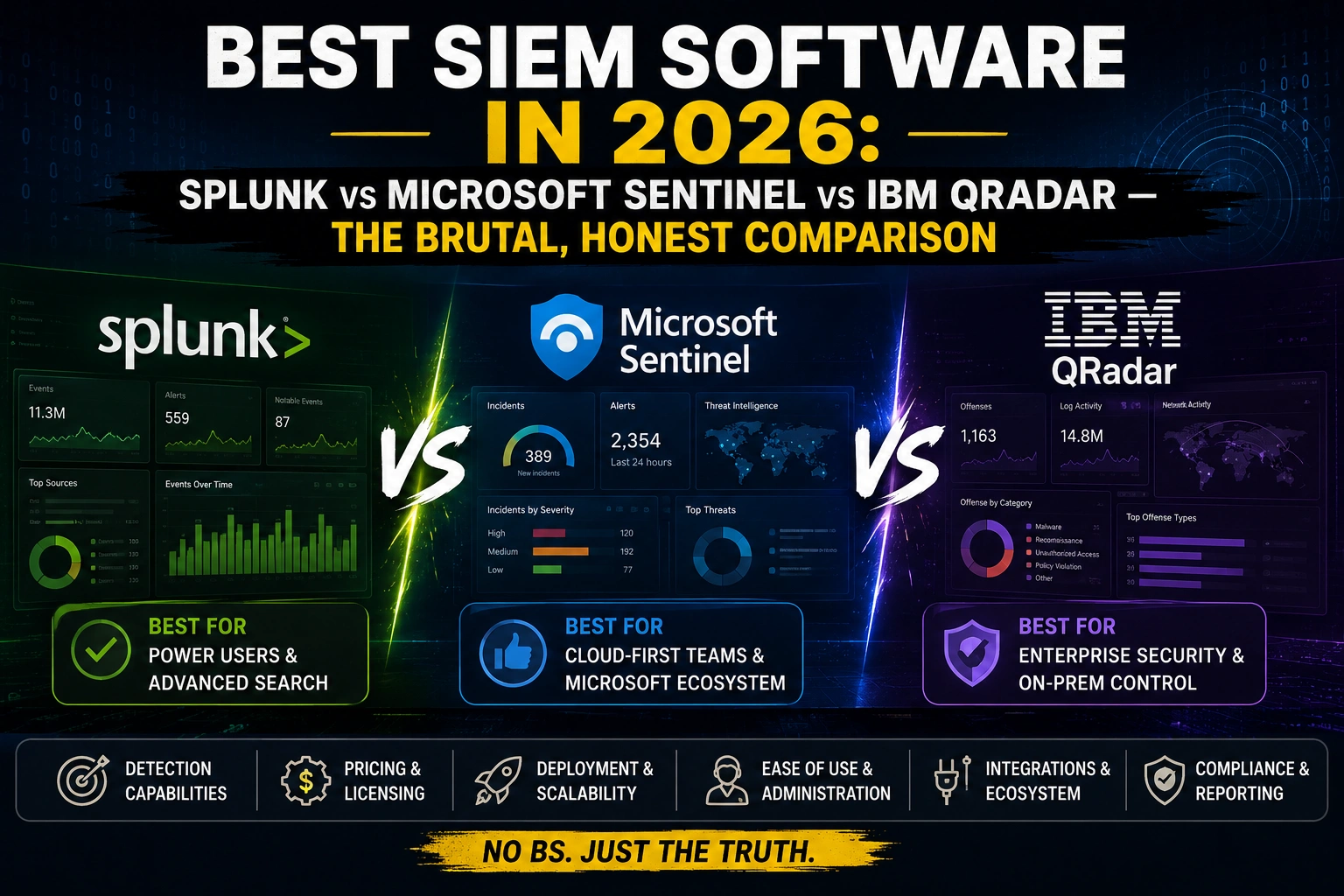
Microsoft Sentinel costs $5.22/GB for ingestion. Splunk costs $150+/GB/day — but appears in 78% of SOC job postings. IBM QRadar starts at $10,000/year for 100 events per second. Cisco acquired Splunk for $28 billion in December 2023. And CrowdStrike's LogScale engine achieves 10–30x compression that changes the cost math entirely. The SIEM landscape in 2026 is the most competitive and complex it has ever been. Here is the complete guide.
Somewhere in your network right now, a lateral movement attempt is generating log entries. A compromised credential is authenticating to systems it has never accessed before. A ransomware pre-cursor — a reconnaissance script running under a legitimate service account — is writing telltale patterns to Windows event logs.
Whether your security team knows about it within minutes or discovers it 258 days later (the IBM 2025 Cost of a Data Breach report average detection time) depends entirely on whether those logs are reaching a SIEM platform with the right correlation rules — and whether someone is watching the alerts.
Security Information and Event Management (SIEM) is the central nervous system of modern security operations. It ingests logs from every source — endpoints, firewalls, cloud environments, identity providers, DNS, network traffic — correlates them in real-time, and identifies the combinations of events that signal threats before they become incidents. In 2026, the SIEM market has consolidated, AI has entered every major platform, and the pricing war between the Big Three has produced dramatic cost differences that should drive every purchasing decision.

I've built and operated SOCs running every major SIEM platform — from Splunk deployments processing 500+ GB/day to Sentinel implementations that cut enterprise SIEM costs by 70%. The most important thing I've learned: the best SIEM is the one your team can actually operate. I've watched organizations spend $2 million annually on Splunk licenses while two exhausted analysts missed the actual breach in a flood of untuned alerts. The 2026 pricing war between Splunk, Sentinel, and QRadar has created genuine options at every budget tier — but the platform selection decision is about team capability and data source economics first, features second. Everything in this comparison is built from real deployment experience, verified pricing data, and the brutal math that actually determines whether a SIEM investment protects your organization or just checks a compliance box.
Quick Answer: Best SIEM 2026
Microsoft Sentinel wins for Microsoft-heavy environments (free M365 ingestion). Splunk leads for analytical power and SOC talent availability. IBM QRadar dominates regulated industries with out-of-the-box compliance. Pair any SIEM with TrustMyIP IP intelligence to enrich authentication events with real-time reputation data.
1. What SIEM Does — The Core Functions
Before comparing platforms, understand what you're actually buying:
6 Core SIEM Functions
1Log Collection & Aggregation
Ingests logs from every source: endpoint logs, network devices, cloud services (AWS CloudTrail, Azure Activity Logs, GCP), identity providers, applications, DNS, and email security. Log volume is the primary cost driver in SIEM pricing.
2Real-Time Correlation & Detection
Applies detection rules that identify threat patterns across multiple log sources. A sequence of failed logins, then a successful login, then first-ever access to a sensitive directory, then bulk file reads — that pattern is a detection rule for credential stuffing.
3UEBA — Behavioral Analytics
ML baseline of normal behavior for every user and system, identifying deviations. A user who always logs in from Chicago at 9 AM triggers an anomaly alert when they authenticate from Eastern Europe at 3 AM — even if credentials are valid.
4Incident Management
Alert triage, case management, and incident tracking. The interface where SOC analysts investigate alerts, escalate confirmed incidents, and document resolution.
5Compliance Reporting
Pre-built reports for PCI-DSS, HIPAA, SOX, ISO 27001, NIST, GDPR. Automated evidence collection that would otherwise require hundreds of hours of manual log review at audit time.
6SOAR Integration
Security Orchestration, Automation, and Response. SIEM detects; SOAR responds automatically — isolating the affected endpoint, revoking credentials, opening a ticket, notifying the SOC — in seconds rather than minutes.
The SIEM Market in 2026
The SIEM market generated $5.4 billion in 2024 and is projected to reach approximately $6.7 billion in 2026. A comprehensive April 2026 evaluation across 12 platforms — using AI detection quality, integration ecosystem, pricing transparency, compliance automation, and analyst reviews — produced a landscape where no single platform dominates across all dimensions.
2. The 5 Platforms That Matter Most in 2026
Platform 1 — Splunk Enterprise Security: The Gold Standard, Now a Cisco Company
Status in 2026
Cisco completed the acquisition of Splunk for $28 billion in December 2023 — the largest cybersecurity acquisition in history. Splunk remains operationally independent but is now positioned as the analytics and SIEM layer of Cisco's broader security vision.
Architecture
Distributed index and search architecture. Data ingested into "indexers," stored in a proprietary format, searched via "search heads" using SPL (Splunk Processing Language). Scales horizontally — more indexers handle more data.
SPL — The Language That Defines a Market
Splunk Processing Language is the most powerful query language in the SIEM market and the reason Splunk appears in 78% of SOC analyst job postings in 2026. A single SPL search can identify every user who: failed authentication more than 5 times in 10 minutes from an IP with a fraud score above 75 → then succeeded on the 6th attempt → then accessed a file server in a path they've never accessed in the past 90 days → then copied more than 100 MB of data within 2 hours. This query, written in SPL, takes minutes. Also, over 2,800 apps in Splunkbase — integrations, detection rule packs, and specialized content for every industry built over 15+ years.
| Pricing Model | Rate | Notes |
|---|---|---|
| Ingestion-Based | $150+/GB/day | Most expensive per GB in the market |
| Workload-Based | Volume discounts | Alternative pricing for high-volume orgs |
| Infrastructure | $3–$15/unit/month | Splunk Cloud vs self-hosted |
✅ Where Splunk Wins
- ✓Fortune 500 enterprises with mature SOC teams who can exploit SPL's power
- ✓Heavy industrial environments (OT/IoT) requiring specialized monitoring
- ✓Security teams building custom detection content from first principles
- ✓Organizations where SPL skill investment is a multi-year competitive advantage
❌ Where Splunk Loses
- ✗SMBs and mid-market organizations where cost is a primary constraint
- ✗Organizations without dedicated Splunk architects and SPL-capable analysts
- ✗Environments with low Microsoft stack density (Sentinel wins on economics)
Platform 2 — Microsoft Sentinel: The Cloud-Native Disruptor
Status in 2026: Microsoft Sentinel has effectively become the operating system for many mid-market and enterprise SOCs in 2026. The disruption was pricing-driven: for organizations already invested in Microsoft 365, Azure, and the Defender suite, Sentinel's economics are genuinely difficult to beat.
Architecture: Fully cloud-native, built on Azure Log Analytics and Azure Monitor. Data ingestion, storage, search, and detection all run in Azure. No infrastructure to manage. Global availability through Azure's data center network.
| Source | Ingestion Cost | Notes |
|---|---|---|
| Non-Microsoft Sources | $5.22/GB | Standard ingestion rate |
| Microsoft 365 / Defender | Free or heavily discounted | Native connector benefit |
| Azure Activity Logs | Free | Native Azure integration |
| Microsoft Entra ID Logs | Free | Identity events at no cost |
| Defender for Endpoint | Free | EDR alerts, no ingestion charge |
✅ The Pricing Model That Changed Everything
For an organization where 70-80% of their log volume comes from Microsoft sources — Windows endpoints, Microsoft 365, Azure, Defender — the effective cost of Sentinel is dramatically lower than any comparable SIEM. The free ingestion of Microsoft data is not a minor feature; it fundamentally changes the TCO calculation.
Microsoft Security Copilot — The AI Layer
In 2026, Microsoft Sentinel is deeply integrated with Microsoft Security Copilot. SOC analysts can: query Sentinel data in natural language; receive plain-language summaries of complex incidents; get automated investigation reports; and generate KQL queries from natural language descriptions. Copilot for Security significantly reduces the skill requirement for effective Sentinel operation — it is the platform most accessible to security teams without deep SPL or KQL expertise.
✅ Where Sentinel Wins
- ✓Organizations on Microsoft 365 E5 (Sentinel included at reduced incremental cost)
- ✓Teams wanting maximum AI/GenAI capability immediately
- ✓Mid-market and growing enterprises that can't staff dedicated Splunk architects
❌ Where Sentinel Loses
- ✗Non-Microsoft environments (AWS-native, GCP-native, Linux-heavy)
- ✗Organizations with high volumes of non-Microsoft logs (cost escalates unpredictably)
- ✗Environments requiring maximum SPL-style analytical flexibility
Platform 3 — IBM QRadar: The Compliance Workhorse
Status in 2026: IBM QRadar has evolved into the "QRadar Suite" — IBM's attempt to modernize the platform that dominated compliance-driven enterprise security in the 2010s. The platform is built like a tank: stable, accurate out-of-the-box detections, and forensically detailed.
Architecture: Available as on-premises appliance, cloud-hosted, or as part of IBM Cloud. The QRadar appliance architecture is the most mature on-premises SIEM available — suitable for air-gapped environments and organizations with strict data residency requirements.
| Tier | Annual Cost | Capacity | Notes |
|---|---|---|---|
| Community Edition | Free | 50 EPS | Learning and small deployments |
| Entry Level | ~$10,000/year | 100 EPS | Smallest commercial tier |
| Mid-Range | $25,000–$100,000/year | 500–5,000 EPS | Mid-enterprise |
| Enterprise | $100,000–$500,000+/year | 10,000+ EPS | Large enterprise |
What QRadar Does Exceptionally Well
- →Network flow analysis: Integrates NetFlow, sFlow, and J-Flow data alongside log events — detecting lateral movement through network traffic analysis that log-only SIEM platforms miss
- →Out-of-the-box detection accuracy: Ships with the highest-quality pre-built detection content of any commercial SIEM — works accurately without the weeks of tuning Splunk requires
- →Compliance reporting depth: Pre-built reports for PCI-DSS, HIPAA, SOX, NIST, and GDPR — the most mature compliance framework in the market built over decades
- →UEBA module: Establishes behavioral baselines and identifies insider threats and compromised credential usage through deviation analysis
- →EPS pricing predictability: Unlike Splunk's per-GB model where costs fluctuate with log volume, QRadar pricing is based on the rate of events — organizations can budget costs precisely
✅ Where QRadar Wins
- ✓Regulated industries with compliance reporting requirements (healthcare, financial services, government)
- ✓Organizations requiring on-premises deployment with strict data residency
- ✓Security teams that need accurate out-of-the-box detection without extensive tuning
❌ Where QRadar Loses
- ✗Organizations wanting modern cloud-native architecture and UI
- ✗Environments needing rapid deployment and operational simplicity
- ✗Teams that need Splunk SPL skill development for career advancement
Platform 4 — CrowdStrike Falcon Next-Gen SIEM (LogScale)
Status in 2026: CrowdStrike's acquisition of Humio (now rebranded as LogScale) produced the SIEM with the most radical performance and compression advantage in the market. LogScale uses a columnar-based stream compression that achieves 10–30x data compression — storing 30 TB of logs in 1 TB of storage.
The Cost Implication
Splunk: 30 TB = pay for 30 TB
Standard storage and query overhead at $150+/GB/day
LogScale: 30 TB → ~1–3 TB stored
10–30x compression. Dramatically lower cost for equivalent data.
Key Differentiators
- ✓CrowdStrike Falcon integration: Organizations running CrowdStrike EDR get that endpoint telemetry ingested into the SIEM at no additional per-GB cost — same economics Sentinel offers for Microsoft data
- ✓Real-time streaming queries: LogScale processes queries against streaming data rather than indexed batches — sub-second query response against current log data
- ✓Charlotte AI: CrowdStrike's generative AI queries SIEM data in natural language — "Show me every endpoint that communicated with this IP address in the last 30 days" answered in seconds
Best For: CrowdStrike Falcon Next-Gen SIEM
Organizations standardized on CrowdStrike Falcon for endpoint security; security teams wanting the best cost efficiency in managed cloud SIEM; organizations that want unified endpoint telemetry and SIEM in a single vendor.
Platform 5 — Elastic Security: Best Open-Source Option
Status in 2026: Elastic Security (built on the ELK stack — Elasticsearch, Logstash, Kibana) is the most powerful open-source SIEM available. Self-hosted Elastic provides enterprise SIEM capability at infrastructure-only cost for organizations with engineering resources.
Pricing
- ✓Self-hosted: Free (pay only for server infrastructure). At 500+ GB/day, typically the cheapest option in the market.
- ✓Elastic Cloud (managed): Starts at approximately $95/month; scales with data volume.
Key Differentiators
- →Rules as code: Detection rules defined in YAML — version-controlled, code-reviewed, shared on GitHub
- →Kibana dashboards: The most flexible visualization layer of any SIEM
- →ECS (Elastic Common Schema): Normalized data model simplifying integration across diverse log sources
⚠️ Limitation
"Out of the box without tuning, alert quality is not as strong as Sentinel or Splunk with their pre-built content. Teams without dedicated Elastic expertise often find themselves spending more time on platform management than on security operations."
Best for: Organizations with existing Elastic/ELK infrastructure; engineering-led security teams who want full control; cost-conscious organizations with the technical depth to manage self-hosted deployment.
3. Head-to-Head Pricing Comparison
The single most important table for procurement decisions:
| Platform | Pricing Model | 10 GB/Day | 100 GB/Day | 500 GB/Day |
|---|---|---|---|---|
| Splunk ES | Per GB ingested | ~$547K/yr | ~$5.5M/yr | ~$27M/yr |
| Microsoft Sentinel | Per GB (MS data free) | ~$19K/yr | ~$190K/yr | ~$950K/yr |
| IBM QRadar | Per EPS | ~$25–50K/yr | ~$75–150K/yr | ~$150–400K/yr |
| CrowdStrike LogScale | Volume + compression | ~$15–30K/yr | ~$60–120K/yr | ~$150–300K/yr |
| Elastic (self-hosted) | Infrastructure only | ~$5–10K/yr | ~$20–40K/yr | ~$60–120K/yr |
*All figures are rough estimates; actual pricing depends on negotiated terms, committed use discounts, and data source mix. Microsoft Sentinel costs assume 50%+ Microsoft source data. Splunk workload pricing available as alternative.*
4. How to Choose Your SIEM — The Decision Matrix
5-Scenario SIEM Decision Guide
A"We're a Microsoft shop (M365 E5 + Azure + Defender)"
→ Choose: Microsoft Sentinel
The economics are decisive. Microsoft source ingestion is free or deeply discounted. Copilot for Security provides AI-powered analysis immediately. Native integration with your existing Defender, Entra ID, and Intune eliminates weeks of connector configuration. For the 90% of US businesses running significant Microsoft infrastructure, Sentinel's TCO beats Splunk at virtually every scale.
B"We need the most powerful analytics and can staff a dedicated SIEM team"
→ Choose: Splunk Enterprise Security
SPL is the most powerful query language in SIEM. The 2,800+ Splunkbase integrations cover every possible data source. Splunk appears in 78% of SOC job postings — hiring and training talent is easier than for any alternative. The cost is the highest, but the capability ceiling is the highest.
C"We're in a regulated industry with strict compliance requirements"
→ Choose: IBM QRadar or Microsoft Sentinel
QRadar's out-of-the-box compliance reporting, EPS-based predictable pricing, and stability make it the traditional choice for healthcare, financial services, and government. Sentinel is competitive on compliance features and significantly cheaper for Microsoft-heavy environments.
D"We run CrowdStrike on all our endpoints"
→ Choose: CrowdStrike Falcon Next-Gen SIEM
Free endpoint telemetry ingestion from CrowdStrike agents — the same economics that makes Sentinel attractive for Microsoft shops. LogScale's compression advantage and AI-driven detection through Charlotte AI make this the most cost-efficient option for CrowdStrike-standardized organizations.
E"We have engineering resources and want cost control at scale"
→ Choose: Elastic Security
For organizations ingesting 500+ GB/day where Splunk's per-GB cost becomes prohibitive, Elastic self-hosted is the most cost-efficient enterprise SIEM available. The engineering investment to deploy and tune it pays back at scale.
5. The AI Revolution in SIEM — 2026
Every major SIEM platform has added generative AI capabilities in 2026. The practical implications:
Microsoft Security Copilot (Sentinel)
Natural language queries, automated incident summaries, KQL generation. Most mature and widely deployed AI layer in SIEM as of 2026.
Splunk AI / Cisco AI Assistant
Charlotte AI functionality post-Cisco acquisition being integrated into Splunk. Natural language SPL generation significantly lowers the barrier to advanced Splunk analytics.
IBM QRadar AI
Threat detection models and investigation assistance built into QRadar Suite. IBM's AI assistant generates investigation hypotheses and suggests remediation actions.
CrowdStrike Charlotte AI
Unified AI across endpoint and SIEM — "Show me every endpoint that communicated with this IP address in the last 30 days" answered in seconds.
✅ What AI in SIEM Actually Changes
- ✓Reduces mean time to detect (MTTD) by accelerating investigation workflows
- ✓Lowers the analyst skill floor — junior analysts can execute complex investigations
- ✓Automates tier-1 alert triage, freeing senior analysts for complex cases
- ✓Translates natural language to query language, making platforms more accessible
❌ What AI Does NOT Change
- ✗The underlying economics of data ingestion
- ✗The importance of alert tuning and detection engineering
- ✗The need for human judgment on complex incidents
6. SIEM and IP Intelligence — The Integration Layer
SIEM platforms are most effective when they incorporate IP intelligence data alongside log events. The direct connections:
IP Reputation Enrichment
Every SIEM includes a threat intelligence integration layer — Splunk ESCU, Sentinel's Microsoft Threat Intelligence, QRadar's X-Force. IP reputation data enriches security events: when a user authenticates from an IP on a fraud blacklist, the SIEM automatically flags the event as high-priority.
DNS Query Analysis
DNS logs feed SIEM platforms with queries that reveal malware communication, data exfiltration attempts, and domain reconnaissance. Combining DNS logs with IP reputation creates a layered detection capability — the DNS query to a suspicious domain and the subsequent connection to the resolved IP both generate correlated SIEM alerts.
Geolocation Anomalies
When an authentication event shows a user logging in from an IP in a country they've never been to, IP geolocation data in the SIEM triggers an impossible travel alert. Use TrustMyIP IP Lookup to verify IP reputation during incident investigations and enrich SIEM event context.
7. Frequently Asked Questions
How much do organizations actually pay for SIEM after negotiation?
Enterprise SIEM pricing involves aggressive negotiation — list prices are theoretical starting points. Splunk customers at 50+ GB/day regularly negotiate 40–60% below list. Microsoft Sentinel committed use discounts provide 20–30% reductions. IBM QRadar's standard commercial pricing involves 30–50% negotiated discounts. The most important advice: never accept list price, always get quotes from at least three vendors including competitive alternatives to use as leverage.
Is SIEM necessary for compliance (PCI-DSS, HIPAA, SOC 2)?
PCI-DSS requires a SIEM specifically for Requirement 10 (log monitoring) and Requirement 11 (vulnerability testing and intrusion detection). HIPAA requires audit controls and activity review that SIEM fulfills. SOC 2 Type II requires continuous monitoring that SIEM is specifically designed to provide. For organizations pursuing these certifications, SIEM is effectively mandatory.
Can a small business (under 50 employees) afford SIEM?
Elastic SIEM self-hosted is deployable for infrastructure-only costs (approximately $500–$2,000/month) for organizations with Linux administration skills. Microsoft Sentinel starts at approximately $5.22/GB — a small business generating 5 GB/day would pay approximately $776/month. SIEM is no longer exclusively enterprise technology, but it does require dedicated expertise to operate effectively regardless of platform.
What is the difference between SIEM and SOC?
A SOC (Security Operations Center) is the team of analysts who operate security tools and respond to incidents. A SIEM is one of the primary tools the SOC uses. SIEM without a SOC generates alerts that no one investigates — the technology investment is wasted. For organizations without a SOC, managed SIEM or MDR (Managed Detection and Response) services — where a vendor operates the SIEM and provides analyst coverage — are the appropriate model.
Why does Splunk appear in 78% of SOC job postings?
Splunk's market dominance over two decades created a talent ecosystem. Security certifications, training programs, and the Splunk User Conference have produced the largest community of SIEM professionals in the world. Hiring a Splunk-trained analyst is easier than hiring a QRadar or Elastic specialist. For organizations that prioritize talent availability and training resources, Splunk's market presence has compounding value beyond the platform capabilities.
Conclusion: The Best SIEM Is the One Your Team Can Actually Operate
The worst SIEM deployment in 2026 is a $500,000 Splunk instance generating 10,000 alerts per day that two overwhelmed analysts work through at 30% completion — missing the actual breach in the noise of false positives. The best SIEM deployment is a properly tuned platform matched to your team's skill set, integrated with your actual data sources, and generating actionable alerts at a rate your analysts can genuinely investigate.
Summary Recommendation
- →Microsoft-heavy environment: Sentinel — the economics are unmatched
- →Need maximum analytical power and have the team: Splunk — the gold standard
- →Regulated industry with compliance reporting requirements: QRadar — out-of-the-box compliance depth
- →CrowdStrike-standardized endpoint: Falcon Next-Gen SIEM — unified telemetry economics
- →Engineering-led team, high volume, cost-conscious: Elastic — infrastructure-only cost at scale
Pair your SIEM deployment with TrustMyIP IP reputation enrichment to add IP intelligence context to every authentication event, and explore our cybersecurity blog for the latest guidance on SIEM tuning, detection engineering, and SOC operations in 2026.
*This article is for informational purposes only. Pricing, features, and product specifications change frequently. Actual enterprise pricing involves significant negotiation below list rates.*
*Last updated: May 2026 | Data sourced from guptadeepak.com 2026 SIEM comparison, underdefense.com 12-platform SIEM evaluation (April 2026), unihackers.com SIEM comparison (March 2026), panicomputer.com Splunk vs Sentinel analysis, IBM QRadar Community Edition documentation, and verified vendor pricing data*
Enrich Your SIEM With IP Intelligence!
Add real-time IP reputation context to every authentication event. Catch credential-based attacks before they become incidents.