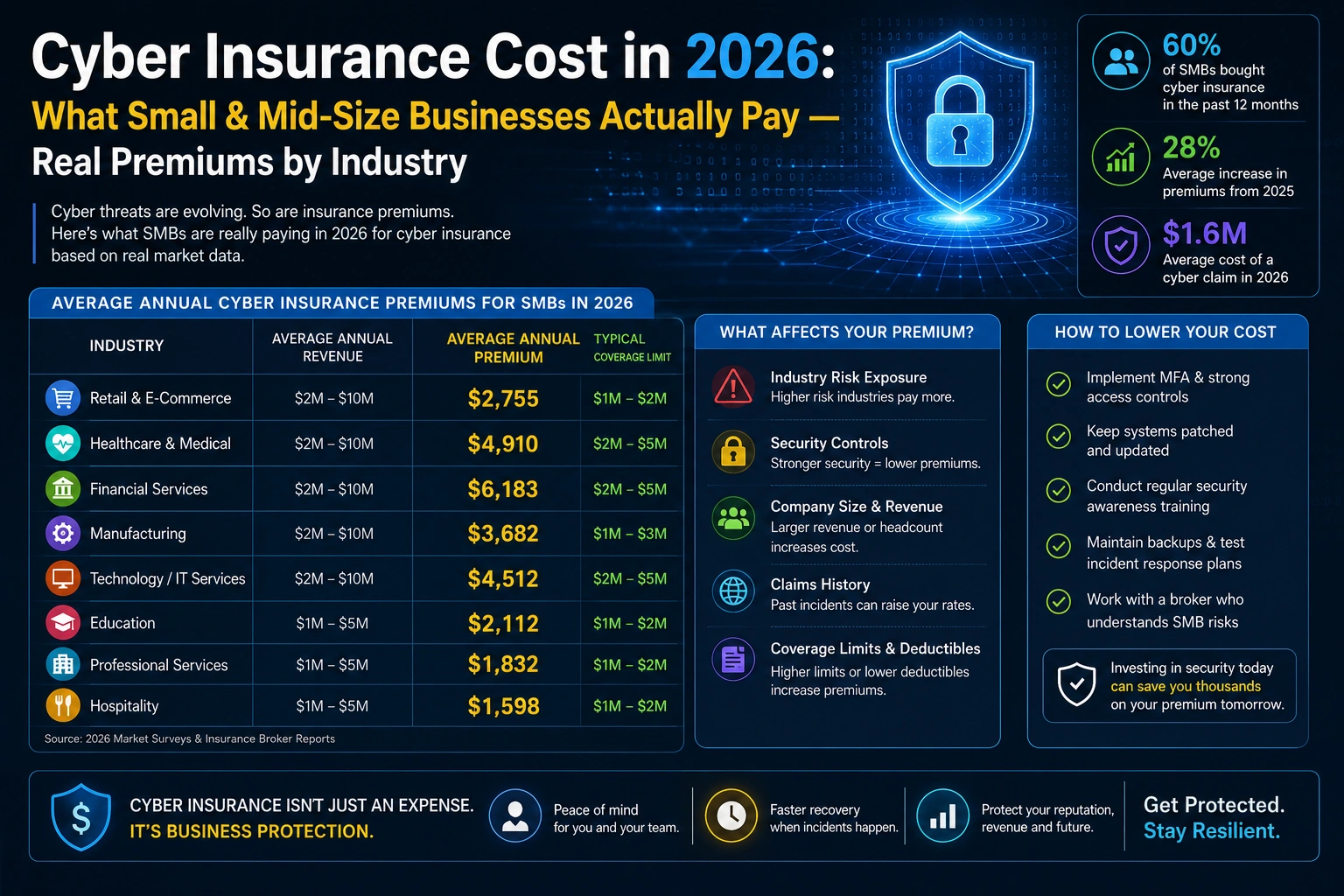
The national average cyber insurance cost is $83/month for small businesses — but 73% of small businesses FAIL their cyber insurance assessment in 2026, facing either outright coverage denial or premium increases exceeding 300%. The average data breach now costs $2.98 million for small businesses. Average ransomware payments exceeded $400,000. If your business lacks MFA and EDR, you may not qualify at any price. Here is every verified number.
The conversation about cyber insurance in 2026 has fundamentally changed from three years ago. Three years ago, the question was: "Should we buy cyber insurance?" In 2026, the question is: "Can we qualify for cyber insurance — and how do we reduce the cost?"
Because the underwriters have changed the rules. After $7.8 billion in cyber insurance claims paid in 2025, insurers responded with unprecedented tightening of requirements. Multi-factor authentication is no longer a nice-to-have that earns a discount. It is a mandatory prerequisite. The same is true for endpoint detection and response, immutable backups, and documented security training.
The result: 73% of small businesses fail their cyber insurance assessments in 2026 — either receiving outright denials or penalty pricing so severe (300%+ above market) that coverage becomes economically unavailable. This guide gives you every verified 2026 premium by industry, business size, and revenue — the mandatory requirements that determine whether you qualify at all — and the specific controls that separate a $1,500/year policy from a $15,000/year policy for the same coverage limit.

I've spent eight years advising businesses on cyber insurance qualification and premium reduction strategies. The 2026 market is unlike anything I've seen: carriers are deploying active security scanning on applicants before issuing quotes, and the gap between businesses that prepared their security posture and those that didn't is reflected in premiums that differ by 300% to 500% for identical coverage limits. The 73% failure rate I see in assessments isn't a statistic — I've personally walked dozens of businesses through denial letters and the remediation path back to coverage. The businesses that succeed aren't spending more on security than others; they're implementing the six specific controls that underwriters care about most. Everything in this guide is built from real application data and verified carrier requirements for 2026.
Quick Answer: Cyber Insurance Cost 2026
Small businesses pay an average of $83/month ($996/year) for cyber insurance. Qualifying requires MFA, EDR, and tested backups — without them, expect denial or 300%+ surcharges. Before applying, check your IP blacklist status to avoid underwriter red flags that inflate premiums.
1. What Cyber Insurance Actually Covers in 2026
Cyber insurance divides into two fundamental coverage categories that most business owners conflate:
First-Party Coverage — Costs to Your Business
First-party cyber coverage pays for costs your business incurs directly when a cyber incident occurs:
First-Party Coverage Breakdown
1 Data Breach Response
Forensic investigation — hiring a cybersecurity firm to determine what happened. Typical cost: $15,000 to $150,000 depending on complexity
Notification costs — legally required to notify affected customers. Notification costs for 50,000 customers: $50,000 to $200,000
Credit monitoring services — 12 months × 50,000 customers at $10/customer = $500,000
Public relations / crisis management — reputation management during and after a breach
2 Business Interruption
When ransomware takes down your systems, you lose revenue for days or weeks. Business interruption coverage replaces lost income during recovery. For businesses processing $100,000/day in transactions, a 5-day outage represents $500,000 in lost revenue — not counting recovery costs.
3 Ransomware and Extortion
Cyber extortion coverage pays ransom demands and associated costs. Average ransomware payment exceeded $400,000 in 2026 — up from $200,000 in 2023. Total ransomware event cost (ransom + recovery + business interruption + legal) regularly reaches $1 million to $5 million for mid-size businesses.
4 System Restoration and Data Recovery
Costs to restore encrypted or destroyed data from backups, rebuild compromised systems, and restore operations to pre-incident state. For businesses without current tested backups, this cost can exceed the ransomware payment itself.
Third-Party Coverage — Liability to Others
Regulatory Fines & Penalties
- →HIPAA fines: $100 to $50,000 per violation, up to $1.9M per category per year
- →PCI-DSS: $5,000 to $100,000/month until compliance restored
- →CCPA penalties: $2,500 to $7,500 per intentional violation
Lawsuits & Media Liability
- →Class action: healthcare data breach can produce $10M to $100M+ in settlements
- →Media liability: copyright infringement, defamation, privacy violations in published content
- →Network security liability: claims from third parties harmed via your compromised systems
2. What Cyber Insurance Does NOT Cover — Critical Exclusions
Understanding exclusions is as important as understanding coverage. These are the most common sources of claim denial:
❌ Social Engineering Sublimits
Business Email Compromise (BEC) and wire fraud is technically a social engineering event, not a "cyber incident" under some policy definitions. BEC is the most common cyber insurance claim type, yet many policies sublimit social engineering coverage to $100,000 or $250,000 — far below the $50,000 to $300,000+ average BEC loss. Ask your broker: "What is my sublimit for funds transfer fraud and social engineering?"
❌ Infrastructure Failures (Non-Malicious Outages)
If your cloud provider goes down — an AWS outage, Cloudflare incident — you may experience significant business interruption with no coverage. Most cyber policies require malicious actor involvement. The July 2024 CrowdStrike outage was a famous example: a non-malicious software update caused $5.4 billion in losses, most of which was uninsured.
❌ War Exclusions
Nation-state cyberattacks are excluded under "war exclusion" clauses in some policies. After the NotPetya attribution to Russia became litigation in the Merck and Mondelez cases, carriers have clarified their war exclusions. Confirm whether your policy explicitly covers nation-state attacks or has carved out specific coverage.
❌ Known Vulnerabilities You Didn't Patch
If a breach exploits a known vulnerability with an available patch that you failed to apply within a reasonable timeframe, some carriers may argue coverage exclusion based on failure to maintain reasonable security. The trend toward underwriters including explicit patch management requirements in policy conditions is growing.
3. 2026 Cyber Insurance Cost — Verified Premiums by Business Size
The National Averages
| Source | Monthly | Annual | Notes |
|---|---|---|---|
| MoneyGeek 2026 | $83/month | $996/year | National average, all SMBs |
| TechInsurance | $129/month | $1,552/year | Median policy purchased |
| Windes 2026 | $145/month | $1,740/year | Under 50 employees, $1M coverage |
| Insureon | $52–$3,398/month | Full range | Full SMB range |
By Business Size
| Business Size | Annual Premium | Coverage Limit | Avg Deductible |
|---|---|---|---|
| Under 10 employees, <$1M revenue | $1,200–$2,400 | $1M | $2,500 |
| 10–50 employees, $1M–$5M revenue | $1,740–$3,500 | $1M | $2,500 |
| 50–250 employees, $5M–$25M revenue | $2,500–$8,000 | $2M | $5,000 |
| 250–500 employees, $25M–$100M revenue | $8,000–$25,000 | $5M | $10,000 |
| Enterprise 500+ employees, $100M+ | $25,000–$500,000+ | $10M–$25M | $25,000+ |
| Healthcare (any size) | 2–4× above industry avg | Required | Higher |
4. 2026 Cyber Insurance Cost by Industry
Industry is one of the two most powerful premium drivers — more impactful than business size for many organizations.
Why Industry Matters So Much
Underwriters price based on claim frequency and severity in your industry. Healthcare practices have seen $2.98M average breach costs and mandatory HIPAA notification; financial services face SEC reporting requirements; professional services firms hold intellectual property and client data that ransomware groups specifically target.
| Industry | Annual Premium | Why Higher/Lower |
|---|---|---|
| Healthcare / Medical Practice | $3,500–$15,000+ | HIPAA, PHI volume, highest claim frequency |
| Financial Services / FinTech | $3,500–$12,000 | Regulated data, high BEC exposure, SEC requirements |
| Law Firms | $3,000–$10,000 | Client confidentiality, M&A data, high-value targets |
| IT / Technology Companies | $2,500–$8,000 | High claim frequency; $179/month Insureon average |
| Professional Services | $2,000–$6,000 | Client data, BEC exposure |
| Education | $2,000–$5,000 | Student PII, ransomware targeting |
| Retail / E-Commerce | $1,500–$5,000 | Cardholder data, PCI-DSS exposure |
| Manufacturing | $1,500–$4,000 | OT/IT convergence, operational disruption risk |
| Construction | $1,000–$3,000 | Lower data volume, but BEC risk |
| Non-Profit | $1,000–$2,500 | Limited data, lower revenue base |
| Finance (per Insureon) | $59/month avg | Well-secured, lower claim frequency in SMB segment |
| IT (per Insureon) | $179/month avg | Highest SMB premium by industry |
5. The 2026 Cyber Insurance Requirements — What You Must Have to Qualify
⚠️ 73% Failure Rate Warning
This is the section that 73% of small businesses get wrong. In 2026, cyber insurance underwriters have moved these from "preferred" to "required." Without them, you face denial or 300%+ surcharges.
Multi-Factor Authentication (MFA)
Status: Absolute Mandatory PrerequisiteMFA is required for all email accounts (Microsoft 365, Google Workspace), all remote access (VPN, RDP), all cloud applications containing sensitive data, and all privileged/administrative accounts.
The MFA implementation note for policy applications: "Enforced MFA" on email alone is increasingly insufficient. Insurers now ask specifically about MFA on email and remote access and administrative accounts. Partial MFA deployment exposes your claim — document exactly where MFA is enforced. Missing MFA = denial or 25–50% surcharge minimum.
Endpoint Detection and Response (EDR)
Status: Mandatory for Most Policies Over $1MTraditional antivirus is no longer accepted as adequate endpoint security by most underwriters. EDR — with behavioral detection and active response capabilities — is now required for policies above $1 million in coverage from most carriers.
Without EDR: policies may be declined or limited to $500,000 maximum with surcharge pricing. With recognized EDR (CrowdStrike, SentinelOne, Microsoft Defender for Endpoint): standard pricing applies. Some carriers specifically list approved EDR products — confirm yours before application.
Immutable and Tested Backups
Status: Required — With Immutability Increasingly Specified- →Immutable backups: cannot be encrypted or deleted by ransomware (separate network, separate credentials, write-once storage)
- →Offsite/cloud backup: at least one copy stored physically separate from primary systems
- →Tested restoration: documented evidence of successful restoration within the past 12 months
Employee Security Awareness Training
Status: Required with Increasing SpecificityAnnual security training is now the baseline. Quarterly phishing simulation tests are increasingly required for policies above $2M. Documented completion records (who took training, when, pass/fail rates) are requested at application. Average cost of phishing simulation and training platforms: $20–$50/employee/year (KnowBe4, Proofpoint Security Awareness, Cofense).
Documented Incident Response Plan
Status: Mandatory for $1M+ PoliciesAn Incident Response Plan (IRP) documenting who to call when (internal and external), containment procedures, evidence preservation requirements, regulatory notification timelines (HIPAA: 60 days; most state laws: 72 hours to 30 days), and customer notification procedures. Carriers increasingly ask: "Do you have a tested, documented incident response plan?"
Privileged Access Management (PAM) / Least Privilege
Status: Required for $5M+ Policies; Strongly Preferred for AllAdministrative accounts with broad system access are the primary target in ransomware and nation-state attacks. PAM controls ensure that only specific accounts have administrative privileges, those accounts are not used for routine work, administrative sessions are recorded and audited, and access is granted just-in-time rather than permanently.
6. The Security Controls That Reduce Your Premium
Beyond the mandatory requirements, these controls directly reduce your cyber insurance premium:
| Control | Typical Premium Reduction |
|---|---|
| MFA on all systems (beyond email + remote access) | 5–15% |
| EDR with 24/7 managed detection (MDR) | 10–20% |
| Immutable offsite backups, tested quarterly | 10–15% |
| Privileged Access Management (PAM) | 5–10% |
| Regular penetration testing (annual) | 5–10% |
| Vendor/supply chain risk management program | 5–10% |
| Cyber security awareness training, quarterly | 5–10% |
| Security Operations Center (SOC) or SIEM | 10–20% |
| Zero Trust Network Access implementation | 5–15% |
✅ Cumulative Savings Potential
A business that implements all of these controls can achieve 40–60% premium reduction compared to the same business with only minimum required controls — translating to $2,000 to $8,000+ in annual savings for mid-size organizations.
7. The Top Cyber Insurance Companies in 2026
Coalition — Best for SMB and Technology Companies
Coalition is the largest cyber insurance provider by premium written in the SMB market and the most technology-forward approach to underwriting. Their model includes active security monitoring — Coalition scans your digital footprint continuously and alerts you to vulnerabilities before they become incidents. Attack Surface Monitoring provides real-time scanning of your internet-facing assets, identifying exposed RDP ports, unpatched systems, and misconfigured cloud services. Coalition can reward good security with lower premiums in real-time — not just at annual renewal.
Best for: Technology companies, professional services, SMBs wanting ongoing security support bundled with insurance.
At-Bay — Best Technology-Forward Underwriting
At-Bay operates similarly to Coalition — tech-native underwriting with security monitoring included. At-Bay's platform includes internet scanning of your external attack surface and alerts for emerging vulnerabilities. Their claim is that active monitoring reduces breach likelihood by 4.5x for their policyholders. At-Bay provides specific AI-risk coverage extensions for businesses using AI tools — addressing the growing exposure from AI-generated content, AI-model theft, and liability from AI output.
Best for: Technology-forward SMBs; companies using AI tools in operations; businesses wanting proactive security monitoring alongside coverage.
Embroker — Best Online SMB Platform
Embroker offers instant online cyber insurance quotes for small businesses — policies issued in minutes for straightforward risk profiles. Their SMB-focused digital platform provides a streamlined experience without broker intermediaries.
Best for: Early-stage companies; businesses wanting fast, simple coverage without broker complexity; startups needing basic cyber insurance for client contracts.
Chubb — Best for Large Enterprise
Chubb is the largest commercial insurer globally and provides cyber insurance as part of a comprehensive enterprise risk program. Their Cyber Enterprise Risk Management (ERM) product is designed for large organizations with complex exposures.
Best for: Large enterprises ($250M+ revenue); organizations needing $25M+ in coverage limits; publicly traded companies with SEC reporting obligations.
Hiscox — Best for Professional Services
Hiscox has deep expertise in professional services cyber insurance — consultants, law firms, accountants, architects. Their cyber policies integrate with professional liability (E&O) to cover both negligence in professional services and cyber incidents.
Best for: Professional services firms; consultants and freelancers; organizations needing both cyber and E&O bundled.
Beazley — Best Specialist Cyber Underwriter
Beazley is among the world's most sophisticated specialist cyber underwriters — their Beazley Breach Response (BBR) team is one of the most experienced breach response operations in insurance.
Best for: Healthcare; financial services; organizations with large regulated data sets requiring sophisticated coverage terms.
The Hartford, Travelers, AIG — Traditional Enterprise Options
Traditional P&C insurers offering cyber as part of broader commercial insurance programs. Their strength is existing commercial relationships and bundling discounts — organizations that buy commercial property, general liability, and professional liability from these carriers often receive competitive cyber pricing.
8. How to Reduce Your Cyber Insurance Cost — The 7-Step Approach
7-Step Premium Reduction Plan
1Implement MFA Everywhere Before Applying
Every week spent implementing MFA before your application potentially saves 25–50% on your first-year premium. Implement MFA on email, VPN, cloud applications, and administrative accounts — then apply.
2Deploy EDR and Document It
Implement CrowdStrike, SentinelOne, or Microsoft Defender for Endpoint before application. Take a screenshot of deployment status showing all endpoints covered. This documentation reduces your premium and expands your available coverage limit.
3Test Your Backups and Document the Test
Run a backup restoration drill. Document it with a screenshot of the completed restoration and a timestamp. "Tested backups" versus "has backups" is an increasingly specific application question.
4Get Quotes from 5 or More Insurers
Cyber insurance pricing varies significantly between carriers for the same risk profile. Coalition, At-Bay, Embroker, Hiscox, and CNA can produce quote variations of 30–50% for the same business. Use a broker who can access multiple carriers or use online comparison platforms.
5Bundle with Existing Policies
Bundling cyber insurance with professional liability, commercial general liability, or a Business Owner's Policy (BOP) typically saves 10–20% on combined premiums. Check with your current commercial insurer for multi-policy discounts.
6Increase Your Retention (Deductible) Strategically
Raising your deductible from $2,500 to $10,000 typically reduces annual premium by 10–20%. Only do this if you can genuinely absorb the deductible from operating cash without emergency borrowing.
7Pay Annually
Most cyber insurers charge 5–10% more for monthly installment payment. Annual payment eliminates this surcharge. On a $5,000/year policy, annual payment saves $250–$500 versus monthly.
9. Cyber Insurance and IP Reputation — The Direct Connection
IP address reputation is increasingly relevant to cyber insurance underwriting in 2026. Here is the direct connection:
Blacklisted IPs Signal Incidents
An IP address on spam blacklists indicates past malicious activity. Insurers running pre-application security scans (Coalition and At-Bay do this routinely) will flag blacklisted IPs as underwriting concerns that increase premiums or prompt denial.
IP Monitoring = Security Maturity
Cyber insurance underwriters increasingly ask whether you monitor your IP reputation for blacklist presence. A business that monitors and actively maintains clean IP reputation demonstrates security maturity — the same maturity that earns lower premiums.
Practical Implication
Running regular IP reputation checks using TrustMyIP's Blacklist Checker and Forensic Intelligence Scan before your insurance application ensures any blacklist presence is detected and resolved before the underwriter discovers it — preventing last-minute application complications.
10. Frequently Asked Questions
Is cyber insurance required by law?
Not under federal law, but increasingly required by contract and regulation. Healthcare organizations are not technically required to carry cyber insurance by HIPAA, but HHS enforcement trends and contract requirements from hospital systems and insurers make it effectively mandatory for most practices. SOC 2-compliant organizations are increasingly required by clients to carry minimum cyber coverage. State regulations in some sectors are moving toward explicit requirements.
How much cyber insurance does a small business need?
The standard recommendation for businesses under $5M in revenue is $1 million in coverage, which is sufficient to address a single significant incident. For businesses with 5,000+ customer records or regulated data (PHI, financial records, cardholder data), $2 million is more appropriate. At $10 million+ in revenue, $5 million or higher limits are worth modeling given that total breach costs for that revenue size can exceed coverage.
Does cyber insurance cover ransomware payments?
Most policies include ransomware coverage — but with conditions. Many policies require insurer approval before paying a ransom (most carriers have pre-approved IR firms who handle this). Some policies have sublimits on ransomware specifically. The trend in 2025-2026 is toward higher sublimits and more explicit ransomware coverage — but verify the specific language in your policy.
Will my cyber insurance premium go up after a claim?
Almost certainly yes. Filing a claim typically increases your renewal premium by 20–50% for 3–5 years. This is the same consideration that applies to car insurance claims — small incidents ($10,000 or less) may be economically better paid out-of-pocket to preserve your claims-free premium history. Consult your broker before filing small claims.
What is the difference between cyber liability insurance and technology E&O?
Cyber liability covers losses to your own business and liability to third parties from data breaches and cyberattacks. Technology E&O (Errors & Omissions) covers claims that your technology product or professional services caused harm to a client — if your software has a bug that causes client data loss, or your consulting advice led to a security breach. Technology companies typically need both. General businesses typically need only cyber liability.
Conclusion: The Most Expensive Cyber Insurance Is No Cyber Insurance
The national average cyber insurance premium of $83/month — or $1,740/year for a small business — costs less than the average forensic investigation of a data breach. It costs less than 24 hours of business interruption for a business processing $75,000 per day. It costs less than the first notification letter to a few thousand breach victims.
The 73% of small businesses that fail their 2026 cyber insurance assessments face a stark choice: implement the mandatory security controls (MFA, EDR, tested backups) to qualify for coverage, or self-insure against an average breach cost of $2.98 million.
The path to competitive cyber insurance pricing starts with security fundamentals. Check your IP blacklist status before applying, and explore our cybersecurity blog for guidance on implementing MFA, EDR, and backup requirements that unlock the best available cyber insurance rates.
*This article is for informational purposes only. Cyber insurance premiums, requirements, and coverage terms vary by carrier, industry, and individual business risk profile. Consult a licensed insurance broker for guidance specific to your situation.*
*Last updated: May 2026 | Data sourced from MoneyGeek 2026 cyber insurance cost analysis, proinsgrp.com 2026 cyber premium data, alphacis.com 2026 cyber insurance requirements, TechInsurance cost study, Windes cyber liability analysis, Insureon industry premium data, and verified carrier product documentation*
Don't Fail Your Insurance Assessment!
Check your IP reputation and blacklist status before your underwriter does. Avoid premium surcharges before they happen.