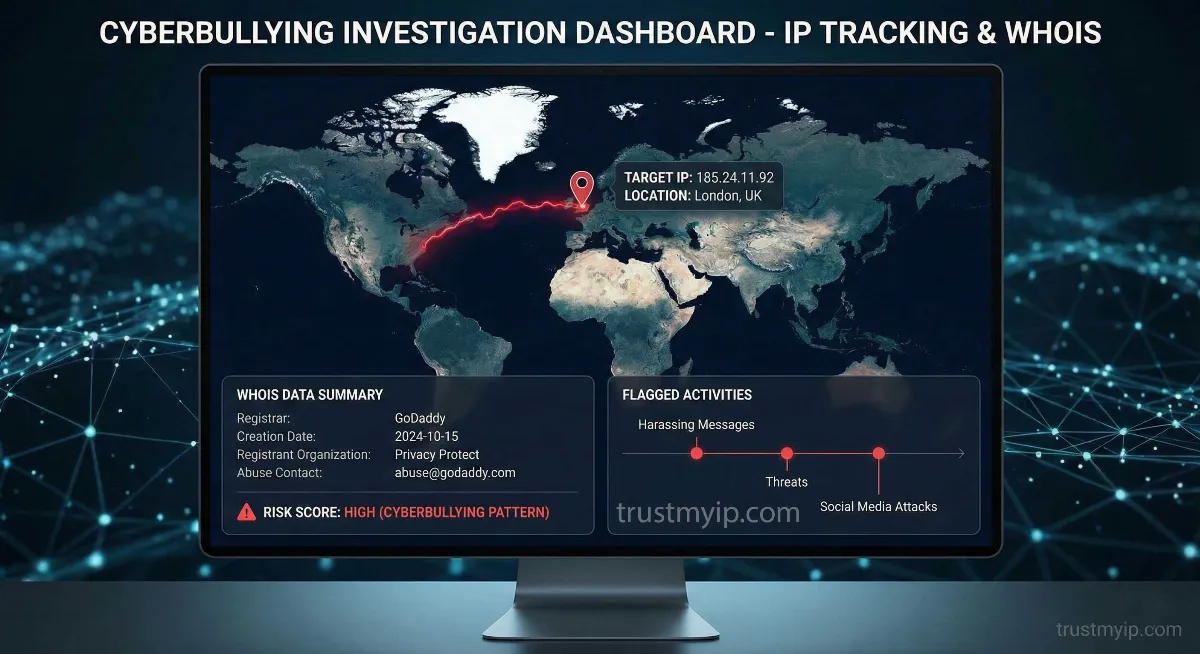
Being the target of online harassment or cyberbullying is an incredibly isolating and stressful experience. Whether it’s coming from a complete stranger or someone you suspect you know, the "anonymity" of the internet often makes victims feel powerless. However, every digital action leaves a footprint, and that footprint usually starts with an IP address.
"If you are looking to hold someone accountable, you might be wondering: 'Can I find the owner of an IP address to report cyberbullying?' The short answer is yes—but the process is a marathon, not a sprint. In this guide, we will walk you through the professional steps to identify an IP owner, gather intelligence via TrustMyIP, and transition to a formal legal report."
1. Understanding the Role of an IP Address in Cyberbullying
An IP (Internet Protocol) address is like a digital return address. When someone sends a harassing email or posts a malicious comment, their device communicates with a server using this unique identifier. While an IP doesn’t immediately reveal a person’s name or home address to the public, it is the key piece of evidence that law enforcement and lawyers use to unmask a bully.
The Intelligence Spectrum
What an IP Reveals vs. What it Hides
- • User's Approximate City/Region
- • Internet Service Provider (ISP)
- • Network Management Organization
- • Person's Legal Name
- • Exact Street Address
- • Private Phone Number
Privacy laws prevent ISPs from handing over personal customer data to just anyone. To get the "name" behind the numbers, you generally need to involve the authorities or a court order.
2. How to Locate the Offender’s IP Address
You can’t report an IP if you don’t have it. Depending on where the bullying is happening, there are different ways to extract this information.
From Harassing Emails
IP addresses are often hidden in the "header" of the message.
- Gmail: Open Email > 3 dots > "Show original" > Search "Received: from".
- Outlook: Open Email > 3 dots > "View" > "Message details".
Social Media & Websites
On platforms like Facebook or X (Twitter), IPs are hidden for security.
In these cases, legal subpoenas are required to force platforms to release log data containing the offender's IP.
3. Using WHOIS and IP Lookup Tools for Evidence
Once you have a suspicious IP address, your next step is to "enrich" that data. This is where a WHOIS lookup becomes your best friend.
4. The Legal Path: How to "Unmask" the Bully
Because of the Electronic Communications Privacy Act (ECPA), ISPs cannot hand over identities without a legal reason.
The "John Doe" Lawsuit
An attorney can file this against an unidentified defendant. The court then grants a subpoena forcing the ISP to release the name and billing address associated with the IP.
Law Enforcement Route
If threats of violence occur, it's criminal. File a report with the FBI IC3. Police can serve warrants much faster than civil suits.
5. How to Build a Strong Cyberbullying Report
The quality of your evidence determines how quickly experts can act. Don't just say "someone is being mean"—show the digital trail.
Essential Evidence Checklist
Also Read: Why is My Public IP Showing a Different City? Geolocation Accuracy Explained.
6. Reporting Directly to Platforms
| Platform | How to Report | What Happens? |
|---|---|---|
| Instagram / Meta | Tap "..." on profile > Select "Report". | Account deletion or shadowbanning. |
| X (Twitter) | Select "Report Post" > "Harassment". | Account locking until content removal. |
| Google / Outlook | Report as "Phishing" or "Harassment". | Termination of email services. |
7. Safety First: What to Do Right Now
Investigating an IP address is a technical task, but your mental health and physical safety come first. If you are in the middle of a cyberbullying crisis:
Do Not Retaliate
Reaction complicates legal proceedings and fuels the bully.
Block & Filter
Set profiles to "Private" and use the block feature immediately.
Tell Someone
Reach out to parents, trusted friends, or legal professionals.
Frequently Asked Questions
Is it legal to look up someone's IP address?
Yes. Using public IP lookup tools or WHOIS databases is legal. However, using that IP to hack, DDOS, or "dox" someone is illegal.
Can a VPN hide the bully's IP?
Yes. A VPN lookup will show the VPN server IP instead of the home ISP. In these cases, you must subpoena the VPN provider.
How long does it take to get a name from an IP?
3 to 6 months for civil cases. Criminal investigations involving threats to life can move in hours or days.
Conclusion: Moving from Victim to Advocate
Finding the owner of an IP address is a vital first step in stopping a cyberbully. While the internet offers a sense of anonymity, tools like TrustMyIP allow you to pull back the curtain and identify the network being used for harassment. By combining professional IP intelligence with a strong record of evidence, you can take control of your online safety.
Take Charge of Your Safety
Need help drafting a formal "Letter of Complaint" to an ISP's abuse department using an IP you’ve found? Contact our team or explore our tools for more intelligence reports.