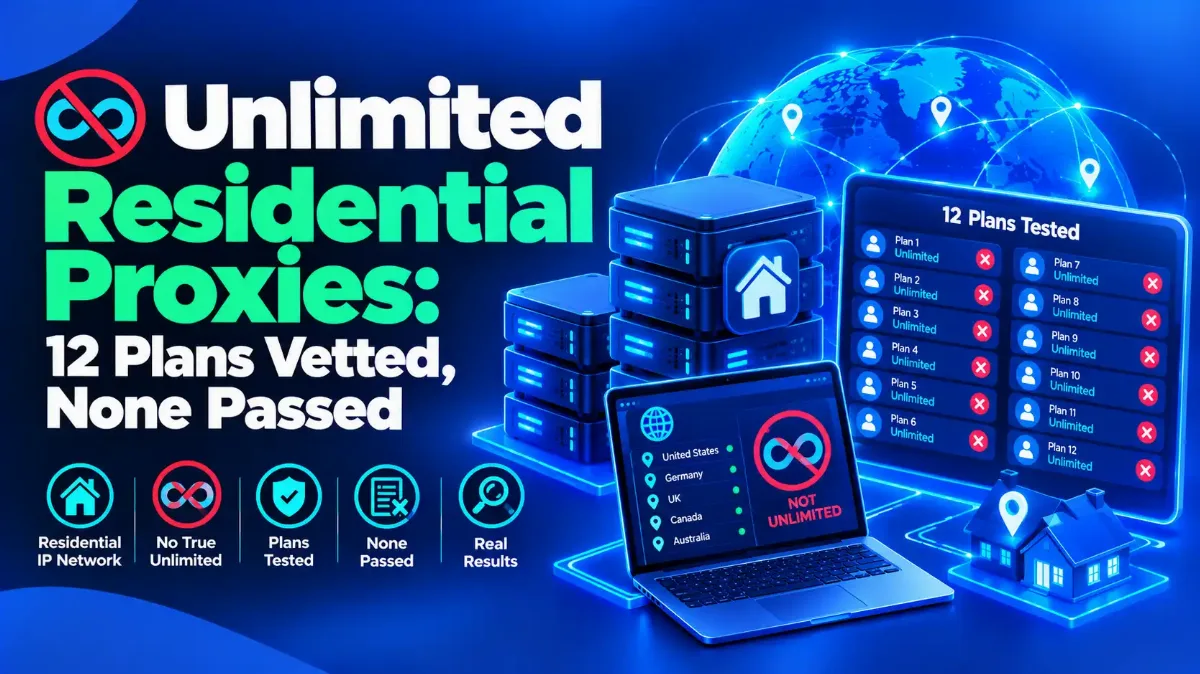
No unlimited residential proxy plan we checked passed our seller vetting. We read 12 plans: Proxyrack, ProxyEmpire, Geonode, Storm Proxies and eight other sellers. Each seller promotes sneaker or ticket bots, multiple-account use, Craigslist posting or ways around bans on its plan page, its menus and footer, or pages they link to. KrebsOnSecurity also reported in January 2026 that one of them, PlainProxies, distributed a proxy SDK found on devices infected by the Kimwolf botnet. The closest clean option is not unlimited: Rayobyte's Scale Residential plan includes 6,600 GB of rotating residential traffic and 100 concurrent requests for $100 a month, as of October 2026.
An unlimited plan removes the gigabyte meter, not the limits. You pay for threads, ports or a speed tier instead, and sellers add their own rules on countries, session length, refunds and fair use. If proxies are new to you, read about the middleman role of a proxy first. This guide takes each cap from the seller's own pages, works out when a flat price beats paying per GB, and lists the checks to run before a trial ends.
It is written for teams with steady, legitimate high-volume traffic, such as price and ad monitoring, SEO rank tracking, market research and QA testing. We compared plans on what they cap, what they cost, their refund terms and the seller behind them. Our sources are each seller's own pages, Proxyway's research and its one test of an unlimited pool, and named security reports. TrustMyIP bought and tested nothing. No seller paid for placement, and every link here is editorial, with no affiliate codes.

Quick Answer: Unlimited Residential Proxies
How Did We Check Unlimited Residential Proxy Plans?
We started from the sellers that appeared in the top results for 18 unlimited-plan searches, such as "unlimited residential proxies", "unlimited bandwidth residential proxies" and "best residential proxies unlimited bandwidth". We added the unlimited sellers named in Proxyway's research and reviews or found in follow-up searches. Then we read each plan's product page, pricing, terms and refund policy on October 22, 2026. For every plan we noted five things:
- → What you pay for: threads, ports, a speed tier or a time pass, and how many of each the entry plan includes.
- → Entry price and plan length: the smallest order the seller prints, dated to October 2026.
- → Written limits: fair-use clauses, countries, session length, open ports and what happens when you reach the cap.
- → Refunds and trials: what the pricing page promises and what the refund policy actually allows.
- → The seller behind the plan: our exclusion rule, any sourcing statement and public reports about the network.
Independent evidence is thin. Proxyway's annual market study for 2026 reports no test of an unlimited pool, and it warns that "brands with unlimited plans have a tendency not to last long." The only published test of an unlimited pool we found is Proxyway's August 2025 review of Proxyrack, covered below. AIMultiple's proxy benchmark covers no unlimited plan.
Verdict rule: we recommend an unlimited plan only if it sells residential traffic with no gigabyte meter at a printed, self-serve price, and its seller passes our exclusion rule. None of the 12 plans did, so this guide ranks no unlimited plan. It describes each one so you can judge the caps yourself, then points to the closest clean option.
How we screened sellers
What Do Unlimited Bandwidth Residential Proxies Really Cap?
Unmetered residential proxies and unlimited ones are the same kind of plan under two names, and some sellers say "flat-rate": none of them counts gigabytes. Proxyrack describes "Unmetered bandwidth on real residential IPs", while Geonode sells "Unlimited residential proxies. One flat price." Neither word means no limits. Every plan we read swaps the gigabyte meter for one or more of these five limits, taken from the sellers' own pages as of October 2026:
| What You Buy | How the Limit Works | Seller Example |
|---|---|---|
| Threads | Each thread is one open connection, so more parallel work needs more threads | Proxyrack: "Each thread connects to one IP at a time, so your plan determines how many connections you can run in parallel." |
| A speed tier | All your connections share one Mbps ceiling, and extra traffic waits | ProxyEmpire: "The plan is limited by throughput rather than GB usage." Geonode: excess traffic "is queued until capacity becomes available". |
| Ports | Each port is one gateway with its own IP, rotation or speed rules | Storm Proxies: "1 access IP (use on 1 computer)" and "Proxies rotate every 5 minutes." 711Proxy sells ports at 5 Mbps each for 7 days |
| Time passes | You buy an hour, a day, a week or a month of access | Rainproxy sells 60 minutes at 200 Mbps; LightningProxies sells 1 day, 1 week or 30 days |
| Terms and scope | Fair-use wording, country-only targeting or a single gateway country | Geonode's policy says unlimited "does not permit unlawful, abusive, disruptive, harmful, or excessive use." ProxyEmpire targets countries only |
A speed tier is a hard ceiling, not a promise. A 100 Mbps tier moves at most 12.5 MB a second: about 1.08 TB a day, or 32.4 TB in 30 days, if it ran flat out around the clock. Real throughput is lower, because every request waits on a home device and its connection. Our guide on why throughput falls below bandwidth explains that gap.
The home devices behind a pool have their own limits too. Research on Include Security's blog in June 2026 found that Bright Data's proxy SDK sets a "200 GB default monthly maximum WiFi traffic limit", plus battery and CPU rules. Bright Data sells no unlimited rotating residential plan. The point is general: any pool spreads your traffic across devices that each carry caps of their own.
Regulators have a yardstick for the word, though not for proxies. UK advertising guidance on telecom ads, published in May 2025, sets two tests for an "unlimited" claim. Legitimate users past a usage threshold should face no extra charge or suspension, and limits on speed or usage should be ones that "are moderate only and are clearly explained". In 2019, settling its case against AT&T, the US Federal Trade Commission said internet providers "must tell people about any restrictions on the speed or amount of data promised." Expect the same from a proxy seller: the cap belongs next to the word.
Threads, Ports and Sessions Are Not the Same Thing
In Proxyrack's plan, a thread is one open connection through the gateway, so 100 threads let 100 requests run side by side. A port is a gateway endpoint: each Storm Proxies port hands you an IP that rotates every five minutes, while each 711Proxy port carries 5 Mbps. A session is how long one exit IP stays with you, which Proxyrack puts at "usually 10, 20, or 30 minutes" for sticky IPs. When a seller promises "unlimited threads", ask which of the three it means.
Four Well-Known Unlimited Residential Plans, and Why Each Was Left Out
These four sellers turn up in search results or ranking lists for unlimited residential proxies, and all four sell rotating residential IPs. Here is how their plans compare, from each seller's own pages as of October 2026:
| Seller | You Pay For | Entry Price | Targeting | Refund or Trial |
|---|---|---|---|---|
| Proxyrack | Threads | $300 a month for 100 threads | Country, city or ISP | $5 trial for 3 days; no refund after any trial |
| ProxyEmpire | A speed tier | $200 a day or $1,500 a month at 100 Mbit | Country only | All sales final, refunds only at its discretion; 1-hour trial on request |
| Geonode | A speed tier | $1,800 a month at 200 Mbps | 150+ countries claimed; docs name the US gateway only | $100 trial for 1 day, non-refundable |
| Storm Proxies | Ports | $19 a month for 1 port | USA or EU | 24-hour refund on the 1-port package only |
Each summary below quotes the plan as its seller describes it, dates every price and ends with the page that kept it off our list.
Proxyrack: Unmetered Traffic, Priced per Thread
Proxyway calls Proxyrack "a veteran provider known for its unlimited traffic residential proxy plans." Its Unlimited Residential plan costs $3.00 per thread from 100 threads ($300 a month), falling to $0.90 per thread at 5,000 threads ($4,500), as of October 2026. Each thread is one connection to one IP. Sticky sessions last "usually 10, 20, or 30 minutes", and the same plan carries HTTP, HTTPS, SOCKS5 and UDP.
Where it wins
- No gigabyte limit on the plan, per its pricing page
- Country, city and ISP targeting are on by default
- HTTP, HTTPS, SOCKS5 and UDP on one plan
- Login by username and password, or up to 800 whitelisted IPs
Where it falls short
- Its $5, 3-day trial cancels the refund: the policy refuses refunds to anyone who "had a free or paid trial"
- No fair-use clause or speed figure for the plan in its terms, which date from June 2021
- Proxyway counted 495,528 unique IPs over 21 days in August 2025, while its pricing page claims 35 million+ monthly IPs as of October 2026
- It sources IPs "through an SDK and proxyware", per Proxyway's 2026 research
Why we left it out: its residential page puts "Account Creation", "Sneakers / Shoes" and "Bots" on its list of uses. The same page says rotation keeps "your actions hidden and undetected which is useful for tasks like managing multiple social media accounts". Its footer also links a use-case hub with pages for account creation and sneakers.
ProxyEmpire: A Speed Tier With Country Targeting Only
ProxyEmpire sells its unlimited plan by speed. As of October 2026, 100 Mbit costs $200 a day, $650 a week or $1,500 a month, and 1,000 Mbit costs $5,400 a month. Its own page warns that "Unlimited GB traffic does not mean unlimited performance." Targeting stops at country level, timed rotation is not offered, and by default it opens just two ports, 80 and 443.
Where it wins
- Daily and weekly passes as well as monthly plans
- Sticky sessions or a new IP on every request
- An about page saying device owners in its supply opt in, are paid and can leave
- A 1-hour trial at 50 Mbit on request
Where it falls short
- "All sales are final and there is no money-back guarantee."
- No city, region or ISP targeting on this plan
- No UDP on any of its proxy types, and ports 80 and 443 only by default
- No published test of the unlimited pool; Proxyway tested its per-GB pool instead, with 98.17% infrastructure success in April 2026
Why we left it out: a use-case page in its main menu shows a "Sneaker Purchasing" tile. A testimonial there says "I use ProxyEmpire to manage multiple accounts without interruptions" and reports "zero bans since day one". Its targets page, linked from both the menu and the footer, lists ticketing and Craigslist.
Geonode: Monthly Speed Tiers With a Queue at the Cap
Geonode charges for speed instead of gigabytes: 200 Mbps costs $1,800 a month and 1,000 Mbps costs $3,800, as of October 2026. "Excess traffic is queued until capacity becomes available," its product page says. New customers need approval, and its docs say the plan works through the US gateway only, while the product page mentions 150+ countries.
Where it wins
- Traffic over the cap waits in a queue rather than being cut off
- A written policy on what "unlimited" does and does not allow
- A 1-day trial for $100, credited if you upgrade
- A named company, Geonode PTE LTD, with a Singapore address
Where it falls short
- Paid trials are non-refundable, and refunds stop once you use more than 5% of "allocated bandwidth", a term the policy never defines
- Its page says both "There is no limit on threads or simultaneous connections." and "Each tier has a concurrency limit"
- Its docs allow only the US gateway and do not say whether other exit countries work
- No published test of the unlimited pool
Why we left it out: its site footer links a Use Cases page with a "Sneaker botting" card, though the card limits it to drops "that permit bots and raffles". The footer also links a "Proxies for apps" page that lists AIO Bot, Stellar AIO and Craigslist.
Storm Proxies: Cheap Ports With Five-Minute Rotation
Storm Proxies sells rotating residential ports with "Unlimited bandwidth". As of October 2026, one port costs $19 a month, five cost $50 and 100 cost $550. Each plan allows "1 access IP (use on 1 computer)", and "Proxies rotate every 5 minutes." Login is by IP only: "There's no user:pass option for them."
Where it wins
- The lowest monthly price we could read among the 12 plans
- USA or EU IPs, chosen in the member area
- Six-month plans as well as monthly ones
- A 24-hour money-back guarantee on the 1-port package
Where it falls short
- "After that, all sales are final and there are no refunds."
- One access IP per plan, and no username login
- Its residential page claims "20M+ real home IPs", while Proxyway's review, last updated in 2021, put its residential pool at around 700,000 IPs
- No company name or address on its site; Proxyway's only test, in 2021, measured a mixed backconnect pool, not this residential one
Why we left it out: its menu links "Sneaker Sites Residential: Nike, Supreme, Adidas & more" and "Ticket Sites Residential: Ticketmaster & ticket sites". Its plan page and homepage both list "bulk account registration" among uses.
Eight Other Unlimited Sellers We Checked
These eight sell the same kinds of plans, often by the hour or the day. Each row below comes from the seller's own pages as of October 2026, unless the row names another source:
| Seller | What You Pay For | Entry Price | Refund Terms | Why It Is Out |
|---|---|---|---|---|
| ProxyOmega | Ports (5 to 100), or a speed tier | $51.99 a month for 5 ports | Budget plan: listed faults only, within 24 hours | Its main menu links a "Sneaker proxies" page about routing a proxy "in front of your bot" |
| PlainProxies | A speed tier and a time pass | €158 for 1 day at 200 Mbps (discounted) | Not stated on the plan page | Its plan page pitches "sneaker bots" and managing multiple accounts, and Proxyway's 2026 research says its network "was later found to be connected to a botnet" |
| LightningProxies | A speed tier and a time pass | From $155 a day | Card payments only, within 48 hours, or 24 hours on 1-day plans | A main-menu page on anti-detect browsers says sites "see each profile as a different device", calling that "essential for managing multiple accounts" |
| Rainproxy | Port speed and a time pass | $15 for 60 minutes at 200 Mbps | "Non-refundable, including unused days." | Its main-menu Use cases page sells "Post & Classified Ads" with "Per-account routing" for "5x more live listings / account" |
| Proxiware | A speed tier and a time pass | From $9.60 a day | No refunds under any conditions | Its menu and footer link a "Tools & Services We Recommend" page with partner pitches to cut the risk of accounts "being banned" and to "bypass SMS verification" |
| ColdProxy | A speed tier and a time pass | $2.49 for 1 hour at 5 Mbps | None unless the proxies do not work or the law requires it | A footer page on Instagram covers running "dozens of Instagram profiles" so the site "sees each profile as an independent user" |
| PrivateProxy.me | A speed tier for 30 days | $2,499 a month for 200 Mbps | Not stated; trials go through sales | Its menu and footer link a page selling "residential proxies for sneaker bots" |
| 711Proxy | Time at 200 Mbps, or ports at 5 Mbps | $5 for 5 ports over 7 days | No refunds on unlimited plans | A main-menu e-commerce page says its proxies "allow stores to create multiple accounts" |
Some brands that Google's Threat Intelligence Group tied to IPIDEA have sold unlimited plans too. As of October 2026, Luna Proxy's homepage lists an "Unlimited Residential Proxy" from $79 a day. Proxyway reports that PIA S5 Proxy, which sold one, "is no longer in business". We recommend no IPIDEA-linked brand. ProxyScrape may also sell an unlimited residential plan, but its pages would not load for our checks, so we could not confirm it.
What Do Independent Tests Say About Unlimited Pools?
Only one test exists, as far as we could find. Proxyway's review of Proxyrack, dated August 12, 2025, says "Our benchmarks of Unlimited residential proxies are from August 2025." Over 21 days and 1.2 million requests, the unmetered pool showed 495,528 unique IPs. Without filters, the pool was "nearly 35% Indian, 13.5% Indonesian, and 12% Filipino", with "relatively few proxies in Europe".
The results were weak. "The proxies failed more often than we'd have liked," the Proxyrack review on Proxyway says, and on popular targets the unmetered proxies "had serious issues with Google". Its August 2025 verdict covers both Proxyrack pools: "Both the Unmetered pool and the supposedly best-quality Premium pool have fallen behind today's standards."
We found no published test of the speed-tier plans from ProxyEmpire, Geonode or the other eight sellers. Proxyway's 2026 research benchmarked ProxyEmpire and Proxyrack without labeling any result as an unlimited pool. Proxyway says affiliate commissions are its main income and that it also sells reviews to interested companies, though "paying doesn't guarantee a favorable evaluation."
Why Are Cheap Unlimited Pools a Sourcing Risk?
A flat price rewards whoever can add devices cheaply, and some of that supply comes from infected machines. In January 2026, KrebsOnSecurity's report on the Kimwolf botnet traced a proxy SDK called ByteConnect on infected devices to "a provider known as Plainproxies". That provider "advertises the ability to provide content scraping companies with 'unlimited' proxy pools." Krebs adds that its CEO did not respond to repeated interview requests. The same month, the security firm Synthient reported Kimwolf proxies offered at "$1.4K a month for unlimited bandwidth".
Google's Threat Intelligence Group described the wider mechanism in its January 28, 2026 report on IPIDEA. App developers embed proxy SDKs and "are then paid by IPIDEA usually on a per-download basis." Google added that when sellers say they source IPs ethically, those claims "are often incorrect or overstated".
Proxyway's 2026 research says unlimited traffic plans from Chinese and other sellers have distorted the market. "Major brands are seriously disadvantaged here due to their IP acquisition costs and ethical commitments," it adds. A very low flat price for a large residential pool is a reason to ask how the devices joined. These are the signs worth checking before you pay:
- → A named company and a sourcing page that explains how device owners consent, get paid and opt out.
- → Pool claims that agree with each other. Several sellers here print two or three different pool sizes on their own pages.
- → No pitch for sneaker bots, ticket checkouts or running many accounts anywhere in the menu or footer.
- → Card payments and written refund terms, not crypto-only sales with every sale final.
How Much Traffic Makes an Unlimited Plan Worth It?
Divide the flat monthly price by the per-GB rate you would otherwise pay. Proxyway's 2026 market research, based mostly on data from March and April, found a median residential price of $3.00 per GB for 50 GB orders. For 500 GB orders, the median was $2.25 per GB. At those rates, each monthly plan below must replace this much traffic before it saves money:
| Plan | Monthly Price (as of October 2026) | Break-Even at $3.00 per GB | Break-Even at $2.25 per GB |
|---|---|---|---|
| Storm Proxies, 1 port | $19 | About 6 GB | About 8 GB |
| Proxyrack, 100 threads | $300 | 100 GB | About 133 GB |
| ProxyEmpire, 100 Mbit | $1,500 | 500 GB | About 667 GB |
| Geonode, 200 Mbps | $1,800 | 600 GB | 800 GB |
| 711Proxy, 200 Mbps | $1,920 | 640 GB | About 853 GB |
| PrivateProxy.me, 200 Mbps | $2,499 | About 833 GB | About 1,111 GB |
| Rayobyte Scale Residential (6,600 GB included) | $100 | About 33 GB | About 44 GB |
The break-even is only half the test. A thread plan pays off only if your threads stay busy, and a speed tier only if your jobs push enough traffic through it. Storm's single port comes with one access IP and five-minute rotation, so its low break-even says little about how much work it can carry.
Usage matters as much. A 100 Mbps tier used at 30% of its ceiling for 30 days moves about 9.7 TB. At that level, ProxyEmpire's $1,500 monthly tier, priced as of October 2026, works out near $0.15 per GB. Its 500 GB break-even at $3.00 per GB is under 2% of the 32.4 TB the tier could move in 30 days. The harder question is whether home exits can sustain your jobs.
If your traffic swings from month to month, a per-GB plan or a large allowance is safer than a flat tier you might not fill. For seller-by-seller prices on the per-GB side, compare what residential traffic costs per GB before you commit to either model.
The Closest Clean Option: Rayobyte Scale Residential
Rayobyte's Scale Residential is not unlimited, but it removes most of the reason to want an unlimited plan. Its $100 monthly plan includes 6,600 GB of rotating residential traffic and "1 concurrent request per $1 of plan", so 100 concurrent requests. Larger plans include 40,000 GB for $500, 136,000 GB for $1,500 and 526,000 GB for $5,000, the last at $0.0095 per GB, as of October 2026. Rayobyte passed our vetting: we found none of the excluded pitches on its homepage, menus, footer or use-case hub. An older blog category of sneaker-bot guides is still live, but we found no link to it from the pages our one-level rule covers.
Where it wins
- 6,600 GB and 100 concurrent requests for $100 a month
- A per-GB rate that falls to $0.0095 on the $5,000 plan
- Sticky sessions or a new IP on every request
- A sourcing statement: device owners opt in through an app's consent screen and can opt out
Where it falls short
- No location targeting, since the network picks the IP; SOCKS5 and UDP are Premium Residential features
- Access opens only "after a compliance review", for verified businesses, and "Unusual use triggers ID checks."
- "Banks, government sites, login pages and sites that report abuse are blocked."
- No trial on Scale and no refund terms on its page; the free trial covers Premium Residential instead
- The page does not say what happens when the allowance runs out
- No published test of Scale itself; Rayobyte says it shares Premium Residential's network, and Proxyway's April 2026 test of Rayobyte's residential pool found 98.02% infrastructure success
Verdict: the pick if you want a fixed monthly bill for high-volume collection where the exit country does not matter. If your job needs a country, a city or a long session, a targeted per-GB plan fits better. Since Scale has no trial, run the checks below on the free Premium Residential trial, which Rayobyte says uses the same network. Rayobyte says routing without targeting, which sends traffic "wherever the network has room", is a large part of why the price is low.
Other Ways to Avoid a Gigabyte Bill
Many sellers that advertise unlimited proxies with "unlimited bandwidth" mean static IPs, not rotating residential ones. Bright Data's unlimited plan, for example, covers its ISP proxies. As of October 2026, its pricing page says "Each IP includes a 100 GB fair usage allowance per month." If one steady address per job is enough, a static ISP plan priced per IP avoids the gigabyte meter up to each IP's fair-use allowance. If you wanted an unlimited rotating residential proxy for targeted work, a per-GB plan bought at volume is the usual clean route.
What Should You Ask Before Buying an Unlimited Plan?
Most of the traps in this guide sit in policy pages, away from the plan's sales copy. Before you pay, get written answers to these questions:
- What exactly is capped? Threads, ports, Mbps or time, and how many of each the entry plan includes.
- What happens at the cap? Whether requests are queued, slowed or refused, or the account is suspended.
- Where can you target? Which countries, cities and ASNs the plan covers, and through which gateway.
- How long do sessions last? The sticky session length, and whether you can rotate on a timer.
- Is there a fair-use clause? Where it is written, and what counts as "excessive" use.
- Does a trial cost you the refund? And which payment methods can be refunded at all.
- Where do the IPs come from? How device owners consent, get paid and opt out.
The refund trap on unlimited plans
How Can You Test an Unlimited Pool During a Trial?
A short trial is enough to see whether a pool matches its page. Run these checks through the proxy, on the country you paid for:
1 See the exit IP and added headers
2 Look up who runs each exit's network
3 Rule out cloud and hosting ranges
4 Check for hosting flags and blocklists
5 Time your own throughput
Repeat the sample on two different days, because a rotating pool changes all the time. If many exits sit on hosting networks, or throughput stays far below the tier you bought, raise it with the seller before the trial ends.
Should You Buy an Unlimited Residential Proxy?
Not from the sellers we checked. Each of the 12 unlimited residential proxy plans we read comes from a seller that promotes uses we exclude. One of them, PlainProxies, appears in KrebsOnSecurity's report on the Kimwolf botnet. Only Proxyrack's unlimited pool has a published test, and it found serious problems with Google. If a flat bill matters most, Rayobyte Scale Residential gives a large monthly allowance at a fixed price, without targeting.
| If You Need | Choose | Why (Prices as of October 2026) |
|---|---|---|
| A flat monthly bill, with no targeting needed | Rayobyte Scale Residential | 6,600 GB and 100 concurrent requests for $100 a month |
| Rotating IPs with country or city targeting | A per-GB residential plan | Targeting and published tests, billed by use |
| One steady IP per job, with no GB meter | Static ISP proxies | Billed per IP, often with a monthly fair-use allowance |
| A thread or speed-tier plan anyway | A trial first | Check exits, networks and throughput before the trial ends |
For rotating pools with session controls, compare rotating proxies with long sticky sessions. For one steady address, see static ISP proxies billed per IP. Both bill in ways you can predict before you commit.
Whichever route you take, run the five checks above during a trial or your first week, starting with the proxy checker and the ASN lookup. Every seller fact above was read on the sellers' own pages or in the named public sources in October 2026. A seller that changes its plan or removes an excluded page can send us the public link for a fresh look at our next review.