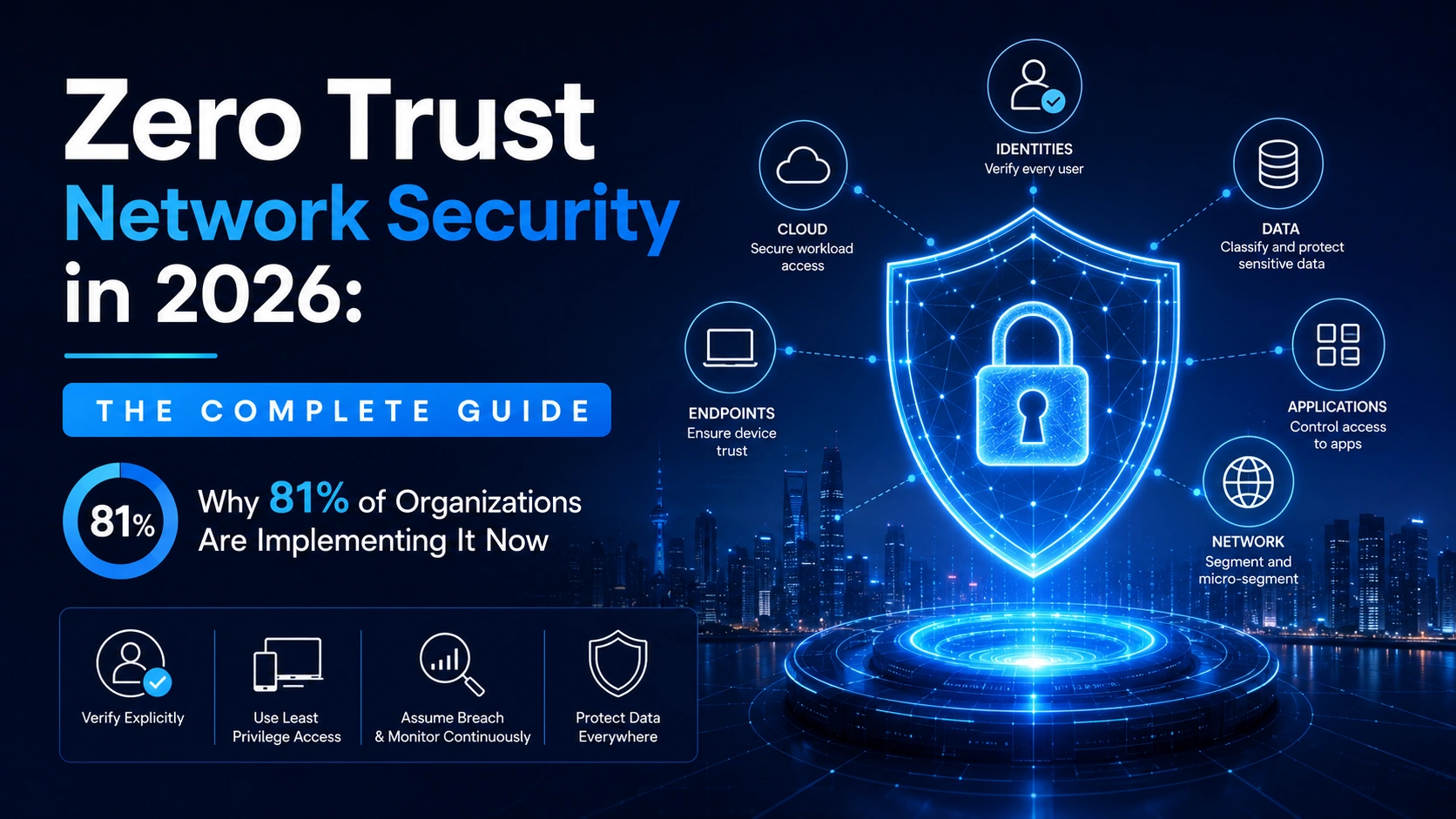
The Zero Trust Network Access market reached $59.89 billion in 2026. According to Zscaler's ThreatLabz 2026 VPN Risk Report, 81% of organizations plan to implement Zero Trust strategies within the next 12 months — and 65% are actively replacing VPN services right now. In 2025, 56% of organizations reported a breach directly exploited through VPN vulnerabilities. If you still run a traditional perimeter-based network, you are operating on a model attackers have already cracked.
The old security model had a name nobody called it at the time: the castle-and-moat approach. Build strong walls, dig a deep moat, install a drawbridge at the perimeter, and trust everyone who gets past the gates. That idea made sense when employees came to the office, used company desktops, and connected to on-premises servers. That world no longer exists.
Today, your employees connect from home networks, coffee shops, airports, and hotel rooms. Your applications live in AWS, Azure, Google Cloud. Your contractors access internal systems from laptops you have never touched. In 2025, 75% of breaches exploited legitimate credentials — not zero-day exploits, not exotic malware. Attackers stole valid usernames and passwords, then walked straight through the traditional perimeter.
Zero Trust was built specifically to stop this. Not by building a higher moat. By eliminating the assumption of trust entirely — even for users and devices already inside your network.

I've designed Zero Trust architectures for organizations ranging from 50-person startups to Fortune 100 enterprises, and the 2025–2026 transition has been the most decisive I've seen. The 81% implementation rate isn't aspirational anymore — it's reactive. I've personally been called in for three incident response engagements in 2025 where the root cause was identical: a VPN credential was compromised, and once inside the perimeter, the attacker had 5 to 10 days of unrestricted lateral movement before detection. Every one of those organizations is now implementing Zero Trust. The good news: the tools in 2026 are dramatically more accessible than they were five years ago. Cloudflare's free tier and Microsoft's bundled capabilities mean Zero Trust is no longer exclusively an enterprise initiative with a seven-figure budget. This guide is the one I wish I could hand to every CISO who's still waiting to start.
Quick Answer: Zero Trust in 2026
Zero Trust = never trust, always verify. Start with MFA (stops 99% of credential attacks), then add Cloudflare Access (free for 50 users) to replace VPN. Organizations with mature Zero Trust deployments save an average $1.76M per breach versus those without. Use TrustMyIP IP reputation as a real-time Zero Trust access signal.
1. What Is Zero Trust Network Security?
Zero Trust is a security framework built on one absolute principle: never trust, always verify.
Every Access Request Must Be:
1. Authenticated
Who are you? Proven identity, typically with multi-factor authentication
2. Authorized
Do you have permission for this specific resource? Least-privilege access only
3. Continuously Validated
Is your device clean? Is your behavior normal? Context is checked continuously, not just at login
❌ Traditional VPN (Old Model)
Authenticates you once at the perimeter and then trusts you with broad internal network access. Once a credential is stolen, an attacker has the same broad access as the legitimate user.
✅ Zero Trust (New Model)
Authenticates you continuously and grants access only to the specific application or resource you need at that specific moment — nothing else. No lateral movement possible.
The phrase originated with: John Kindervag, then a Forrester Research analyst, coined the term "Zero Trust" in 2010. The first real-world enterprise implementation at scale was Google's BeyondCorp project, built in response to Operation Aurora — a sophisticated 2010 nation-state cyberattack. Rather than build a higher wall, Google dismantled the perimeter entirely and rebuilt access around identity verification and device health rather than network location.
2. Why VPNs Are Failing in 2026 — The Data
56%
of organizations experienced a cybersecurity breach directly linked to VPN exploitation in 2025 (Zscaler ThreatLabz 2026)
75%
of breaches in 2025 exploited legitimate credentials — not zero-day exploits or exotic malware
65%
of organizations are actively replacing traditional VPN infrastructure with Zero Trust Network Access solutions in 2026
81%
of organizations plan to implement Zero Trust strategies within the next 12 months (Gartner 2026)
The Regulatory Driver
The U.S. National Institute of Standards and Technology (NIST) has released NIST SP 800-207, the official Zero Trust Architecture standard, and NIST SP 800-207A for cloud-native applications. The U.S. government issued a federal mandate requiring Zero Trust adoption across all federal agencies by 2024 — driving the entire enterprise market to follow. The European Union Agency for Cybersecurity (ENISA) has similarly mandated Zero Trust models for critical infrastructure protection across EU member states.
3. The 5 Pillars of Zero Trust — What You're Actually Implementing
Zero Trust is not a single product you buy — it is an architecture across five interconnected pillars:
The 5 Zero Trust Pillars
1Identity Verification — The New Perimeter
Identity is the new perimeter in Zero Trust: MFA for every session, adaptive authentication, SSO with centralized governance, PAM for administrative accounts, and machine identity management. Why it's the most important pillar: 75% of breaches exploit legitimate credentials. Hardening identity is the highest-ROI security investment available.
Key vendors: Okta, Microsoft Entra ID, Ping Identity, CyberArk (PAM), Duo Security (Cisco)
2Device Health and Posture
Zero Trust requires the device requesting access meets security standards. Device posture checks verify: OS version and patch level, endpoint protection software, disk encryption, screen lock and PIN, no known indicators of compromise, and MDM/UEM enrollment. A user presenting valid credentials from an unpatched device fails posture verification — regardless of valid credentials.
Key vendors: Microsoft Intune, Jamf, CrowdStrike Falcon, SentinelOne, Tanium
3Network Segmentation (Micro-Segmentation)
Traditional networks provide broad access once inside. Zero Trust networks are segmented at the application and workload level. Micro-segmentation means that a breach in one segment cannot propagate laterally — the compromise of a development server does not provide a pathway to the payroll system, customer database, or domain controller.
Key vendors: Zscaler Private Access, Illumio, Guardicore (Akamai), VMware NSX, Cisco Tetration
4Application Access Control (ZTNA)
ZTNA replaces VPN: users connect to a cloud proxy (not the network directly), the proxy validates identity and device posture, then creates an encrypted session to the specific application. Users never see the internal network. Attackers who compromise a user account cannot reach the network layer where ransomware spreads.
Key vendors: Zscaler Internet Access, Cloudflare Access, Palo Alto Prisma Access, Cisco Secure Access
5Data Classification and Protection
Zero Trust extends to data itself — ensuring sensitive data is classified, tagged, and subject to access controls that follow the data regardless of where it moves: DLP policies, classification of PII/financial/IP, encryption at rest and in transit, and access controls that follow data into cloud environments.
Key vendors: Varonis, Microsoft Purview, Forcepoint, Symantec DLP
4. The Best Zero Trust Solutions in 2026 — Company Comparison
Zscaler — Best Cloud-Native ZTNA
Zscaler Zero Trust Exchange is the market's most widely deployed cloud-native ZTNA solution. With over 150 data centers globally and purpose-built cloud architecture, Zscaler processes over 300 billion transactions daily.
Key Products
- →Zscaler Internet Access (ZIA): Secure web gateway + cloud firewall + SSL inspection
- →Zscaler Private Access (ZPA): ZTNA replacement for VPN — zero network access, application-only tunneling
- →Zscaler Digital Experience (ZDX): End-user experience monitoring
Pricing & Best For
Pricing: $$$. Enterprise SaaS licensing; starts at approximately $4–$7/user/month for ZIA Business tier; ZPA adds $4–$6/user/month.
Best for: Mid-to-large enterprises migrating from legacy VPN; organizations with heavy cloud workloads; regulated industries requiring comprehensive logging.
Okta — Best Identity-First Zero Trust
Okta is the identity pillar of Zero Trust — the platform that answers "who is this user?" with continuous, contextual verification. Okta serves over 19,000 customers globally.
Key Products
- →Okta Workforce Identity Cloud: SSO, MFA, lifecycle management
- →Okta Customer Identity Cloud (Auth0): For customer-facing applications
- →Okta Privileged Access: PAM capabilities for administrative accounts
- →Okta Identity Governance: Role-based access control, policy enforcement
Pricing & Best For
Pricing: Workforce Identity starts at $2/user/month (SSO) to $15+/user/month for full governance suite.
Best for: Organizations building identity-centric Zero Trust; companies with hybrid cloud environments; enterprises replacing Active Directory as the primary identity source.
CrowdStrike Falcon — Best Endpoint-Focused Zero Trust
CrowdStrike addresses the device health pillar of Zero Trust through its Falcon platform — ensuring that every endpoint requesting access meets security standards before access is granted. Named a Leader in the 2025 Gartner Magic Quadrant for Endpoint Protection Platforms for the fourth consecutive year.
✅ The Zero Trust Integration Play
CrowdStrike Falcon generates device health scores that integrate directly with ZTNA platforms (Zscaler, Cloudflare, Palo Alto). If a device's Falcon security score falls — because a threat was detected or a patch is missing — the ZTNA platform dynamically revokes or restricts access in real-time.
Pricing: Approximately $8.99–$15.99/device/month depending on tier. Best for: Organizations prioritizing endpoint security as the foundation of Zero Trust; enterprises needing real-time device posture integration with ZTNA.
Palo Alto Networks Prisma Access — Best Full-Platform ZTNA
Palo Alto Networks offers the most comprehensive platform approach to Zero Trust through Prisma Access — their cloud-delivered SASE (Secure Access Service Edge) platform. Prisma Access combines network security (ZTNA, SWG, FWaaS) and SD-WAN into a single cloud platform — SASE architecture.
- →Prisma Access: Cloud-delivered ZTNA + Secure Web Gateway + CASB
- →Prisma Cloud: Cloud-native application protection (CNAPP)
- →Cortex XSIAM: AI-driven security operations
- →Pricing: Enterprise pricing; typically $7–$14/user/month depending on tier.
Best for: Large enterprises wanting a single-vendor full-stack approach; organizations implementing SASE; companies with complex multi-cloud environments.
Microsoft — Best for Microsoft-Heavy Environments
Microsoft's Zero Trust capabilities are embedded across their existing enterprise stack — making them the default choice for organizations already invested in Microsoft 365 and Azure.
Key Components
- →Microsoft Entra ID: Identity and access management
- →Microsoft Conditional Access: Policy engine for Zero Trust decisions
- →Microsoft Intune: Device management and posture enforcement
- →Microsoft Defender XDR: Extended detection and response
✅ The Microsoft Advantage
Organizations already paying for Microsoft 365 E5 (~$57/user/month) have substantial Zero Trust capabilities included. The integration between Entra ID, Intune, and Defender creates a coherent Zero Trust stack without additional spend.
Best for: Organizations deeply invested in Microsoft 365 and Azure; SMBs and mid-market companies that want Zero Trust without dedicated security budget.
Cloudflare — Best Zero Trust for SMBs and Mid-Market
Cloudflare One is the most accessible enterprise-grade Zero Trust platform available in 2026, with a free tier for up to 50 users and competitive pricing for organizations of all sizes.
Key Components
- →Cloudflare Access: ZTNA — replaces VPN, proxies application access
- →Cloudflare Gateway: DNS security + Web filtering + DLP
- →Cloudflare WARP: Device agent for traffic inspection
- →Cloudflare Magic WAN: SD-WAN replacement for network connectivity
✅ The SMB Case
Cloudflare's free tier includes Zero Trust for up to 50 users — meaning small businesses can implement enterprise-grade Zero Trust architecture with no licensing cost. At $7/user/month for full Zero Trust suite, they're the clear choice for organizations under 500 employees.
Best for: SMBs and mid-market companies; startups; organizations looking for accessible entry into Zero Trust without enterprise pricing.
Cisco Secure Access — Most Complete Legacy Integration Path
Cisco offers the most comprehensive path for organizations transitioning from legacy Cisco infrastructure to Zero Trust: Duo Security (MFA), Cisco ISE (network access control), Cisco Umbrella (DNS security), and Cisco Secure Access (ZTNA).
The Cisco advantage: Organizations with existing Cisco networking infrastructure — routers, switches, firewalls — can implement Zero Trust as a layer on existing investment rather than replacing it. Cisco's 2026 SASE offering converges these components into a unified cloud platform. Best for: Large enterprises with existing Cisco investments; organizations requiring granular network access control; federal agencies and regulated industries.
5. Zero Trust Implementation — The Step-by-Step Roadmap
Zero Trust is not installed in a weekend — it is built iteratively. The NIST SP 800-207 implementation framework provides the recognized roadmap:
5-Phase Zero Trust Implementation (NIST SP 800-207)
1Define Your Protect Surface (Not Attack Surface)
Zero Trust inverts traditional security. Define what you're protecting first: Data (PII, financial records, IP), Applications (which apps process critical data), Assets (critical devices and workloads), and Services (essential network services). Document your protect surface explicitly — every Zero Trust control is designed to protect these specific assets.
2Map Transaction Flows
For every critical asset, document every legitimate flow of data: who accesses it (users, service accounts, partners), from what devices (managed, BYOD, vendor), from what locations (office, remote, third-party), and through what applications. Understanding legitimate traffic is the foundation for detecting anomalous traffic.
3Build Zero Trust Architecture Around Each Protect Surface
Starting with your highest-priority protect surface: implement MFA for all access, device posture verification, microsegmentation isolating the protect surface, ZTNA replacing VPN, and continuous monitoring and logging. Do not attempt enterprise-wide Zero Trust from day one. Start with your highest-risk, highest-value protect surface. Build confidence. Expand.
4Create Zero Trust Policy (The Kipling Method)
Develop access policies based on: Who — which verified users (identity pillar); What — which device posture is required; When — time-of-day conditions; Where — location signals; How — application-layer access controls; Why — business justification for access.
5Monitor, Maintain, and Mature
Zero Trust requires continuous improvement: log and analyze all access requests, detect anomalies in user and device behavior, review and tighten policies as understanding improves, and measure progress against NIST ZTA maturity model.
6. Zero Trust and IP Address Intelligence — The TrustMyIP Connection
IP address intelligence is a fundamental input to Zero Trust policy decisions. Here is precisely where IP intelligence integrates:
IP Reputation as a Zero Trust Signal
Your Zero Trust policy engine should incorporate IP reputation data as a real-time access control signal. A login attempt from a known malicious IP — regardless of valid credentials — should trigger elevated authentication requirements or automatic denial. TrustMyIP's Forensic Intelligence Scan provides exactly the signal ZTNA platforms need.
VPN Detection as a Zero Trust Control
Zero Trust policies may require that users not be connected through anonymizing proxies or VPNs when accessing sensitive systems — particularly for administrative access. Detecting VPN and proxy connections at the IP layer is a standard Zero Trust verification step.
Geolocation Consistency
Zero Trust platforms evaluate whether the user's claimed location matches their IP's geolocation. A user logging in from a US IP while their account shows a concurrent session from a foreign IP triggers impossible travel detection — a core Zero Trust signal.
Fraud Score Integration
High IP fraud scores can dynamically elevate authentication requirements — requiring step-up MFA even for users with valid session cookies when their current IP carries elevated fraud risk. Use TrustMyIP Fraud Score as a dynamic policy signal.
7. Zero Trust for Small Businesses — It Is Not Just for Enterprises
⚠️ The SMB Threat Reality
Ransomware groups deliberately target SMBs because their security posture is weaker than enterprises. The average ransomware payment in 2025 exceeded $2.73 million — an amount that threatens the survival of any small business. One successful VPN compromise is all it takes.
✅ Free Tier Options Exist
- ✓Cloudflare Zero Trust: Free for up to 50 users
- ✓Microsoft Entra ID Free: Basic SSO for cloud applications
- ✓Duo MFA Free: Up to 10 users at no cost
Where to Start With Limited Budget
1MFA First
Implement MFA on every account immediately — Microsoft Authenticator, Google Authenticator, or Duo Free. This single control stops 99% of credential-based attacks.
2Cloudflare Access
Replace VPN with Cloudflare Access for remote employees. Free tier covers most small teams. Takes a half day to implement.
3Device Management
Use Microsoft Intune (included in Microsoft 365 Business Premium) to enforce device policies — encryption, updates, screen lock.
4DNS Filtering
Cloudflare Gateway or NextDNS free tier blocks malicious domains before connections are established.
Five hundred dollars per year in Cloudflare and Microsoft subscriptions provides a Zero Trust architecture that would have cost $500,000 in enterprise licensing five years ago.
8. Zero Trust ROI — The Business Case
$4.88M
Average total cost of a data breach (IBM 2025)
$1.76M
Less per breach for organizations with mature Zero Trust deployment
258 days
Average time to identify and contain a breach without Zero Trust
Cyber Insurance Premium Impact
Cyber insurers increasingly require Zero Trust controls as a condition of coverage. Coalition, At-Bay, and Chubb Cyber all provide meaningful premium reductions — typically 10% to 20% — for organizations that can demonstrate Zero Trust maturity with documented MFA, device management, and privileged access controls.
9. Frequently Asked Questions
Is Zero Trust the same as ZTNA?
Zero Trust is the overarching framework and philosophy. ZTNA (Zero Trust Network Access) is one technical component — specifically the secure access mechanism that replaces VPN. Zero Trust also encompasses identity management, device health, network segmentation, data protection, and continuous monitoring. ZTNA is the plumbing; Zero Trust is the architecture.
How long does a Zero Trust implementation take?
A full enterprise Zero Trust transformation typically takes 2 to 5 years. However, the highest-value components — MFA, basic ZTNA replacing VPN, device posture checking — can be deployed in weeks. The NIST guidance is explicit: start with a single protect surface, demonstrate success, and expand. You do not need a 5-year plan to get material security improvement.
Can Zero Trust be implemented without replacing all existing infrastructure?
Yes. Most Zero Trust vendors are designed to integrate with existing infrastructure rather than replace it wholesale. Cloudflare Access, Okta, and Microsoft Zero Trust tools overlay existing networks. CrowdStrike integrates with existing identity providers. The practical approach is incremental addition, not wholesale replacement.
What is the difference between SASE and Zero Trust?
SASE (Secure Access Service Edge) is a network architecture framework introduced by Gartner that combines WAN (SD-WAN) and security (Zero Trust, SWG, CASB) into a single cloud-delivered service. Zero Trust is a security philosophy that can be implemented within SASE or independently. Palo Alto Prisma Access and Zscaler are both SASE platforms; Okta and CrowdStrike are Zero Trust point solutions.
Does Zero Trust eliminate the need for firewalls?
No — but it changes their role. In a Zero Trust architecture, firewalls shift from perimeter enforcement to internal micro-segmentation enforcement. East-west traffic (between internal systems) becomes the primary concern rather than north-south traffic (inbound/outbound). Next-generation firewalls from Palo Alto, Fortinet, and Check Point are integrated components of Zero Trust architectures.
Conclusion: The Perimeter Is Gone — The Verification Must Be Everywhere
The Zero Trust Network Access market reached $59.89 billion in 2026. Eighty-one percent of organizations are implementing it. Sixty-five percent are replacing their VPNs. The data breach statistics from organizations still running traditional perimeter security tell the cost of inaction with increasing clarity.
Zero Trust is not a product, a vendor, or a budget line. It is a commitment to verifying every access request, every time, with every available signal — regardless of where the request originates. In a world where credentials are the primary attack vector, where 75% of breaches exploit legitimate identity, and where the castle walls have demonstrably failed, continuous verification is the only rational security model.
Start Here — 6-Step Zero Trust Quick Win
- 1.Implement MFA on all email, remote access, and cloud applications
- 2.Add Cloudflare Access or Okta for Zero Trust application access
- 3.Verify device posture before granting access
- 4.Segment your most critical applications from the broader network
- 5.Monitor every connection through IP intelligence and fraud scoring
- 6.Each step measurably reduces your breach risk and the $4.88 million average cost that follows
The castle-and-moat model trusted the walls. Zero Trust trusts nothing — and verifies everything. Integrate TrustMyIP IP reputation intelligence into your Zero Trust policy engine, and explore our network security blog for the latest Zero Trust implementation guides and ZTNA comparisons.
*This article is for informational purposes only. Product features, pricing, and market statistics change frequently. Verify current specifications directly with vendors before making purchasing decisions.*
*Last updated: May 2026 | Data sourced from Zscaler ThreatLabz 2026 VPN Risk Report, Fortune Business Insights Zero Trust Security market analysis, Research and Markets ZTNA market data, NIST SP 800-207 Zero Trust Architecture standard, IBM Cost of a Data Breach Report 2025, and verified vendor product documentation*
Verify Every Access Request!
Add real-time IP intelligence to your Zero Trust policy engine. Catch malicious IPs, impossible travel, and fraud signals before they reach your network.