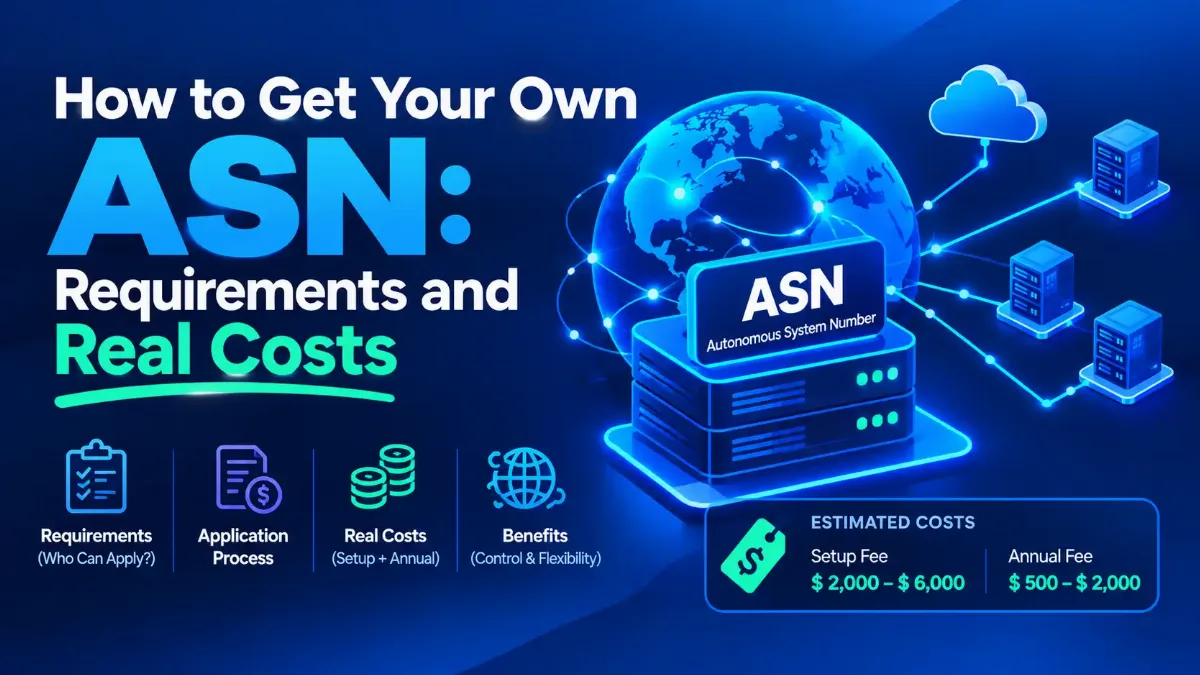
You can get your own AS number, and it is cheaper and easier than the internet tells you. What the guides tend to skip is that the rule you were warned about belongs to one registry, not all of them, and the registry you apply to is decided by where your organization is legally formed.
Learning how to get your own ASN is mostly learning which of five registries you are talking to. One of them hands out two of them free. One of them will not deal with an individual at all. One of them still wants the names and email addresses of two peering partners before it will consider you.
This is the five registries side by side, what each one really charges per year, what the application asks for, and the part the guides skip: the number is the cheapest thing you will need.

Quick Answer: Getting an AS Number
Where to Get Your Own ASN, and Why Your Region Decides
There is no central place to apply. Each of the five bodies that hand out AS numbers is a regional internet registry, and which one you deal with is decided by where your organization is legally formed, not where your servers sit. Get that wrong and the application stops before anyone reads it.
ARIN will issue a first number to any organization that asks for one. RIPE still wants two peering partners and a routing policy written in RPSL. Same resource, very different bar, and the registry with the friendliest policy is not the cheapest.
One honest gap before the table. LACNIC publishes its ASN policy and fee schedule only through a JavaScript-rendered site, and its own robots file blocks the PDF of its policy manual, so I could not read either. I am not going to print a LACNIC figure I could not find on a LACNIC page. If you are in that region, the policy manual section you want is the one on assignment of autonomous system numbers, and Brazil goes through Registro.br instead.
| Registry | What you must show | Who may hold one |
|---|---|---|
| ARIN | Nothing. A first number is issued on request | An organization only, and it must be legally formed inside the ARIN region |
| RIPE NCC | Multihoming, a routing policy in RPSL, and two peering partners with contact details | A member, or anyone through a sponsoring LIR, including a private individual |
| APNIC | Multihomed, or a need to interconnect with another AS. Either one qualifies | A member, or a non-member account holder |
| AFRINIC | Interconnection with more than one AS, or a unique routing policy, plus membership in good standing | LIRs, non-LIR members and non-members |
| LACNIC | Not verifiable from a LACNIC page | Not verifiable. Brazil applies through Registro.br as a national registry |
Before any of this is worth doing, it helps to be clear about what the thing being numbered actually is. The layer underneath all of this, explained without the autonomous systems covers addressing on its own terms, because an AS number identifies a network, not an address. Next, the rule that sends most people away before they apply.
Only One Registry Actually Requires Two Upstream Providers
Nearly every guide on how to get an ASN tells you a registry will not issue one until you have two upstream providers. That is true in one region and false in the others, and the confusion has an origin worth untangling, because it decides whether you bother applying at all.
Take ARIN first, because it is the registry most often described wrongly. Its current policy is one sentence: "Any organization may be issued a single Autonomous System Number (ASN) upon request." No justification, no upstreams, no routing policy document.
That replaced the old text in 2023 under a policy proposal named, with unusual candor, Remove Barrier to BGP Uptake in ASN Policy, adopted 18 July 2023.
Here is the part that gets misreported, and I want to be precise because I have seen it stated backwards. The old ARIN text asked you to verify "that it requires a unique routing policy, such as a plan" followed by three options joined by or: to originate announcements from an ASN different from your upstream's, to multihome a site, or to interconnect with other Autonomous Systems.
Read the first option again. A single-homed network announcing its own space from its own number satisfies it. So ARIN never required multihoming. What 2023 deleted was the paperwork, not a two-upstream bar, and anyone telling you ARIN used to demand multihoming is describing a rule that was not there.
The rule people are actually remembering is RIPE's, and it is very much alive. RIPE's current AS number policy document, ripe-679, dated 14 March 2017, says it in one line: "A network must be multihomed in order to qualify for an AS Number."
A proposal to soften it is moving but has not passed. RIPE proposal 2026-01, version 1.0 dated 7 July 2026, reached its review phase in September 2026 per the RIPE chair team, with an impact analysis next. The proposal page itself still shows the earlier phase, so check both.
Read what it would actually do, because it is not the giveaway it sounds like. It would let "legitimate holders of an IP address prefix assigned or allocated directly by the RIPE NCC" skip the justification. That swaps a multihoming test for a requirement that you already hold RIPE address space directly, which most small applicants do not.
APNIC settled this years ago and states it as a choice rather than a hurdle. Its eligibility rule is that an applicant qualifies if "it is currently multihomed, or it has the need to interconnect with another AS." Two ways in, and only one of them involves a second provider.
APNIC also adds a clause that solves the ordering problem. An applicant qualifies if it "can demonstrate that it will meet the above criteria upon receiving an ASN (or within a reasonably short time thereafter)." So you may apply before the upstream is live.
So a need test still exists at RIPE, APNIC and AFRINIC, and ARIN dropped its in 2023. I could not read LACNIC's, so I am not going to pretend I know it. Which brings us to money.
What It Costs, Every Year, For As Long As You Keep It
Two separate things get mixed up in every discussion of ASN registration. An AS number is a subscription rather than a purchase, and the figure quoted on most pages is a one-off registration fee that in some regions no longer exists.
Every figure below is from the registry's own fee schedule, with the date that schedule carries. Where two registries use different currencies I have left them alone rather than converting, because exchange rates date a page faster than anything else.
| Registry | To get it | To keep it, per year |
|---|---|---|
| APNIC, non-member | No charge for the number itself while you hold two or fewer. AUD 575 sign-up for the account | AUD 575 for an account with no chargeable resources. From three numbers, AUD 500 and AUD 100 a year per number allocated |
| ARIN | The issuance fee was scrapped, but a new organization pays USD 50 to create its Org ID first | USD 275 on the smallest plan tier, covering one to three numbers. USD 288.75 from January 2027 |
| AFRINIC | USD 400 once, per number. Half that for non-profit academic use, nothing for critical infrastructure | USD 50 membership if the number is your only resource |
| RIPE NCC, through a sponsoring LIR | Whatever that LIR charges. RIPE does not set it, and published rates start around 77 Swiss francs a year | The same fee, yearly, and the number stays tied to that LIR |
| RIPE NCC, as your own LIR | EUR 1,000 sign-up for a new LIR account | EUR 1,800 in 2026 plus EUR 50 for the number. EUR 1,894 in 2027 with the first number included |
| LACNIC | Not verifiable from a LACNIC page | Not verifiable from a LACNIC page |
The top row needs reading carefully, because it is better than it looks and worse than it sounds. APNIC charges non-members nothing for their first two AS numbers, in both the allocation fee and the annual fee, per its non-member fee schedule version 013 effective 6 March 2026.
The number is free. The account is not. A non-member account costs AUD 575 to open and, with no chargeable resources on it, AUD 575 a year, and AS numbers are excluded from what counts as chargeable.
So an ASN-only holder pays for the account and nothing for the number. Applicants from least-developed countries get half off.
Now the RIPE row, because it is being reported as good news and the arithmetic says otherwise. The 2027 charging scheme, published 11 September 2026, states that "the first ASN assignment registered to an LIR account is included in the annual fee." True. But the 2026 scheme charges EUR 1,800 a year plus EUR 50 for the number, which is EUR 1,850, and the 2027 annual fee is EUR 1,894.
So an LIR holding exactly one AS number pays forty-four euros more in 2027, not fifty less. A line item disappeared into a larger annual increase. That is not a scandal, it is just arithmetic worth doing before you repeat that RIPE made ASNs free.
One more catch in the same document, and it matters if you were planning the cheap route. "Sponsored ASN" remains a charged category in the 2027 scheme. The included-first-number change applies to LIR accounts, not to numbers held through a sponsoring LIR, which is exactly the path an individual would take.
One detail about the sponsoring route matters more than the price. The LIR satisfies RIPE on your behalf, so it asks you for what RIPE asks it for, and published requirement lists are blunt about the constraint that trips people up: your two upstreams must sit inside the RIPE service region, and one states they cannot be an hourly cloud provider. Two cheap virtual machines will not qualify you.
If part of your plan involves address space as well as a number, note that the two cost nothing like each other. Why the registries ran dry and what addresses now sell for covers the exhaustion timeline and the transfer market, and the short version is that the number is the trivial expense. Next, the question that decides which row above applies to you.
A Company or a Person, and Why ARIN Says No
This is the most-asked question on the topic and the answers online contradict each other flatly, because the answer genuinely differs by registry. One registry documents a path for a private individual. Another has just refused to create one.
ARIN is the strict one, and its own words are worth reading carefully: ARIN's "longstanding business practice is to require any organization requesting Internet number resources to be an active business entity legally formed within the ARIN service region." Note where that lives. It is a stated business practice, not a line in the policy manual, so a reader searching the policy text for it will never find it.
And this is settled rather than merely unaddressed. A policy proposal called Resource Issuance to Natural Persons asked ARIN to change exactly this, arguing that current policy "limits access for individuals who are running networks under their own legal name." It was abandoned on 26 August 2025.
RIPE goes the other way and puts it in a contract. The agreement behind a sponsoring LIR arrangement defines the End User as a "natural person or legal entity," and RIPE's own procedural document spells out the consequence: "If the End User is a natural person, the sponsoring LIR must submit the identification papers of the End User. This can be a passport, driving license or other official document proving the identity of the individual."
Be careful with how far that stretches, though. That sentence covers independent number resources generally rather than AS numbers by name, and an AS number is one of those resources, so the reading is sound but it is a reading rather than a quotation about ASNs specifically.
So the inversion worth holding on to: ARIN asks you for no justification at all but will not deal with you unless you are an incorporated entity in its region, while RIPE will deal with an individual holding a passport but wants two peering partners and a routing policy. The easy registry on paper is the hard one in practice for most people reading this. Which leads to the form itself.
What the Application Actually Asks You For
This is where most guides stop. What a registry asks in order to request an AS number is published in three cases out of five: two are specific about documents, one says almost nothing, one is unreadable.
RIPE is the most demanding and also the most transparent, which is a decent trade. Its supporting notes are specific: "You must provide at least two AS Numbers from your peering partners, their contact details (including email addresses) and the routing policy in Routing Policy Specification Language (RPSL)."
That last clause is the one people trip over. Not a description in prose. RPSL.
1 RIPE NCC tells you the fields, and screens you
2 ARIN publishes no field list at all
3 AFRINIC asks for a topology diagram
4 APNIC wants incorporation papers and a topology diagram
Three of the five publish a timetable. ARIN and APNIC give the figures above, and AFRINIC publishes step timings for a resource request of two working days for compliance checks and four for evaluation, though none of them are ASN-specific. RIPE NCC publishes no processing time for an AS number request anywhere I could find.
One pattern holds across all of them: the policy is published and the form mostly is not. Where a registry does publish its document list, read it first, because two want incorporation papers. Next, the part that decides whether any of this was worth doing.
The Number Is the Cheap Part, and the Easy Part
Before any of the above, a question most guides never put to you: do you need a globally unique number at all? If you connect through one provider and want to run BGP with them, a private AS number does that. It costs nothing and involves no registry.
Reserved ranges exist for exactly this purpose and our ASN lookup page lists them. A private number never appears in the global routing table, which is the point of it and also its limit: the moment you want a second upstream you need a real one. Settle that question before you pay anybody.
The commercial registration pages stop at the assignment. The practitioner write-ups do not, and they are right: the number is closer to a starting cost than a finish line. An AS number on its own routes nothing, and the things it needs alongside it are harder to get than the number was.
You need an upstream willing to run BGP with you. No registry supplies this, no policy mentions it, and it is the real gate. A provider who sells you transit is not obliged to accept your announcements, and a small operator who has not had that conversation before applying has done the steps in the wrong order.
My honest opinion, and it is the one thing I would say to anyone about to start: get the upstream conversation done first. The registry paperwork is a form. Finding someone to peer with you is a relationship, and it is the step that actually fails.
You also need address space, and it has to be large enough to survive filtering. The NLNOG BGP filter guide, which is the reference operators actually build filters from, states the floor plainly: "Routes smaller than a /24 (IPv4) or /48 (IPv6) should not be expected to have working global routing."
Its reasoning is not arbitrary. Filtering small prefixes "avoids more specific hijacks on /32's or small prefixes (targetted attacks)." Announce something smaller and much of the internet will simply decline to carry it, which makes an IPv6 /48 the realistic place to start for most people.
Then there is the permanent upkeep: route objects, RPKI signatures so other networks accept what you announce, and keeping your records current. None of it is hard. All of it is forever, and it does not stop when the assignment email arrives.
| What you need | Who supplies it | How hard it actually is |
|---|---|---|
| The AS number | Your regional registry | A form, and in two regions no justification at all. The easiest item on this list |
| An upstream willing to run BGP with you | Nobody. You have to find one | The real gate. No registry mentions it and no policy covers it |
| Address space you are allowed to announce | A registry, a transfer, or your upstream | Expensive for IPv4, routine for IPv6, and it must clear the filter floor |
| A router that speaks BGP | You, or a Linux box | Cheap. Software on ordinary hardware is enough to start |
| Route objects and RPKI signatures | You, through the registry portal | Not difficult, but permanent. Skip it and other networks may refuse your routes |
It is also worth understanding what having a number exposes. What your number tells every site you connect to shows how operators read AS numbers as a classification signal, and how an entire network gets shut out by that number covers what someone can do to you with one line of firewall configuration. Both are worth reading before you become a number. One last thing that catches people.
Numbers That Sit Unused Get Taken Back
The plan of getting a number now and using it later is a specific mistake, and at least one registry has an active process for exactly that situation.
RIPE runs a clean-up against numbers that never appear in the routing table, and publishes the scale of it: "There are currently around 6,600 ASNs in our service region that are not being advertised in the routing system." The emails to holders began in June 2017, so this is long-running practice rather than a new crackdown.
The process has clear timings. If there is no reply within a month of the first email, deregistration starts, and "this takes three months, during which time LIR can still indicate if the AS Number is needed." You keep it if you plan to start using it within three months, and return it if not.
There is a second version of the same risk if you took the cheap route. A number held through a sponsoring LIR depends on that arrangement continuing, and the sponsoring LIR agreement is what holds it. If the agreement ends, the resource can be reassigned to someone else, which means your AS number has a counterparty you did not think of as one.
So the sequence that actually works runs backwards from the usual advice. Line up the upstream, know which address space you will announce, then apply. Check what a number is announcing, and whether that matches what you intended once it is live, because a number announcing nothing is the state the clean-up process is looking for.
What I Would Do, By Situation
My position, stated plainly
This subject is full of confidently repeated rules that belong somewhere else. So learning how to get your own ASN is mostly reading one registry's own documents rather than a summary of all five, then checking the date on what you read. These rules move. The pages describing them mostly do not.
Two things worth reading first. What a slash twenty-four actually means, bit by bit covers the notation those filter rules are written in, and testing whether an address sits inside the block you think it does is the check to run before handing a prefix to anyone.