You see 10.5.20.1 on one network and 192.168.1.1 on another. Your networking textbook mentions "Class A" and "Class C" addresses. Network documentation references 172.16.0.0 as "Class B private." These classifications seem arbitrary and confusing.
Learning about IP address classes A B C D E explained with examples reveals the historical system that organized the internet's address space from 1981 to 1993. Understanding IP address classes helps you grasp networking fundamentals, recognize private IP ranges, troubleshoot legacy systems, and appreciate why modern CIDR replaced classful addressing.
This comprehensive guide explains what are IP address classes, shows you how to identify IP address class from the first octet, provides detailed breakdowns of Class A IP address, Class B IP address, Class C IP address, Class D IP address, and Class E IP address with real-world examples, reveals the difference between Class A B C in terms of network size, teaches IP address classification using binary patterns, and explains why classful addressing is obsolete but still referenced today—all using visual comparison tables, calculation formulas, and practical network scenarios.

"After analyzing thousands of network configurations, I still encounter legacy systems using IP address classes for documentation. While classful addressing became obsolete in 1993, understanding Class A, B, and C distinctions remains essential for network certifications, troubleshooting older equipment, and recognizing private IP ranges that still follow class boundaries."
Quick Answer
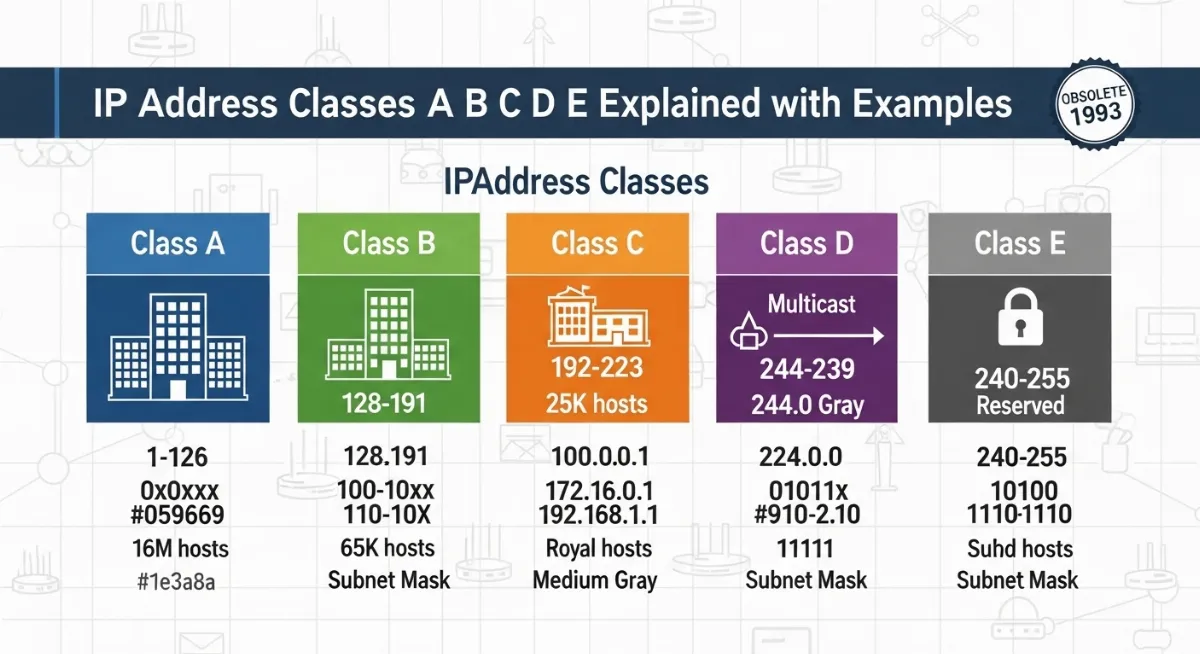
IP address classes A B C D E explained: Classful addressing divided IPv4 addresses into five categories based on the first octet. Class A (1-126) provided 126 networks with 16 million hosts each for large organizations. Class B (128-191) offered 16,384 networks with 65,534 hosts each for mid-size companies. Class C (192-223) gave 2 million networks with 254 hosts each for small businesses. Class D (224-239) handled multicast addressing. Class E (240-255) was reserved for experiments. Each class had distinct binary patterns, default subnet masks, and network ID/host ID splits. Modern networks use CIDR instead, but classes still appear in certifications and documentation.
1. What Are IP Address Classes? Understanding Classful Addressing
IP address classes represent a historical IP address classification system that organized IPv4's address space into five distinct categories. Classful addressing operated from 1981 (RFC 791) until 1993, when CIDR replaced it.
The Internet Engineering Task Force (IETF) created IP address classes to allocate addresses efficiently based on organization size. Each class served different network sizes—from massive corporations needing millions of addresses to tiny offices needing just a few.
IP address classes explained: The system divided the entire IPv4 address space (4.3 billion addresses) into five classes identified by examining the first octet's binary pattern. This simple classification allowed routers to quickly determine network size without complex calculations.
The Five Classes Overview
What are IP address classes specifically? Five distinct categories existed:
Class A: Mega networks (1-126 in first octet) for massive organizations—126 networks supporting 16+ million hosts each
Class B: Large networks (128-191 in first octet) for mid-size companies—16,384 networks supporting 65,534 hosts each
Class C: Small networks (192-223 in first octet) for small businesses—2+ million networks supporting 254 hosts each
Class D: Multicast addresses (224-239 in first octet) for one-to-many communication—no traditional network/host split
Class E: Reserved/experimental (240-255 in first octet)—reserved for future use, never deployed publicly
Why Classful Addressing Was Created
In 1981, the internet had only thousands of connected devices. Classful addressing provided a simple allocation method: huge organizations got Class A blocks, medium organizations got Class B, small organizations got Class C.
This simplicity came with massive waste. A company needing 300 devices had to take an entire Class B block (65,534 addresses), wasting 65,234 addresses. By the early 1990s, this wastefulness threatened IPv4 address exhaustion.
Why classful addressing is obsolete: In 1993, CIDR (Classless Inter-Domain Routing) replaced classes with flexible subnetting using slash notation (/24, /16, etc.). Networks could now receive exactly the addresses they needed. The shift also coincided with the development of IPv6—explore the technical differences between IPv4 and IPv6 in our IPv4 vs IPv6 comparison guide. However, classes remain relevant for understanding private IP ranges and appear frequently in networking certifications. Learn the basics in our IP address fundamentals guide.
2. How to Identify IP Address Class Instantly
How to identify IP address class: Examine only the first octet (first number before the first period). The first octet range immediately reveals which class an address belongs to.
How to determine IP address class using this simple method works for any IPv4 address you encounter in network configurations, documentation, or troubleshooting scenarios.
Quick Identification Table
| Class | First Octet Range | Binary Pattern | Default Subnet Mask |
|---|---|---|---|
| Class A | 1 - 126 | 0xxxxxxx | 255.0.0.0 |
| Class B | 128 - 191 | 10xxxxxx | 255.255.0.0 |
| Class C | 192 - 223 | 110xxxxx | 255.255.255.0 |
| Class D | 224 - 239 | 1110xxxx | N/A (Multicast) |
| Class E | 240 - 255 | 1111xxxx | N/A (Reserved) |
Practical Identification Examples
Let's practice how to determine IP address class with real addresses:
10.5.20.100 → First octet = 10 → Between 1-126 → Class A IP address
172.16.50.1 → First octet = 172 → Between 128-191 → Class B IP address
192.168.1.1 → First octet = 192 → Between 192-223 → Class C IP address
224.0.0.5 → First octet = 224 → Between 224-239 → Class D (multicast)
240.100.50.1 → First octet = 240 → Between 240-255 → Class E (reserved)
3. Class A IP Address: Complete Breakdown
Class A IP address represents the largest networks in classful addressing. Class A IP address range spans from 1.0.0.0 to 126.255.255.255.
These mega-networks were designed for the world's largest organizations—massive corporations, governments, and research institutions needing millions of device addresses within a single network.
Class A Technical Specifications
Binary pattern: Class A addresses always start with binary 0 in the first octet. Pattern: 0xxxxxxx where x can be 0 or 1.
Class A subnet mask: 255.0.0.0 (or /8 in CIDR notation). This default subnet mask dedicates the first octet to network ID, leaving three octets for host ID.
Network ID: Only the first octet identifies the network. Example: In 10.5.20.100, the network ID is 10.
Host ID: The last three octets identify devices. Example: In 10.5.20.100, the host ID is 5.20.100.
How many networks in Class A: 126 total networks (addresses 0.x.x.x and 127.x.x.x are reserved—0 for special routing, 127 for loopback address).
Hosts per network: 16,777,214 usable addresses per network. Calculation: 2^24 (three octets = 24 bits) - 2 (network address and broadcast address) = 16,777,214.
Class A IP Address Examples
Real-World Class A Examples
Example 1: 10.0.0.1
Network: 10.0.0.0/8 | Network ID: 10 | Host ID: 0.0.1 | Class A private range
Example 2: 45.128.50.200
Network: 45.0.0.0/8 | Network ID: 45 | Host ID: 128.50.200 | Public Class A
Example 3: 12.100.75.250
Network: 12.0.0.0/8 | Network ID: 12 | Host ID: 100.75.250 | Public Class A
Private Range: 10.0.0.0/8 (entire 10.x.x.x range)
Used by: Large corporate networks, data centers, cloud providers
Class A Network Examples in Practice
Class A network examples from real organizations:
• IBM historically held multiple Class A blocks (e.g., 9.0.0.0/8)
• U.S. Department of Defense controlled numerous Class A ranges
• Major ISPs like Level 3 Communications operated Class A networks
• The entire 10.0.0.0/8 private range serves corporate intranets worldwide
Most Class A public addresses were allocated to organizations before 1993. Today, private Class A range 10.0.0.0/8 remains the most common for large enterprise networks. Check your network's address with our IP address checker.
4. Class B IP Address: Mid-Size Network Detailed Analysis
Class B IP address served mid-size organizations needing more than 254 hosts but fewer than 16 million. Class B IP address range extends from 128.0.0.0 to 191.255.255.255.
Universities, regional ISPs, mid-size corporations, and government agencies typically received Class B allocations—networks supporting thousands to tens of thousands of devices.
Class B Technical Specifications
Binary pattern: Class B addresses always start with 10 in the first octet. Pattern: 10xxxxxx where x can be 0 or 1.
Class B subnet mask: 255.255.0.0 (or /16). This default subnet mask uses the first two octets for network ID, leaving two octets for host ID.
Network ID: First two octets identify the network. Example: In 172.16.50.10, the network ID is 172.16.
Host ID: Last two octets identify devices. Example: In 172.16.50.10, the host ID is 50.10.
Total networks: 16,384 Class B networks available (2^14 = 16,384 possible combinations in the variable bits).
How many hosts in Class B: 65,534 usable addresses per network. Calculation: 2^16 (two octets = 16 bits) - 2 = 65,534.
Class B IP Address Examples
Class B IP address example addresses:
172.16.0.1 → Network: 172.16.0.0/16 | Private Class B range
150.100.50.25 → Network: 150.100.0.0/16 | Public Class B
180.25.100.200 → Network: 180.25.0.0/16 | Public Class B
191.255.1.50 → Network: 191.255.0.0/16 | Public Class B (last Class B network)
Class B Network Examples
Class B network examples from actual deployments:
• Universities: MIT, Stanford used Class B ranges for campus-wide networks
• Regional ISPs: Operated Class B networks serving thousands of customers
• Mid-size corporations: Companies with 1,000-50,000 employees typically got Class B
• The 172.16.0.0/12 private range (172.16.x.x through 172.31.x.x) serves mid-size company networks
Class B addresses were most coveted—large enough for substantial growth but not wastefully huge like Class A. By the late 1980s, Class B exhaustion drove the development of CIDR. Learn about private ranges in our public vs private IP guide.
5. Class C IP Address: Small Network Deep Dive
Class C IP address designed networks for small organizations needing fewer than 254 devices. Class C IP address range runs from 192.0.0.0 to 223.255.255.255.
Small businesses, branch offices, and early ISP customers received Class C blocks—perfect for offices with dozens to hundreds of computers.
Class C Technical Specifications
Binary pattern: Class C addresses start with 110 in the first octet. Pattern: 110xxxxx where x can be 0 or 1.
Class C subnet mask: 255.255.255.0 (or /24). This default subnet mask dedicates the first three octets to network ID, leaving only one octet for host ID.
Network ID: First three octets identify the network. Example: In 192.168.1.100, the network ID is 192.168.1.
Host ID: Only the last octet identifies devices. Example: In 192.168.1.100, the host ID is 100.
Total networks: 2,097,152 Class C networks (2^21 = 2,097,152 possible combinations).
Hosts per network: Only 254 usable addresses per network. Calculation: 2^8 (one octet = 8 bits) - 2 = 254.
Class C IP Address Examples
Class C IP address example addresses you encounter daily:
192.168.1.1 → Network: 192.168.1.0/24 | Most common home router address | Private Class C
192.168.0.100 → Network: 192.168.0.0/24 | Common home network | Private Class C
200.50.25.10 → Network: 200.50.25.0/24 | Public Class C
223.255.255.254 → Network: 223.255.255.0/24 | Last Class C network
Class C Network Examples
Class C network examples dominate modern networks:
• Home networks: Nearly all residential routers use 192.168.x.x private Class C ranges
• Small offices: Branch offices with 10-200 employees typically deploy Class C networks
• Early internet: Small ISPs and organizations received public Class C blocks
• The entire 192.168.0.0/16 private range (192.168.0.x through 192.168.255.x) comprises 256 Class C networks
Class C addresses represent the most commonly seen IP address class today. Even though classful addressing ended in 1993, home networks continue using /24 subnets that match original Class C sizing. Calculate network capacity with our subnet calculator.
6. Class D IP Address: Multicast Addressing Explained
Class D IP address serves a completely different purpose than Class A, B, or C. Class D multicast range spans 224.0.0.0 to 239.255.255.255.
Multicast addressing enables one-to-many communication—a single source sending data to multiple receivers simultaneously without creating separate streams for each recipient.
Class D Technical Specifications
Binary pattern: Class D addresses start with 1110 in the first octet. Pattern: 1110xxxx.
No subnet mask: Class D doesn't use the network ID/host ID concept or subnet masks. The entire address identifies a multicast group.
Usage: Streaming protocols, video conferencing, IPTV, routing protocols (OSPF, RIP), and any application needing efficient one-to-many distribution.
Class D Examples and Applications
Common Class D multicast addresses:
• 224.0.0.1 - All hosts on local network segment
• 224.0.0.2 - All routers on local network segment
• 224.0.0.5 - OSPF routing protocol
• 224.0.0.9 - RIP version 2 routing protocol
• 239.x.x.x - Organization-specific multicast (administratively scoped)
Class D remains actively used today for efficient video streaming, online gaming, stock ticker updates, and network protocol communications. Unlike Classes A-C, Class D never became obsolete because multicast addressing serves a unique, irreplaceable function.
7. Class E IP Address: Reserved for Experiments
Class E IP address represents the most mysterious and rarely-seen class. Class E reserved range covers 240.0.0.0 to 255.255.255.254.
Originally reserved for future use and experimental purposes, Class E addresses never saw public deployment and remain largely unused.
Class E Technical Specifications
Binary pattern: Class E addresses start with 1111 in the first octet. Pattern: 1111xxxx.
Status: Reserved by IETF (Internet Engineering Task Force) for experimental use only. Most operating systems and routers reject Class E addresses as invalid.
Special address: 255.255.255.255 within Class E serves as the limited broadcast address—packets sent here broadcast only on the local network segment.
Class E holds historical significance but no practical use. With IPv4 exhaustion, some proposed reclaiming Class E for public use, but the effort required to update worldwide infrastructure proved impractical. IPv6 adoption remains the long-term solution.
8. Special IP Address Ranges Within Classes
Certain IP address ranges within classes serve special purposes defined by networking standards. Understanding these reserved IP ranges prevents configuration errors.
Loopback Address Range
Loopback address range 127.0.0.0/8 (entire 127.x.x.x range) falls within Class A but serves special purposes.
The most famous loopback address is 127.0.0.1 ("localhost"). Traffic sent here never leaves your computer—it loops back internally for testing network software.
Private IP Addresses in Classes
Private IP addresses in classes defined by RFC 1918:
Class A private: 10.0.0.0/8 (10.0.0.0 through 10.255.255.255) - One massive private network
Class B private: 172.16.0.0/12 (172.16.0.0 through 172.31.255.255) - 16 contiguous Class B networks
Class C private: 192.168.0.0/16 (192.168.0.0 through 192.168.255.255) - 256 Class C networks
Every public IP address — whether it falls within a former Class A, B, or C range — carries a reputation score that influences how websites, email servers, and security systems treat traffic from that address. Learn how this scoring works in our guide on what is an IP reputation score.
9. Complete Class Comparison and Why Classful Addressing Ended
Difference between Class A B C primarily involves network scale. Class A provided few massive networks, Class C provided many tiny networks, Class B balanced between extremes.
Complete Class Comparison Table
| Class | Range | Networks | Hosts/Network | Usage |
|---|---|---|---|---|
| A | 1.0.0.0 - 126.255.255.255 | 126 | 16,777,214 | Massive corps |
| B | 128.0.0.0 - 191.255.255.255 | 16,384 | 65,534 | Universities |
| C | 192.0.0.0 - 223.255.255.255 | 2,097,152 | 254 | Small business |
| D | 224.0.0.0 - 239.255.255.255 | N/A | N/A | Multicast |
| E | 240.0.0.0 - 255.255.255.254 | N/A | N/A | Reserved |
Why Classful Addressing Failed
Why classful addressing is obsolete: Three critical failures doomed the system.
Problem 1 - Massive waste: Organizations needing 300 addresses had to take an entire Class B (65,534 addresses), wasting 65,234. Companies needing 5,000 addresses couldn't fit in Class C (254 hosts) but wasted 11,000+ addresses with Class B.
Problem 2 - Rapid exhaustion: By 1990, Class B addresses were nearly depleted. The rigid class system couldn't adapt to actual needs.
Problem 3 - Routing table explosion: Class C networks created millions of individual routing entries, overwhelming internet routers.
Classful vs Classless Addressing
Classful vs classless addressing represents the shift from rigid to flexible IP allocation.
Classful (1981-1993): Fixed network sizes. You got 16 million, 65,000, or 254 addresses—no middle ground.
Classless (CIDR, 1993-present): Flexible subnetting. Networks can be any size: /25 (126 hosts), /23 (510 hosts), /20 (4,094 hosts), etc.
Modern networks use CIDR exclusively. However, understanding IP address classes remains valuable for networking certifications (CCNA, Network+), legacy documentation, and recognizing that private IP ranges still follow class boundaries. Learn modern subnetting with our CIDR calculator.
Conclusion: Understanding IP Address Classes Today
Learning IP address classes A B C D E explained with examples provides essential networking foundation even though classful addressing ended three decades ago. IP address classification knowledge appears throughout networking certifications, legacy documentation, and troubleshooting scenarios.
IP address classes explained summary: Class A (1-126) provided 126 mega-networks with 16+ million hosts each, Class B (128-191) offered 16,384 mid-size networks with 65,534 hosts each, Class C (192-223) gave 2+ million small networks with 254 hosts each, Class D (224-239) handled multicast addressing, and Class E (240-255) remained reserved.
How to identify IP address class: Simply examine the first octet. Values 1-126 indicate Class A, 128-191 indicate Class B, 192-223 indicate Class C, 224-239 indicate Class D multicast, and 240-255 indicate Class E reserved addresses. This quick identification method works instantly for any IPv4 address.
Class A subnet mask (255.0.0.0 or /8) dedicated one octet to network, three to hosts. Class B subnet mask (255.255.0.0 or /16) split evenly—two octets network, two octets hosts. Class C subnet mask (255.255.255.0 or /24) used three octets for network, one for hosts. These default subnet masks defined the rigid network portion and host portion splits.
Private IP addresses in classes remain relevant today: Class A private range 10.0.0.0/8 serves large enterprise networks, Class B private range 172.16.0.0/12 fits mid-size deployments, and Class C private range 192.168.0.0/16 dominates home and small office networks. These ranges still follow original class boundaries despite CIDR replacement.
Classful addressing examples demonstrate the system's limitations: A university needing 10,000 addresses received Class B (65,534), wasting 55,000+ addresses. A company needing 500 addresses had to use two Class C blocks (508 total), complicating management. Why classful addressing is obsolete: This inflexibility wasted addresses and accelerated IPv4 exhaustion.
Classful vs classless addressing contrasts rigid (classes) versus flexible (CIDR) allocation. Modern CIDR allows precise network sizing—/25 (126 hosts), /22 (1,022 hosts), /19 (8,190 hosts)—eliminating waste. Networks of any size can now receive appropriate address blocks without the constraints that doomed classful addressing. Once you understand IP address classes, the natural next step is knowing how to change your IP address when needed — our complete guide covers how to change your IP address on any device.
Master IP address classes for certifications and historical understanding, but implement CIDR for actual networks: Check your address class with our IP address checker, analyze network structure with our IP lookup tool, calculate modern subnets with our subnet calculator, generate practice addresses with the random IP generator, and work with flexible CIDR blocks using our CIDR calculator. Understanding how IP address classification evolved from rigid classes to flexible CIDR makes you a more knowledgeable network professional. Learn format fundamentals in our IP address format guide.
Check Your IP Address Class Now!
Instantly identify which class your IP address belongs to, analyze network structure, and calculate subnet details with our professional networking tools.