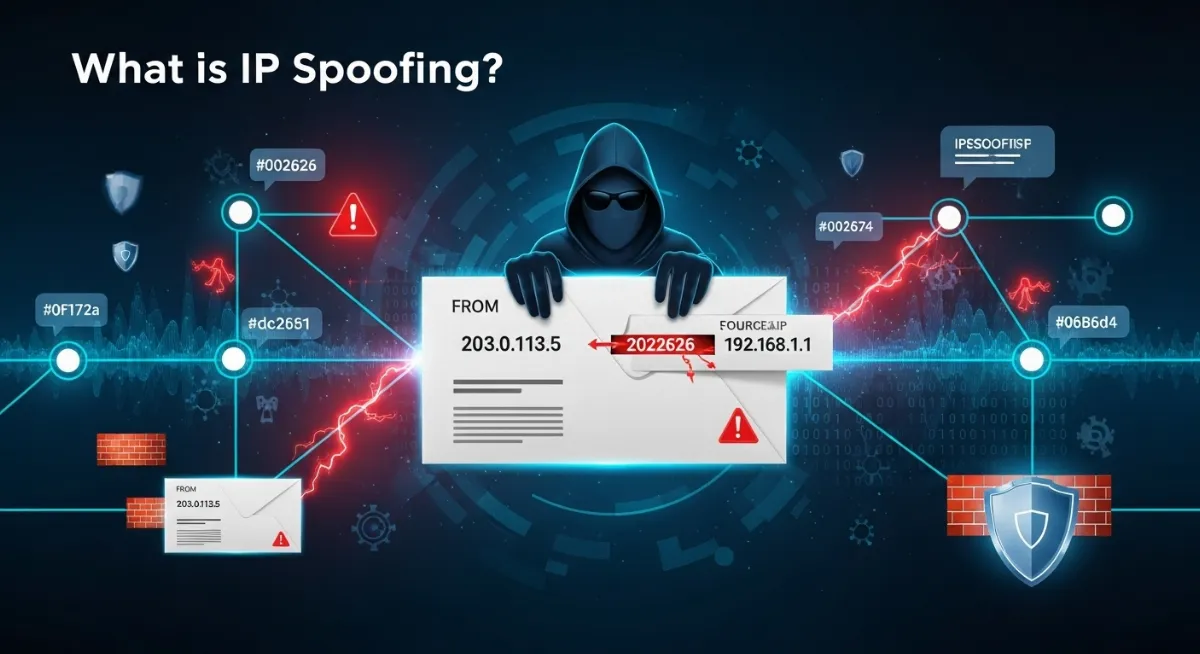
Your server receives millions of requests in minutes. Traffic floods in from what looks like thousands of legitimate IP addresses. Systems buckle. By the time your team identifies it as an IP spoofing attack, the damage is already done — and the attacker's real identity stays hidden behind forged packet headers, which is exactly what makes this attack category so hard to trace.
Understanding what is IP spoofing is the difference between a network that absorbs an attack and one that goes down for days. IP address spoofing is a network-layer technique where threat actors forge the source IP address in IP packets to impersonate trusted sources, slip past authentication checks, or fuel distributed denial of service campaigns large enough to take down entire networks.
This is a fundamentally different problem from IP fraud detection, which flags suspicious IP reputation built up over time. IP spoofing operates one layer lower, where forged packet headers masquerade as legitimate traffic before any reputation check ever runs. Hackers use IP spoofing to run man-in-the-middle attacks, coordinate botnet traffic, hijack sessions, and overwhelm servers with malicious traffic — all while concealing where the traffic is really coming from.
This guide covers exactly how does IP spoofing work at the protocol level, how to detect IP spoofing using packet filtering and network monitoring, real, verified IP spoofing examples — including the largest DDoS attack ever recorded, from just last year — and proven IP spoofing prevention strategies covering ingress filtering, egress filtering, firewall protection, and intrusion detection systems.

"The most dangerous misconception about IP spoofing is assuming a standard firewall catches it automatically. It doesn't, not without specific configuration — IP spoofing operates at OSI model Layer 3, where packet headers get forged before traffic ever reaches most application-layer security tools.
What's changed recently is scale: the record for the largest DDoS attack ever recorded was broken again in 2025, and the trend line only points toward larger, more automated attacks using compromised consumer devices. Without ingress filtering, egress filtering, and proper packet filtering in place before an attack starts, a network has no real way to tell forged traffic from legitimate traffic in real time — waiting until afterward means the damage is already done."
Quick Answer: What is IP Spoofing?
IP spoofing (also called IP address spoofing) is a cyber attack technique where attackers create IP packets with forged source IP addresses to hide their identity, impersonate trusted sources, or bypass security measures. Threat actors manipulate the packet header — the section containing routing details — replacing the real sender's IP address with a fake one, so spoofed packets appear legitimate to receiving systems. How does IP spoofing work? At the network layer (Layer 3 of the OSI model), attackers intercept outgoing IP packets and modify the IP header fields before transmission.
The receiving server trusts the forged source IP address, accepting malicious traffic as if it came from an authorized source. IP spoofing attacks enable DDoS attacks, man-in-the-middle attacks, session hijacking, botnet campaigns, and authentication bypass. How to detect IP spoofing? Use packet filtering, ingress filtering, egress filtering, and intrusion detection systems to identify TTL inconsistencies and validate source addresses against access control lists.
1. What is IP Spoofing? The Complete Technical Breakdown
IP spoofing is a network layer attack technique where attackers forge the source IP address in IP packet headers to deceive receiving systems about a packet's true origin. This manipulation happens at the most fundamental level of internet communication — the TCP/IP protocol that governs how data moves across every network on the internet.
When your computer sends data, that information gets divided into IP packets — small chunks, each containing a packet header and a payload. The packet header carries the routing information: the source IP address (where the packet claims to originate), the destination address, packet length, protocol type, and other TCP/IP metadata.
Threat actors intercept outgoing packets before they leave their system and rewrite the source IP address field in the IP header. The receiving server reads this forged source address and treats the packet as if it came from that address, with no way to independently verify the real sender. This is fundamentally different from IP fraud detection, which analyzes reputation patterns built up over time rather than forgery at the packet level — see our guide on IP reputation scores versus IP fraud for that distinction.
Why IP Spoofing Works: The TCP/IP Vulnerability
The Inherent Design Flaw in Internet Protocol
No Built-in Authentication: The TCP/IP protocol was designed decades ago for trusted academic networks. It never included source address validation — systems accept packet headers at face value without verifying the sender's true identity.
Outgoing Traffic Lacks Filtering: Most networks never examine outgoing packets. If a system sends IP packets with forged source addresses, they flow freely onto the internet unless egress filtering is specifically configured to stop them — and most networks never implement it.
Layer 3 Blind Spot: IP spoofing operates at the network layer (OSI model Layer 3). Application-layer firewalls never see the forgery, because the hardware accepts the packet before that inspection layer runs.
Stateless Protocol Weakness: Each IP packet travels independently. Servers can't correlate packets to verify consistency, so spoofed packets mixed with legitimate traffic become indistinguishable without deep packet filtering analysis.
This architectural gap makes IP address spoofing nearly impossible to eliminate at the protocol level alone. IPv6 was designed with stronger security features, but IPv4 still carries the bulk of internet traffic, and IP spoofing remains viable on both. The IETF's own best-practice guidance — BCP 38, published as RFC 2827 in May 2000, later extended by RFC 3704 (BCP 84) for multihomed networks — has existed for over two decades specifically to address this gap, which tells you how long the industry has known about it without fully closing it: IETF RFC 2827 (BCP 38).
2. How Does IP Spoofing Work? Attack Execution Process
IP spoofing attacks follow a systematic process that exploits the lack of source address validation across internet infrastructure. Understanding each step reveals why traditional security measures often fail to catch these attacks before damage occurs.
Step 1 — Network Reconnaissance: Attackers scan target networks to identify open ports, active IP addresses, and trusted sources the network already accepts. Tools like Nmap or ARP scans reveal which addresses have established trust relationships with the target. You can check your own exposure to this kind of scanning with our port scanner tool.
Step 2 — Packet Interception and Modification: Threat actors intercept outgoing IP packets and replace the real source IP address with a forged one — a random address (blind spoofing), a trusted source address (non-blind spoofing), or the target's own address (reflection attacks). This is the exact point where IP spoofing diverges from IP fraud: fraud detection watches behavior over time, while spoofing forges individual packet headers in real time.
Types of IP Spoofing Techniques
| Spoofing Type | How It Works | Attack Purpose |
|---|---|---|
| Blind Spoofing | Attacker sends spoofed packets without seeing responses, using random source addresses | DDoS attacks, overwhelming targets with volume |
| Non-Blind Spoofing | Attacker on the same subnet intercepts responses, using trusted source addresses | Authentication bypass, session hijacking |
| Reflection Attack | Uses the victim's IP address as the source, so third-party servers flood the victim with responses | Amplification attacks, volumetric DDoS |
| Man-in-the-Middle | Spoofs both endpoints of a connection, intercepting traffic between two parties | Data theft, traffic manipulation, credential harvesting |
| Application-Layer Spoofing | Forges client-supplied headers like X-Forwarded-For rather than raw packet headers | Bypassing rate limiting and IP-based access controls |
| Botnet Masking | Uses compromised devices to send spoofed packets from thousands of distributed sources | Large-scale distributed denial of service |
Worth calling out directly: that fifth row, application-layer spoofing, is a distinct and increasingly common category. It doesn't forge the actual IP packet header the way classic spoofing does — instead, it exploits applications that trust client-supplied HTTP headers like X-Forwarded-For to identify a visitor's "real" IP for rate limiting or access control. Section 3 covers a real, documented example of exactly this.
Step 3 — Packet Transmission: Modified packets travel across the internet through normal routing. Intermediate routers forward packets based on destination address without validating the source IP. Unless networks implement ingress filtering (checking incoming packets) or egress filtering (checking outgoing packets), spoofed packets flow freely.
Step 4 — Target Processing: The target server receives spoofed packets and processes them as legitimate. From here, outcomes diverge: DDoS attacks overwhelm with volume, man-in-the-middle attacks intercept responses, and authentication bypass attacks gain access to systems that trusted the spoofed address. Analyze your own incoming traffic patterns with our HTTP headers analyzer.
3. Real-World IP Spoofing Examples: Verified Incidents
IP spoofing attack examples from recent years show the real scale of the problem — and the trend is toward bigger, not smaller. Every example below is independently verifiable and correctly dated, because getting the specifics wrong on real, named incidents does a disservice to anyone trying to learn from them.
Cloudflare's Record 29.7 Tbps Attack (Q3 2025): The largest distributed denial of service attack ever publicly reported hit Cloudflare's network in the third quarter of 2025, peaking at 29.7 terabits per second. Cloudflare attributed the traffic to the Aisuru botnet, estimated at 1 to 4 million compromised devices worldwide — largely consumer IoT hardware conscripted without its owners' knowledge. The attack was mitigated automatically, but the sheer scale (roughly thirteen times larger than the AWS record from five years earlier) illustrates how much larger botnet-driven spoofed traffic has grown as more consumer devices connect to the internet with weak default security.
AWS's 2.3 Tbps CLDAP Reflection Attack (February 2020): Amazon's AWS Shield service mitigated a then-record 2.3 Tbps DDoS attack using CLDAP reflection — attackers exploited Connectionless Lightweight Directory Access Protocol servers with spoofed IP addresses, where each spoofed request triggered a response 56 to 70 times larger than the request itself (an amplification attack). AWS never disclosed which customer was targeted, and the attack caused three days of elevated threat response before subsiding.
Django REST Framework's X-Forwarded-For Vulnerability (January 2022): Security researcher Hosein Vita discovered that Django REST Framework — a popular API toolkit used by Mozilla, Red Hat, and Heroku, among others — applied its rate-limiting throttle based on client IP address, but trusted the client-supplied X-Forwarded-For header without validating it. That meant an attacker could simply send a different fabricated IP in that header on every request, letting them bypass brute-force protection on login and one-time-password pages entirely. This is a textbook example of application-layer IP spoofing: no packet-level forgery required, just a framework trusting a header the client controls.
Why Volumetric Attacks Keep Getting Bigger
The Trajectory of DDoS Record Attacks
The largest publicly disclosed DDoS attack has grown roughly tenfold in under a decade: a 1.3 Tbps attack against GitHub in early 2018, a 1.7 Tbps attack recorded by NETSCOUT Arbor weeks later, 2.3 Tbps against AWS in 2020, 3.47 Tbps against Microsoft Azure in November 2021, and 29.7 Tbps against Cloudflare in Q3 2025.
The consistent thread across nearly all of these: reflection and amplification techniques that rely entirely on spoofed source addresses. Without the ability to forge a source address, an attacker can't trick a third-party server into flooding a victim with amplified response traffic — which is exactly why BCP 38 ingress/egress filtering, if it were universally deployed, would blunt most of these attacks at the source rather than requiring the victim to absorb terabits of traffic.
The CAIDA Spoofer Project, an academic research initiative that tests real-world networks for spoofing vulnerability, has consistently found that a meaningful share of tested networks still permit spoofed outbound traffic more than two decades after BCP 38 was published — a sobering reminder that this is a coordination problem across thousands of independent networks, not a single company's technical failure.
The pattern across all three verified examples above is the same: attackers exploited a lack of source address validation — whether at the packet level (AWS, Cloudflare) or the application header level (Django REST Framework) — and defenses that weren't specifically configured to check for it failed to catch the forgery. Check whether your own network's IP ranges show up associated with known botnet activity using our IP blacklist checker.
4. How to Detect IP Spoofing: Detection Techniques & Tools
Detecting IP spoofing before it causes damage is possible, but it requires specialized network monitoring configurations that most organizations never implement by default. Spoofed packets don't carry an obvious external tampering signature, which is exactly what makes them hard to catch at Layer 7, where most conventional security tools operate.
Detection Method #1 — Packet Filtering Analysis: Ingress filtering checks incoming packets against access control lists of permitted source addresses. If a packet claims to originate from an internal IP address but arrives on an external interface, it's forged. Egress filtering does the mirror-image check on outgoing traffic, rejecting packets whose source address doesn't match the network's actual assigned ranges.
Detection Method #2 — TTL (Time-to-Live) Analysis: Every IP packet carries a TTL value that decrements at each router hop. Packets claiming the same source but showing inconsistent TTL values are a strong signal of forgery, since legitimate traffic from a single real source maintains a consistent TTL pattern — spoofed packets often don't, because they actually originate somewhere geographically different than their claimed source. Our network ping tool is a simple way to get a feel for expected TTL/latency patterns from a given location.
Comprehensive IP Spoofing Detection Toolkit
| Detection Method | What It Detects | Implementation |
|---|---|---|
| Ingress Filtering | External packets carrying internal source addresses, or invalid IP ranges | Configure router/firewall ACLs at the network edge |
| Egress Filtering | Outgoing packets with forged source addresses from compromised internal devices | Block outgoing traffic with non-internal source IPs |
| IDS/IPS Systems | Behavioral anomalies, unusual traffic patterns, TCP sequence inconsistencies | Deploy an intrusion detection system with spoofing-specific rules |
| Reverse Path Forwarding (uRPF) | Packets not arriving via the router interface expected for their claimed source | Enable uRPF mode on core routers |
| Header Validation | Application-layer spoofing via forged X-Forwarded-For or similar client-supplied headers | Validate proxy headers server-side; never trust client-supplied IP claims for security decisions |
| Traffic Behavior Analysis | Sudden traffic surges, connections from unusual or impossible geolocations | Deploy anomaly-based network monitoring platforms |
Detection Method #3 — Intrusion Detection Systems: Modern intrusion detection systems establish a baseline of normal network behavior, then flag deviations — excessive connections from a single IP address, unusual packet sizes, or geographic impossibilities, such as packets claiming a US origin with latency patterns that only make sense from another continent.
Detection Challenges: Blind spoofing using random source addresses makes detection genuinely harder, since each spoofed packet can look unique to signature-based systems. Botnet attacks using thousands of compromised devices — like the 1 to 4 million devices behind Cloudflare's 2025 record attack — generate traffic diverse enough to mimic a legitimate distributed user base. Layered defense, combining several of the methods above rather than relying on any single one, is what actually holds up against this. Check whether your own IP appears on any threat databases with our IP blacklist checker.
5. How to Prevent IP Spoofing: Protection Strategies
Preventing IP spoofing requires layered defenses, because no single control eliminates the underlying vulnerability. Good IP spoofing prevention makes attacks harder to launch, easier to detect quickly, and less damaging even when they succeed.
Primary Defense — Implement BCP 38 Filtering: BCP 38 (RFC 2827) calls for egress filtering at network boundaries: configure routers to reject outgoing packets whose source address falls outside your own assigned IP ranges. This stops compromised devices on your network from sending spoofed packets out to external targets in the first place. Pair it with ingress filtering to block incoming packets that falsely claim an internal source address.
Secondary Defense — Deploy Deep Packet Inspection: Firewall protection needs to go beyond simple port filtering to examine packet headers for anomalies. Modern next-generation firewalls perform stateful inspection, tracking connection context so they can catch spoofed responses that don't match any session the firewall actually established. Learn more about IP-based access control in our guide to IP blocking and access control.
Multi-Layered IP Spoofing Prevention Architecture
Comprehensive Protection Framework
Layer 1 — Network Edge Filtering: Deploy ingress and egress filtering at every network boundary per BCP 38 and BCP 84. Enable Reverse Path Forwarding (uRPF) on core routers so packet routing is verified against the path expected for the claimed source address.
Layer 2 — Authentication Beyond IP: Never rely on IP address alone for authentication or rate limiting — the Django REST Framework example above is exactly what goes wrong when you do. Multi-factor authentication and cryptographic tokens mean a spoofed source address alone can't grant access.
Layer 3 — Encryption: IPsec, TLS, and VPN encryption protect sensitive traffic because spoofed packets can forge a source address but can't forge or decrypt an encrypted payload without the key. See our current VPN recommendations for encrypted connections.
Layer 4 — Continuous Monitoring: Real-time network monitoring watching for sudden traffic spikes, unusual geolocations, or TTL inconsistencies catches what static filtering misses. If a spoofing-driven attack has already damaged your IP's standing, our guide on recovering a damaged IP reputation score covers the recovery process.
Network Segmentation: Dividing networks into isolated segments with strict inter-segment controls stops an IP spoofing attack that originates in one segment from reaching critical systems in another — the core idea behind zero-trust architecture, where every connection is verified regardless of claimed source IP. Our subnet calculator is a useful starting point for planning segmentation.
ISP-Level Cooperation: Ask your Internet Service Provider directly whether they implement BCP 38 egress filtering. The CAIDA Spoofer Project's ongoing testing shows that meaningful spoofing-vulnerable capacity still exists across the internet more than two decades after BCP 38 was published, which is exactly why individual organizations can't fully solve this alone — it genuinely requires broad ISP participation. Check your own network's public-facing exposure with our IP address checker.
6. IP Spoofing vs IP Fraud vs ARP/DNS Spoofing: Getting the Terms Right
Organizations frequently conflate IP spoofing with IP fraud — and sometimes with ARP spoofing or DNS spoofing — leading to misallocated security resources. These are genuinely different threat categories that need different defenses.
IP Spoofing (Network or Application Layer): Forging the source IP address — either in the raw packet header, or via a trusted-but-unvalidated header like X-Forwarded-For — to hide identity, bypass authentication, or launch DDoS attacks. Detection requires packet filtering and header validation. ARP spoofing and DNS spoofing are related but distinct techniques operating at different layers (ARP spoofing forges local network address resolution; DNS spoofing forges domain-to-IP resolution) — sophisticated attacks sometimes combine more than one of these to evade single-method detection.
IP Fraud (Reputation & Behavior Analysis): Security systems score an IP address's reputation based on historical behavior — spam sending, malware distribution, association with known botnets, or presence on threat databases — tracked over time rather than forged in a single packet. Check IP fraud scores with our IP fraud checker tool.
When to Use Spoofing Defense vs Fraud Detection
| Threat Scenario | IP Spoofing Detection | IP Fraud Detection |
|---|---|---|
| DDoS Attack | ✅ PRIMARY — detects forged source addresses | ⚠️ SECONDARY — flags known attack IPs |
| Rate-Limit Bypass | ✅ PRIMARY — catches forged X-Forwarded-For headers | ❌ IRRELEVANT — forgery, not reputation |
| Account Takeover | ❌ IRRELEVANT — typically uses real IPs | ✅ PRIMARY — detects suspicious IP patterns |
| Payment Fraud | ❌ IRRELEVANT — legitimate IPs typically used | ✅ PRIMARY — flags high-risk IP reputation |
| Botnet Traffic | ✅ PRIMARY — bots often spoof sources | ✅ PRIMARY — identifies known bot IPs |
Most enterprises need both layers running simultaneously. Spoofing defense operates at the network or application layer, checking packet and header authenticity in real time. Fraud detection operates on accumulated reputation. Organizations facing DDoS attacks need the former; e-commerce platforms preventing payment fraud need the latter — and most real networks face both threat categories at once.
7. Is IP Spoofing Illegal? Legal & Legitimate Uses
Is IP spoofing illegal? It depends entirely on intent and authorization. IP spoofing is a neutral technique — legitimate uses exist alongside criminal ones. Unauthorized IP spoofing attacks against third-party systems violate computer fraud laws in essentially every jurisdiction with modern cybercrime legislation.
Illegal Uses: Using IP spoofing to launch DDoS attacks, bypass authentication, steal data, or impersonate others constitutes computer fraud under laws like the Computer Fraud and Abuse Act (CFAA, 18 U.S.C. § 1030) in the United States, with broadly comparable cybercrime statutes across the EU and other jurisdictions. Penalties scale significantly with the severity of harm caused and whether the offense is a repeat violation, and can include substantial prison time for serious cases — though actual sentences vary enormously by case specifics, as the Mirai case below illustrates.
Legitimate Uses: Organizations legally use controlled IP spoofing techniques for load and performance testing, security auditing, and network simulation — for instance, simulating traffic from many geolocations to test load-balancing capacity before a launch. Penetration testers use IP spoofing under written client authorization to identify vulnerabilities. The line between legal and illegal isn't the technique itself — it's authorization.
What Actually Happened in the Mirai Botnet Case
A Case Worth Understanding Correctly
The Mirai botnet — responsible for a massive October 2016 DDoS attack against DNS provider Dyn that knocked major sites offline nationwide — is one of the most consequential botnet cases in internet history, and its legal outcome surprises most people who assume large-scale cybercrime automatically means prison time.
Its three creators, Paras Jha, Josiah White, and Dalton Norman, pleaded guilty under the CFAA in December 2017. In 2018, a federal court in Alaska sentenced all three to five years of probation, 2,500 hours of community service, and restitution — with no prison time for the core Mirai case, specifically because prosecutors credited their "extraordinary" cooperation helping the FBI investigate other cybercriminals. Separately, Jha received six months of home confinement and $8.6 million in restitution for an earlier, distinct set of DDoS attacks he'd launched against Rutgers University.
The lesson for a security-education context: cooperation with law enforcement after the fact can dramatically change legal outcomes, and the specifics of any real case matter far more than the general "if you get caught, you go to prison" assumption that circulates informally.
Security professionals conducting legitimate testing should keep clear documentation proving authorization before any engagement begins. Organizations should maintain explicit acceptable-use policies defining when and how spoofing-adjacent techniques may be used internally. For more on the legal side of IP-related activity generally, see our guide to the legality of tracing an IP address.
Conclusion: Defending Against IP Spoofing in 2026
Understanding what is IP spoofing turns network security from reactive cleanup into proactive defense. IP address spoofing exploits a vulnerability built into the fundamental design of TCP/IP — one that no single patch or product eliminates. Every network connected to the internet carries some level of exposure.
How does IP spoofing work? Threat actors forge source IP addresses — in raw packet headers, or in client-controlled headers like X-Forwarded-For that applications mistakenly trust — creating traffic that bypasses authentication, fuels DDoS attacks, and conceals its true origin, because the underlying protocol was never built with source address validation in mind.
How to detect IP spoofing takes layered monitoring: packet filtering for header consistency, ingress and egress filtering at network boundaries, intrusion detection systems watching for behavioral anomalies, TTL analysis for geographic impossibilities, and strict validation of any client-supplied header used for security decisions.
The real-world record is unambiguous on scale: from a 1.3 Tbps attack on GitHub in 2018 to Cloudflare's 29.7 Tbps record in Q3 2025, spoofed, botnet-driven traffic keeps setting new highs as more insecure consumer devices come online. Separately, application-layer spoofing — like the real, verified Django REST Framework X-Forwarded-For vulnerability from 2022 — shows that classic packet forgery isn't the only version of this problem worth defending against.
Verify your own network's posture: check router configurations for ingress and egress filtering, test your exposure with our IP address tools, and confirm no client-facing system trusts an unvalidated IP header for anything security-relevant. The gap between a network that shrugs off the next DDoS attack and one that goes down for days usually comes down to whether these defenses were configured before the attack started, not after.
Protect Your Network from IP Spoofing
Check your IP's standing, test for spoofing-related exposure, and see if your network appears on any threat databases.