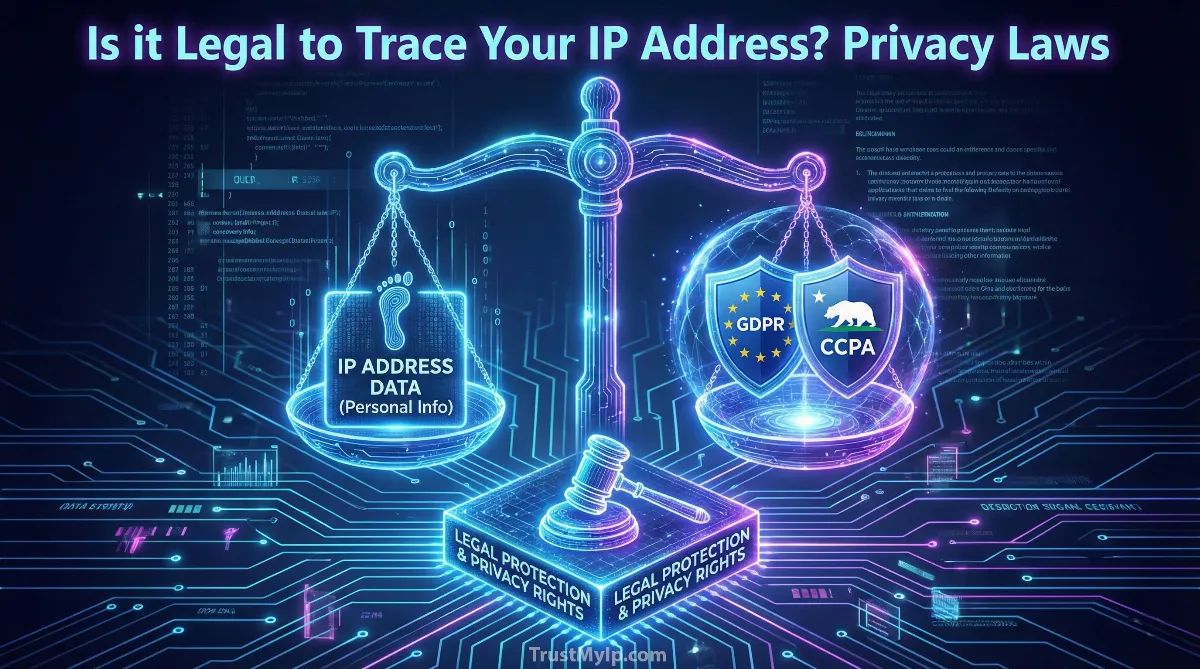
Every time you open a browser and visit a website, your device silently hands over a digital fingerprint — your IP address. It happens automatically. You never approve it. And in 2026, with doxxing incidents rising sharply and AI-powered tracking tools becoming widely accessible, the question of IP address tracing legality has become one of the most urgent privacy concerns on the internet. Over 11.7 million Americans have already been doxxed — many of them starting with an exposed IP address. Yet most people have no idea where the legal line is drawn.
Understanding is it legal for someone to trace your IP address is not a simple yes or no question. It sits at the complex intersection of GDPR, CCPA, federal statutes like the Computer Fraud and Abuse Act, and rapidly evolving case law across multiple countries. Websites collect your IP to function. Advertisers collect it to profile you. Stalkers and harassers try to exploit it. And law enforcement uses it to track criminals — with a court order. This guide cuts through the legal fog, examines what changed in 2026, and explains exactly what your rights are — and what criminals can and cannot actually do with your IP address.

"In my years investigating cyberstalking cases, I've seen IP data weaponized in ways most people would never imagine — from gaming disputes that escalated into doxxing campaigns, to ex-partners using pixel trackers embedded in emails to confirm a victim's home location. The law hasn't always kept up. But in 2026, between California's AB 1979, updated CCPA regulations, and growing federal prosecutions, the legal landscape is finally catching up. The critical thing users need to understand is this: collecting an IP is often legal — weaponizing it almost never is."
Quick Answer: Is It Legal to Trace Your IP Address?
Yes, with limits. Websites, apps, and services can legally collect your IP address for security, analytics, and fraud prevention. But using IP data to harass, stalk, hack, or doxx someone is a federal crime and a violation of state law in all 50 states. Under GDPR, IP addresses are personal data by default. Under CCPA (updated January 2026), they're personal information when linked to an identifiable individual. And in 2026, doxxing prosecution is real — with sentences up to 10 years in federal prison.
1. What an IP Address Actually Reveals — And What It Does Not
Before we discuss legality, let's clear up one of the most widespread myths on the internet: the idea that someone can "trace your IP to your house." In most cases, that is technically false. Understanding what an IP address actually exposes is essential context for every legal question that follows.
What Someone Can See From Your IP Address
When someone obtains your IP address — whether through a chat app, a link they sent you, or a website they control — here's what a standard lookup actually reveals: your approximate city or region (often inaccurate by 50+ miles), your internet service provider, whether you're using a residential, corporate, or VPN connection, and whether your IP is flagged on any threat intelligence lists. That is it. An IP address alone does not reveal your home address, your name, your phone number, or any other personally identifying information. Check exactly what your own IP exposes using our IP address lookup tool.
The Critical Distinction: IP Alone vs. IP Combined With Other Data
The danger — and much of the legal complexity — comes from combining an IP address with other data points. When an IP address is logged alongside a timestamp and browser fingerprint, it can narrow identity significantly. When it's matched with ISP logs (which require a court order to access legally), it maps directly to a subscriber account. This is exactly why GDPR and CCPA treat IP addresses as personal data under specific conditions: not because the IP alone identifies you, but because it can be used as part of a chain of identification.
| What Someone Has | What They Can Find Legally | What Requires Legal Process |
|---|---|---|
| Your IP address only | Approximate city, ISP name, connection type | Your real name, address, account info |
| IP + timestamp + platform logs | Account linked to that session (if they own the platform) | Subscriber identity from ISP |
| IP + ISP records (court order) | Full subscriber name, address, account history | N/A — this is the end of the chain |
| Shared/VPN IP | VPN provider's data center location only | Nothing further — VPN breaks the chain |
This table explains why many people hear "I know your IP, I know where you live" as a threat — and why it usually isn't true. The threat-maker would need unauthorized access to ISP subscriber records to complete that chain. Doing so without a court order is a federal crime. Verify your own ISP exposure using our IP geolocation lookup.
2. The Legal Framework: When Is IP Tracing Lawful?
IP address collection is a fundamental part of how the internet works. The legal question is never whether an IP was collected — it's why it was collected and what was done with it. Courts and regulators in 2026 have clear answers for the most common scenarios.
Legitimate Business Purposes (Legal)
Every time your browser connects to a server, your IP is transmitted automatically as part of the TCP/IP protocol — there is no way for a website to function without receiving it. Courts have consistently ruled that passive collection for fraud prevention, traffic analytics, rate limiting, and network security is entirely lawful when disclosed in a privacy policy. This includes CDNs, cloud providers, analytics platforms, and any standard server log. The key requirements are transparency in a privacy policy and a legitimate stated purpose for the data.
Law Enforcement Access (Legal — With Due Process)
Police and federal agencies can legally trace IP addresses to suspects, but the procedural requirements are strict. They must present evidence of criminal activity to obtain a court order or warrant compelling an ISP to disclose subscriber information. The 2018 Supreme Court ruling in Carpenter v. United States strengthened digital privacy protections by requiring warrants for location data — and its logic has been extended by lower courts to ISP subscriber records in many jurisdictions. Law enforcement cannot simply call an ISP and ask who owns an IP address. Learn about network forensics in our guide on how to find the IP address of any website server.
Copyright Enforcement (Legal — Specialized Process)
Under the Digital Millennium Copyright Act, copyright holders can use a special expedited subpoena process to obtain subscriber identities behind IP addresses captured in piracy monitoring. These cases — where a user's IP is logged downloading a torrent of a film or software — have been controversial, but the subpoena process itself is legal when properly executed through the courts.
3. When IP Tracing Becomes Illegal: The Criminal Line in 2026
This is where most users need clarity. The line between legal IP observation and criminal conduct comes down to intent, method, and use. Here are the specific activities that transform IP awareness into criminal liability.
These activities turn legal IP collection into federal crimes:
- • Unauthorized System Access (CFAA): Using an IP address to probe for vulnerabilities, launch port scans against a private server, or gain unauthorized access to any computer system violates the Computer Fraud and Abuse Act — regardless of whether the IP was obtained legitimately. The Supreme Court's 2021 ruling in Van Buren v. United States clarified the CFAA's scope, but unauthorized intrusion remains squarely illegal.
- • Cyberstalking and Harassment: Using IP data — or a tracking pixel, link, or any other method — to monitor someone's online movements, send threats, or publish their location constitutes cyberstalking under 18 U.S.C. § 2261A. In 2025, Alan W. Filion received 48 months in federal prison for 375 AI-assisted swatting attacks that began with IP-level location data.
- • Doxxing: Publishing someone's IP alongside other personal information to facilitate harassment is now explicitly illegal in multiple states. California's AB 1979, effective January 2025, allows victims to sue for up to $30,000 plus attorney fees. Texas has criminalized doxxing with intent to harm since 2023. All 50 states have applicable harassment or cyberstalking statutes.
- • DDoS Attacks: Using a captured IP address as a target for denial-of-service attacks violates the CFAA and is a federal felony, with penalties of up to 10 years for repeat offenses.
- • Wiretapping: Intercepting IP traffic in transit — packet sniffing on a network you don't own — violates the Electronic Communications Privacy Act, even if the IP addresses themselves are visible in the headers.
The real-world consequence of crossing these lines is increasingly serious. Federal prosecutors filed over 80 cyberstalking cases in a single year at the peak of enforcement, and that number has grown as digital harassment has become more prevalent. For protection strategies, see our article on how to hide your IP address for free.
4. GDPR and IP Addresses in 2026: What the Law Actually Says
The EU's General Data Protection Regulation is the clearest legal framework globally on IP addresses as personal data. Understanding it matters even if you're in the US — because GDPR applies to any organization that processes data of EU residents, regardless of where the business is located.
| GDPR Provision | Impact on IP Tracking | Your Rights |
|---|---|---|
| Article 4(1) — Personal Data | IP addresses are personal data if they can identify an individual, directly or indirectly. GDPR lists online identifiers explicitly. | Right to Access & Deletion |
| Article 6 — Lawful Basis | Companies must have legitimate interest or consent before collecting IP data. Server logs typically use "legitimate interest" (Art. 6(1)(f)). | Right to Object |
| Recital 30 — Online Identifiers | Explicitly names IP addresses alongside cookies and device IDs as identifiers that, when combined with other data, can create profiles of individuals. | Right to Be Informed |
| Article 5 — Data Minimization | Businesses can only retain IP addresses as long as necessary. 90 days is common for server logs; 26 months for analytics tools. | Right to Erasure |
The landmark Breyer v. Germany (CJEU, 2016) ruling established that dynamic IP addresses become personal data when a data controller has legal means to compel ISPs to link those IPs to individuals. This precedent has held firm. Notably, the European Commission's Digital Omnibus proposal of November 2025 initially sought to modify GDPR's personal data definition — but the Council's compromise text of February 2026 eliminated that proposed change, leaving Breyer's case-by-case framework as the governing standard. EU-based sites must still honor full GDPR rights for identifiable IP data.
Practical standard for businesses operating in 2026: treat all IP addresses as personal data unless you can demonstrate with absolute certainty that no path exists to link that IP to an individual. Most compliance teams advise the stricter approach. Check your current exposure with our IP address checker.
5. CCPA 2026 Update: What Changed for California Residents
The California Consumer Privacy Act has always included IP addresses in its definition of personal information — but its practical application has been frustratingly ambiguous. The January 2026 CCPA regulatory update brought meaningful changes that directly affect IP address processing.
CCPA IP Address Framework — 2026 Update
Core Definition: CCPA defines personal information as data that "identifies, relates to, describes, is reasonably capable of being associated with, or could reasonably be linked, directly or indirectly, with a particular consumer or household." IP addresses are explicitly listed.
2026 New Requirement: The January 2026 CCPA regulations now require mandatory risk assessments for automated decision-making that uses IP address data in profiling or behavioral targeting. This directly impacts ad tech, fraud prevention scoring, and personalization systems.
Enforcement Focus: The California Privacy Protection Agency has focused enforcement on large-scale data brokers and major platforms — not individual website operators using basic server logs.
Your Rights: California residents can request disclosure of what IP data businesses have collected, demand deletion, and opt out of the sale or sharing of that data. Businesses must respond to deletion requests within 45 days.
Civil Remedy (AB 1979, Effective Jan 2025): If IP data is used to doxx or harass you, California residents can now sue for up to $30,000 plus attorney fees under AB 1979, independent of any criminal case.
The key ambiguity that has plagued CCPA interpretation — whether an IP address is personal information if a business cannot itself link it to an individual — remains officially unresolved, as the California Attorney General declined to provide categorical guidance. Most compliance-minded businesses treat all IP addresses as personal information to avoid liability. Protect yourself by understanding what information websites can see from your IP.
6. The Computer Fraud and Abuse Act: Federal IP Tracking Law
The Computer Fraud and Abuse Act (CFAA) is the federal statute most commonly applied when IP-based attacks turn criminal. While the law doesn't specifically address IP tracing, courts have applied it broadly to cover the malicious use of IP information in unauthorized access scenarios.
CFAA Violations Connected to IP Tracking
- Unauthorized System Access: Using an IP address to probe or enter any protected computer without authorization — even if you obtained that IP legitimately through a normal website visit — is a federal felony under CFAA § 1030(a)(2).
- Exceeding Authorized Access: The Supreme Court's 2021 Van Buren v. United States ruling narrowed this provision — it applies when someone accesses data they are not permitted to access, not merely when they misuse data they legitimately have. This matters for IP tracking because it clarifies what "exceeding authorization" actually means.
- DDoS and Harmful Code: Targeting captured IP addresses with denial-of-service attacks or malware violates CFAA § 1030(a)(5). Penalties reach 10 years imprisonment for repeat offenses. Test your exposure with our port scanner tool.
- Trafficking in Access Credentials: Combining IP tracking with phishing or credential theft to target specific individuals based on their network location is prosecutable as both a CFAA violation and identity theft under 18 U.S.C. § 1028.
7. ISP Records: Who Can Actually Access Them?
The most common fear people express about IP tracing is: "Can someone find my home address from my IP?" The realistic answer is no — not without ISP records. And accessing ISP records is a tightly controlled legal process.
Who can legally compel ISPs to reveal the subscriber behind an IP address:
- • Law Enforcement with a Court Order or Warrant: Police and federal agents must follow strict procedural requirements established and reinforced by Carpenter v. United States (2018). They cannot simply call an ISP — they need judicial authorization demonstrating probable cause.
- • Civil Litigants via Discovery: Plaintiffs in civil lawsuits can subpoena ISP records through the judicial discovery process — but must demonstrate the IP data is relevant to a valid legal claim. Courts regularly evaluate these subpoenas for proportionality and privacy impact.
- • Copyright Holders via DMCA Subpoena: A specific expedited process under the DMCA allows copyright owners to identify IP addresses linked to alleged infringement. This process has been abused by "copyright trolls" but remains a legitimate legal mechanism when properly used.
- • ISPs Themselves: Providers access their own logs for network management, fraud prevention, and regulatory compliance. Their privacy policies govern internal use of this data.
Individual stalkers, harassers, doxxers, or online trolls cannot legally compel ISP disclosure without going through a court. Anyone claiming they can "trace your IP to your exact address" without legal authority is either bluffing or planning to access ISP systems illegally — which is itself a federal crime. Verify your own ISP visibility using our IP geolocation lookup.
8. The Real-World Threat in 2026: Doxxing, Swatting, and IP-Based Harassment
While the legal framework provides clear protections on paper, the lived reality of IP-based harassment in 2026 is alarming. The numbers have gotten worse — and the tools have gotten more sophisticated.
What the data shows about digital harassment in 2025-2026:
- • Roughly 11.7 million Americans have been doxxed, with 1 in 6 Americans knowing someone who has been victimized. (Safehome.org, 2025)
- • 57% of Americans now avoid sharing political views online out of fear of being doxxed — a chilling effect on free speech with no historical precedent.
- • Executive targeting incidents tripled between 2023 and 2025, with the Security Executive Council recording a 313% increase in incidents.
- • In May 2025, a doxxing site published full personal details on hundreds of Fortune 500 executives — the data remained indexed long after the site was taken down.
- • AI tools now enable automated data scraping that assembles personal profiles — including IP-correlated location data — in minutes, with minimal technical skill required.
The most dangerous pattern involves IP tracking as a first step in a larger harassment campaign. A malicious actor obtains your IP through a game server, chat platform, or embedded tracking link. They use geolocation to narrow your location to a city. They then combine that with social media scraping, public records, and data broker sites to build a profile. IP is rarely the whole story — but it frequently starts it. For protection measures, read our guide on clearing your IP history and digital footprint.
9. Cyberstalking Law: When IP Tracking Becomes a Criminal Offense
Federal and state cyberstalking statutes are the most direct legal tools for victims of IP-based harassment. Courts have grown increasingly sophisticated in understanding how digital tracking constitutes a pattern of stalking conduct.
Federal Cyberstalking Law (18 U.S.C. § 2261A): Prohibits using any electronic means to engage in conduct that causes substantial emotional distress or places a person in reasonable fear of death or serious bodily injury. Using IP tracking to monitor someone's online activity, identify their location, or coordinate a harassment campaign meets this threshold. Federal conviction can result in up to 5 years in prison, rising to 10 years if the victim suffers bodily injury.
State-level enforcement has also become significantly stronger. California's AB 1979 (effective January 2025) allows civil suits for up to $30,000. Texas explicitly criminalized doxxing with harmful intent in 2023. The National Association of Attorneys General documented in 2025 that all 50 states have applicable harassment, stalking, or cybercrime statutes that cover IP-based tracking used for harassment — even in states that don't use the word "doxxing" in their statutory language.
If you are a victim of IP-based stalking or harassment: document every incident with screenshots and timestamps, preserve any communications that demonstrate the stalking pattern, and report the behavior to law enforcement immediately. Courts can and do issue protective orders prohibiting electronic monitoring and harassment. Check if your IP has been misused or flagged using our IP blacklist checker.
10. International Jurisdiction: Cross-Border IP Tracking
The internet has no borders. Your stalker might be in another country. The server logging your IP might be in a jurisdiction with weaker privacy laws. Understanding how legal jurisdiction works in cross-border IP tracking situations is increasingly important.
How Jurisdiction Works in Cross-Border IP Cases (2026)
EU Citizen, Any Server Location: GDPR applies to any organization processing EU resident data, regardless of where the server sits. A US company with EU users must comply with GDPR's IP address protections — confirmed by the February 2026 Council compromise that preserved existing CJEU precedent.
US Stalker, Foreign Victim: US courts may assert CFAA jurisdiction when US-based infrastructure is used in the attack or when effects are felt by a US person. The MLAT (Mutual Legal Assistance Treaty) process allows formal cross-border evidence gathering, though it can take months.
Canadian Precedent (2024): The Supreme Court of Canada's 2024 ruling in R v. Bykovets explicitly recognized IP addresses as personal information warranting constitutional privacy protection — a significant ruling that aligns Canadian law more closely with GDPR.
Data Localization Laws: Russia and China require IP data on their citizens to be stored domestically, creating significant legal complexity for international businesses and limiting foreign law enforcement cooperation.
Practical Reality: Cross-border enforcement is slow and resource-intensive. For most individual victims, pursuing legal remedies in your own jurisdiction while using technical protections (VPN, privacy tools) is the more immediately effective strategy.
Use a reputable VPN service to mask your real IP when accessing content from jurisdictions with weaker privacy protections. This is legal in most countries and provides a meaningful technical layer of protection regardless of the legal landscape. Compare options in our VPN versus proxy comparison guide.
11. Protecting Yourself: Practical Legal and Technical Defenses
You cannot prevent your IP from being visible to every website you visit — that is a technical reality of the TCP/IP protocol. But you can significantly reduce your exposure to malicious IP tracking and assert your legal rights when violations occur.
Your Defense Strategy for 2026
- Use a Reputable VPN: Routing your traffic through a VPN server replaces your real IP with the VPN's IP in all server logs. This is completely legal in most countries and is the single most effective technical protection against IP-based tracking. Learn more in our Tor versus VPN comparison.
- Exercise Your GDPR Rights (EU Users): Submit data subject access requests (DSARs) to any website that processes your IP data. You have the right to know what's collected, request deletion, and object to processing. GDPR requires response within 30 days.
- Exercise Your CCPA Rights (California Residents): Request disclosure of what personal information — including IP data — businesses have collected about you. Demand deletion when there's no legitimate retention purpose. Opt out of data sale or sharing.
- Check Your IP for Misuse: If you suspect someone is using your IP maliciously — or if your IP has been flagged in a harassment campaign — check whether it appears on threat intelligence lists using our IP blacklist checker.
- Document and Report Stalking: If you believe someone is using IP data to track or harass you: screenshot everything with timestamps, preserve all communications, and report to law enforcement. In California, you can also file a civil suit under AB 1979 for up to $30,000 without waiting for criminal charges.
- Be Careful With Links: IP grabbers can be embedded in URLs, images, and files sent in chat apps. If someone sends you a suspicious link — especially in a gaming or social context — treat it as a potential IP capture attempt and do not click without a VPN active.
12. Corporate Compliance: Legal IP Collection Best Practices for 2026
Businesses collecting IP addresses in 2026 face a more demanding compliance environment than ever before. The CCPA's new automated decision-making rules, GDPR's continued strict enforcement, and expanding state-level privacy laws all create obligations that require active compliance programs.
2026 Corporate Compliance Checklist for IP Data
- Document Your Lawful Basis: For server logs and basic analytics, "legitimate interest" under GDPR Article 6(1)(f) is the standard basis. For marketing-specific IP tracking, you likely need explicit consent. Document this in a privacy notice that is genuinely accessible to users.
- Set Real Retention Limits: The standard in 2026 is 90 days for server logs and 26 months for analytics platforms like Google Analytics. Retaining IP logs indefinitely is a GDPR violation and creates unnecessary regulatory risk.
- Build DSAR Response Infrastructure: Under GDPR, you must respond to data subject access requests within 30 days. Under CCPA, consumer requests must be addressed within 45 days. You need a system to receive, track, and fulfill these requests — not a manual process.
- Conduct Risk Assessments for IP-Based Profiling: The January 2026 CCPA regulations now require documented risk assessments before using IP data in automated decision-making, profiling, or behavioral targeting. This is a new obligation that did not exist in prior years.
- Implement Cross-Border Transfer Safeguards: Use Standard Contractual Clauses or approved binding corporate rules when transferring IP data from EU users to non-EU jurisdictions. The EU-US Data Privacy Framework provides a valid transfer mechanism for qualifying US organizations.
Conclusion: The Legal Reality of IP Tracing in 2026
Understanding is it legal for someone to trace your IP address in 2026 means accepting a nuanced answer: observation is usually legal; exploitation almost never is. Websites collect your IP because they have to — it is a technical requirement of internet communication. Businesses analyzing traffic, detecting fraud, and maintaining security are operating within a legal framework that permits this, provided they disclose it and honor applicable privacy rights.
What has changed in 2026 is the severity of the threat when IP data is weaponized — and the strength of the legal response. With over 11.7 million Americans having been doxxed, with AI tools enabling rapid personal profiling from minimal initial data, and with executives facing a 313% increase in targeting incidents, the stakes of digital privacy have never been higher. The good news is that the legal framework has strengthened considerably: California's AB 1979, updated CCPA regulations with mandatory risk assessments, Canada's R v. Bykovets ruling, and continued GDPR enforcement all give individuals meaningful rights. Use those rights. Use a VPN. And if someone crosses the line from observation into harassment — document it, report it, and pursue every legal remedy available. Under GDPR, CCPA, and federal cyberstalking law, the tools to fight back are real.
Check Your IP Privacy Now!
Discover what your IP address reveals right now, check if it appears on any threat intelligence blacklists, and verify your VPN is actually protecting you — with our free privacy diagnostic tools.