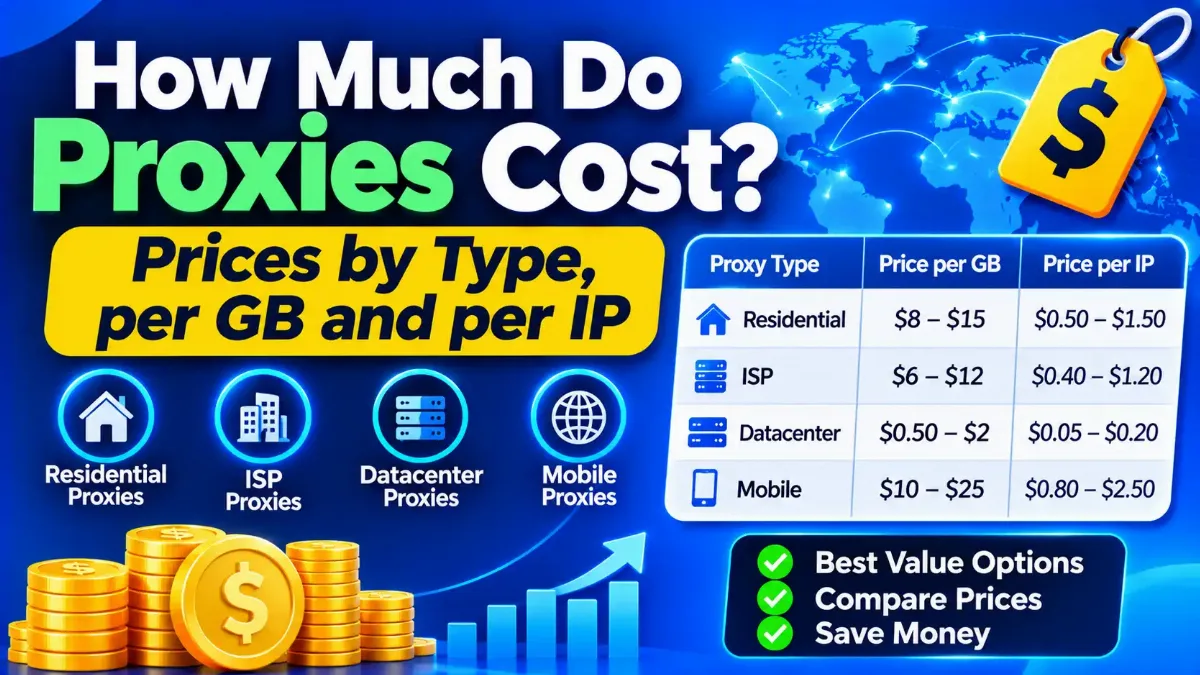

Datacenter proxies cost $0.75 to $2.50 per IP a month, dedicated ISP proxies $2 to $5, and residential traffic a median $2.25 to $3.75 per GB, depending on order size. Mobile traffic sits a little higher per GB. So how much do proxies cost in practice? Type, seller, volume and the unit you are billed in decide it. Seller prices here are list prices as of November 2026, before tax, and market medians come from Proxyway's spring 2026 data.
A proxy forwards your requests from another IP address, as our explainer on where a proxy sits covers. What you rent is either a fixed address for a month, a slice of a rotating pool measured in gigabytes, or finished pages counted per request. Those three billing units explain most of the gap between the cheapest offers and the priciest.
This guide prices all four proxy types plus scraper APIs, then turns the rates into monthly budgets for five common jobs. It also lists the fees, expiry rules, taxes and payment methods that change what you pay. We ran no tests: every budget is arithmetic on sellers' price pages, Proxyway's medians and HTTP Archive page weights. Nothing here is a ranking, sellers cannot pay for a mention, and we earn nothing from the links.

Quick Answer: How Much Do Proxies Cost?
This guide prices proxy servers. Proxy cards for Magic: The Gathering and the proxy-voting fees that companies pay to reach shareholders are separate topics.
Proxy Prices by Type: What Each Kind Costs
Each proxy type has its own billing unit, so compare prices only within a row. Seller rows show list prices as of November 2026, from a first purchase to the lowest self-serve volume rate. The residential and mobile rows show Proxyway's spring 2026 medians for 5 GB and 500 GB plans instead.
| Proxy Type | Billing Unit | Entry Price | Volume Price |
|---|---|---|---|
| Shared datacenter | Per IP, monthly | $1.00 | $0.75 to $0.80 |
| Dedicated datacenter | Per IP, monthly | $1.50 to $2.50 | $0.80 to $1.88 |
| Rotating datacenter | Per GB | $0.30 to $1.25 | $0.23 to $0.50 |
| Dedicated ISP (static residential) | Per IP, monthly | $3.30 to $5.00 | $2.60 to $4.60 |
| Rotating residential | Per GB | $3.75 (median, 5 GB) | $2.25 (median, 500 GB) |
| Rotating mobile | Per GB | $4.38 (median, 5 GB) | $2.48 (median, 500 GB) |
| Scraper API, plain pages | Per 1,000 results | $0.13 to $1.80 | $0.06 to $0.35 |
Datacenter is the cheapest type on either billing unit, while the residential and mobile medians sit within about $0.65 of each other. Medians suit those two rows because Proxyway priced about a dozen sellers, mostly in March and April 2026, against six on our list for residential and five for mobile.
Among the sellers we checked, residential prices as of November 2026 range from Oxylabs' $6 per GB on its smallest plan to $0.55 on Databay's Flex pool. Bigger plans go lower: SOAX's $3,000 monthly plan lists rates from $0.35 in its cheapest region, and Rayobyte's restricted Scale plans go lower still, as the fees section explains. Outside SOAX, which bills mobile at its residential rates, mobile runs from $7.50 per GB at Oxylabs to $0.95 on Rayobyte's $2,500 monthly plan.
Proxyway's October 2026 ISP study puts dedicated ISP IPs at $2 to $4 each before discounts. Pages that need a full browser cost more through an API: Zyte's browser-rendered tiers run $1.01 to $16.08 per 1,000 on pay-as-you-go. Rayobyte's self-serve API rate stays at $1.80 per 1,000 up to 500,000 requests a month.
Two cheaper variants sit outside the table. As of November 2026, shared ISP IPs cost $1.20 to $1.50 each on Oxylabs' self-serve plans, but each one can be shared by as many as three customers. IPv6 datacenter addresses, which use the newer, much larger address format, cost far less: $0.20 an IP a month at Rayobyte in the US. They only reach sites that accept IPv6.
Some price summaries, including Google's AI answer in November 2026, quote datacenter IPs "from $0.015" a month. The closest rate we found, $0.0179, applies only to orders of 60,000 or more shared IPs, from a seller that fails our screen. That seller's entry plan, 100 shared proxies for $2.99, works out to about $0.03 an IP.
How we priced proxies for this guide
Per IP, per GB or per Request: Which Billing Unit Fits?
A proxy cost is the unit price times the units you use, plus any fees and tax. The unit decides which jobs come out cheap, so pick it before you pick a seller:
- → Per IP, monthly: you rent fixed addresses, and traffic is included up to a fair-use limit set in the seller's terms. Datacenter and ISP proxies (server IPs listed under a consumer internet provider) are sold this way. It suits a few addresses that move a lot of data.
- → Per GB: you pay for traffic through a rotating pool of many addresses. Residential, mobile and rotating datacenter pools are sold this way. It suits many addresses that each move little data. Sticky sessions, which keep the same IP for minutes or hours, carry no listed surcharge at Oxylabs or Rayobyte as of November 2026.
- → Per request or result: a scraper API fetches the page for you and charges per 1,000 results, with rotation and retries built in. It suits teams that want pages, not infrastructure.
- → Per port, thread or day: some sellers rent a device, a connection slot or a time pass with traffic included. Proxidize, for example, charges $59 a month per mobile proxy with bandwidth marked unlimited, as of November 2026.
Credits blur these units. Oxylabs' single subscription starts at $15 a month as of November 2026, and its credit is spent across any product at that product's rate. SOAX also prices in credits, with one rate per location tier covering residential and mobile traffic. At Oxylabs the plan size, not the per-GB rate, sets the minimum monthly bill, while SOAX's Sandbox plan has no fee and sells top-ups at higher rates.
Per IP and per GB meet at a break-even point: divide one IP's monthly price by the price per GB. Our break-even math for ISP and residential works through that sum with dated seller prices.
How Much Is 1 GB of Proxy Traffic, and What Does It Buy?
One gigabyte of residential traffic costs a median $3.75 on a 5 GB plan, per Proxyway's 2026 research, and mobile costs a median $4.38. Datacenter gigabytes are far cheaper: $0.30 to $1.25 on small orders at the sellers we checked, as of November 2026. For residential rates seller by seller, see per-GB residential rates by seller.
What a gigabyte buys depends on what you download. HTTP Archive's 2025 page-weight chapter found a median mobile home page of 2,559 KB in its July 2025 crawl, and a median HTML response of 33 KB on mobile. So 1 GB covers about 390 full mobile page loads, or roughly 30,000 fetches of the HTML alone.
Treat those counts as a ceiling. Request headers, encryption handshakes and retries add traffic on top of the page itself. SOAX, for example, counts traffic both ways and includes retries, partial responses and dropped connections. Skipping images and scripts when you only need the text is the biggest single saving on a per-GB plan.
Sample Monthly Proxy Budgets for Five Common Jobs
To budget a month, multiply the pages or addresses you need by the right unit price, then check the seller's smallest plan. Each estimate uses November 2026 list prices for sellers, Proxyway's spring 2026 medians for residential and mobile, and the page weights above.
| Job | What You Buy | Estimated Monthly Cost |
|---|---|---|
| Call a partner API from 5 approved IPs | 5 dedicated datacenter IPs | $9.20 to $15, set by pack sizes |
| Ad checks: 300 page loads a day in US cities | About 23 GB of residential traffic | $69 to $86 at median rates |
| Collect 1 million public HTML pages | About 33 GB, or 1 million API results | Datacenter $10 to $20; residential $99 to $124; API $100 to $500 |
| Test an app on a carrier network | About 5 GB of mobile traffic | About $22 at the median; entry plans often $30+ |
| Fixed US IP for a company dashboard's allowlist | 1 dedicated ISP IP | $15 to $25 once plan minimums apply |
Here is the arithmetic, using November 2026 list prices. HighProxies charges $9.20 for 5 dedicated IPs, a price that includes a 20% discount with no stated end date. Rayobyte's minimum of 5 costs $12.50, and Squid Proxies' smallest pack is 10 for $15. The ad-check row assumes full mobile page loads of 2,559 KB, priced between Proxyway's 50 GB and 5 GB residential medians. US-only traffic can cost more, since SOAX, for one, charges its highest rate for the US.
The data row assumes HTML-only fetches of 33 KB. Rotating datacenter traffic at $0.30 to $0.60 per GB keeps it cheap if the sites accept server IPs. Plan steps can lift it, though: Oxylabs' $15 plan covers 25 GB of datacenter traffic, so 33 GB needs a top-up or its $100 plan. A scraper API costs more, but it returns finished pages and handles retries. Zyte's simplest tier runs $0.10 per 1,000 on a $100 monthly commitment, and Oxylabs' general rate falls to $0.35 on its $500 plan.
The last row shows how minimums swamp small orders. As of November 2026, one Oxylabs dedicated ISP IP lists at $3.30, but its smallest paid plan is $15 a month. Rayobyte sells static ISP IPs in packs of at least 5, at $5 each. Mobile works the same way: Proxyway's median entry purchase for mobile was $30 in its spring 2026 data.
What Drives the Price of a Proxy Server?
The address itself sets a floor. IPv4 space is scarce, and IPv4.Center, an address marketplace, put the lease rate at $0.5859 per IP a month in its first-half 2026 market review. Buying an address averaged $20.04, or $18.95 in the region run by ARIN, North America's address registry. A $1 datacenter IP leaves little room above that.
Residential and mobile prices carry a different cost: bandwidth from real devices, which sellers gather through software kits built into apps and bandwidth-sharing programs. Proxyway's 2026 research adds that "IP sourcing and infrastructure costs create a natural floor." That floor is why a vetted residential gigabyte rarely matches the cheapest offers online.
Four other levers move the price, judging by list prices as of November 2026. Sharing an IP cuts the cost: Oxylabs charges $1.50 for a shared ISP IP and $3.30 for a dedicated one. Location matters too: SOAX's US rate is its highest, at $5 per GB on its fee-free Sandbox plan, against $2 in its cheapest region. Volume and commitment lower the unit price on most price lists we read, though Proxidize charges a flat $2 per GB on mobile.
The last lever is how welcome each IP type is. Datacenter addresses cost least partly because many sites apply hosting-range filters at the door. Mobile addresses come from carrier networks, where many subscribers share one public IP, and mobile entry purchases run far above residential ones.
Market swings matter as well. Proxyway found that residential rates fell by as much as 75% from 2023 to 2025, then held steady and began creeping back up in early 2026. Mobile prices fell further, with Rayobyte cutting rates by up to 98%, per Proxyway. Several large sellers also dropped long-running 40 to 50% coupon codes. That churn helps explain why published ranges disagree: a May 2026 vendor guide quotes mobile at $10 to $40 or more per GB, far above Proxyway's medians.
What Are Proxy Fees? The Catches That Raise the Bill
The headline rate is rarely the whole proxy cost. These are the catches we found across types, each as stated by the seller as of November 2026:
- → Minimum orders: Rayobyte sells static IPs from 5 at a time, and Oxylabs' smallest paid plan is $15 a month. SOAX's first paid plan is $200 plus VAT, though its fee-free Sandbox sells top-ups at higher rates. Proxyway found that several sellers hid pay-as-you-go plans, "increasing the entry points by up to twenty-five times."
- → Credit and traffic that expire: Oxylabs says unused credit lapses when the billing cycle ends. SOAX credits on Sandbox and monthly plans last 60 days, most Databay traffic lapses after 31 days, and Rayobyte and Proxidize mobile bandwidth lasts one month.
- → Traffic you did not want: per-GB plans can bill retries, partial responses and both directions of a connection. Oxylabs' scraper API bills 4xx results, such as a site's 404 "not found" page, though not its own 5xx server failures or 429 "too many requests" replies.
- → Limits behind "unlimited": under Rayobyte's terms, last updated July 30, 2024, its dedicated and static residential proxies count over 30 GB per IP in 30 days as excessive. Above 10 TB a month, users pay $30 per 10 TB or risk termination.
- → Cheap tiers with strings: Rayobyte's Scale residential plans begin at $100 monthly, which buys 6,600 GB, or about $0.015 per GB. They need a compliance review, offer no location targeting and limit how many requests run at once by plan size. Rayobyte's datacenter and ISP Scale plans also skip the top 1,000 or so websites.
- → Single-IP premiums: Proxyway's ISP study warns that buyers of a single proxy pay far more per IP than the next pack size up costs.
Location targeting can cost extra: Proxyway's 2026 research found a seller that still charges twice for advanced targeting, while Oxylabs and Rayobyte list theirs at no extra charge. For residential catches seller by seller, see the residential guide linked above.
How Do You Pay for Proxies, and Is Tax Added?
Payment options and refund rules vary from seller to seller. Here is what each seller in our method box states, as of November 2026:
| Seller | Accepted Payment | Refund Terms |
|---|---|---|
| Oxylabs | Card, PayPal, Google Pay, Apple Pay; wire via sales; no crypto | No refunds on self-serve purchases, per its help center |
| Rayobyte | Card, PayPal; Google or Apple Pay except residential; no Bitcoin | Two-day money-back on static proxies |
| SOAX | Major cards; wire for approved businesses; crypto logos shown | Payments generally non-refundable |
| Databay | Card, wire, WeChat Pay, Ethereum, Litecoin (logos) | Network defects only, within seven days |
| HighProxies | PayPal, card or cryptocurrency | Three days, first order; crypto non-refundable |
| Squid Proxies | Visa, Mastercard, PayPal, Bitcoin and other crypto | Seven-day money-back on the first purchase |
| Proxidize | All credit and debit cards | 30-day money-back while usage stays under 10 GB |
Two patterns stand out. Cards work everywhere, PayPal at four of the seven, and crypto at about half, though HighProxies will not refund crypto payments. Most subscriptions renew on their own, too: Oxylabs says the next cycle's payment is "automatically authorized." Some purchases also wait on an identity check: Proxidize requires identity or business verification on every account, and Rayobyte's Scale plans need one too.
Tax sits on top of the list price. Oxylabs marks its plans "VAT may apply," and SOAX states that its listed prices leave out tax, adding VAT, sales tax or GST by billing location. Rayobyte's terms add "any applicable taxes" at renewal. US buyers should check the checkout total, since state sales tax on digital services varies.
Free and Very Cheap Proxies: What You Give Up
Free proxies cost nothing up front, and research shows why that price is misleading. A 2018 study at the ACSAC security conference found that more than 92% of open proxies on aggregator sites did not respond. A separate 2018 NDSS study found that 38% of the open HTTP proxies it examined modified the content passing through them.
The problem has not faded. The 2024 study "Free Proxies Unmasked," which tracked 11 free-proxy providers for 30 months, found that only 34.5% of listed proxies were active even once. Free proxies can still serve a quick look at a public page, but not logins, payments or any job that needs a steady address.
For small-scale testing, free credit from a paid seller is the safer route. As of November 2026, Oxylabs gives $5 of welcome credit, Zyte $5 of API credit for the first month, and Rayobyte's Scraping API 5,000 free requests. Trial rules vary by product, as our guide to proxy trial catches shows seller by seller.
Very cheap paid pools carry a different risk. Proxyway's spring 2026 research describes a gray market "where a gigabyte can cost $0.30 or even less," and botnet-fed storefronts where it "often runs under $0.50." A rate far below the medians in our first table deserves a question about where the IPs come from, even at a seller that passes our screen.
How to Verify the Proxy Type You Paid For
A higher price should buy a better address, so confirm the type before your refund window closes. Pull a few IPs from your new plan and run these checks.
1 Make sure a premium IP is not a cloud server
2 Match the network to the product name
3 Screen static IPs before the month starts
4 Compare billed traffic with your own count
Repeat the network check from time to time on rotating plans, because pool addresses change from day to day.
How Much Do Proxies Cost? The Bottom Line
Most proxy bills come down to a few unit prices. As of November 2026, a handful of datacenter IPs costs $5 to $15 a month and a dedicated ISP IP $2 to $5. Residential and mobile traffic runs a few dollars per GB, and scraper APIs swap all of that for a price per 1,000 results.
The unit matters more than the headline rate. Pay per IP when a few addresses carry heavy traffic, per GB when many addresses each carry little, and per request when you only want finished pages. Then add the minimum plan, expiry rules, tax and refund terms before you compare totals. For more detail on the cheapest type, see datacenter plans and their limits, and read why sites turn some IPs away before you buy it.
Start with the smallest plan that covers a week of real work, measure your traffic, and scale only once the numbers hold. Check a few IPs with our ASN lookup and cloud range check first, so the price you pay matches the address type you get.