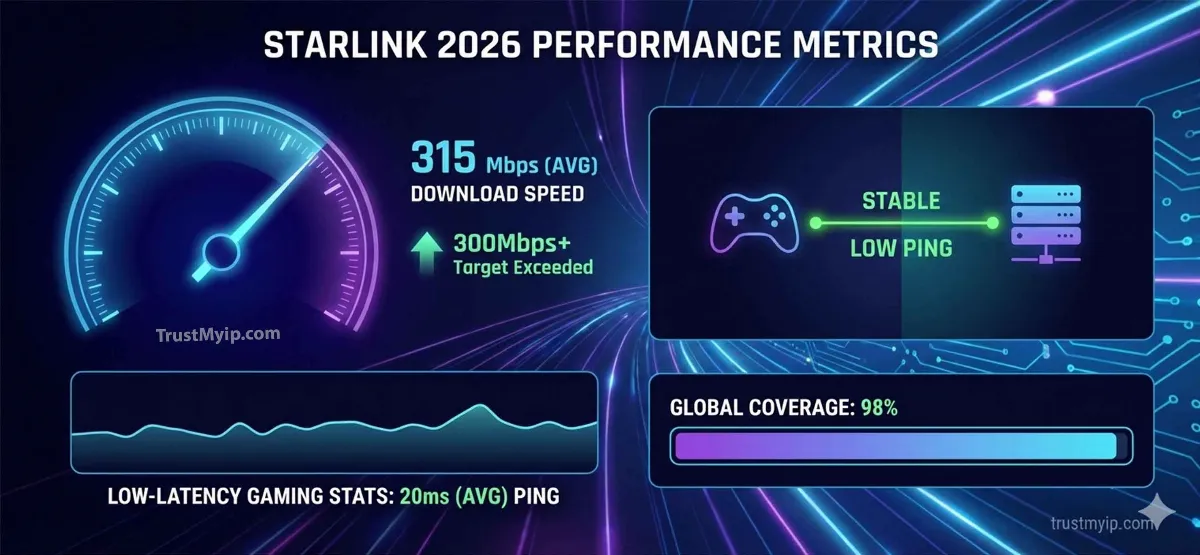
The era of "slow satellite internet" is officially dead. As we navigate through 2026, SpaceX's constellation has reached a density that rivals urban fiber in many parts of the USA. But Starlink internet speed isn't just a single number on a speed test; it is a dynamic metric influenced by orbital mechanics, atmospheric conditions, and your specific network inventory. If you want to know if Starlink can handle your 8K streaming or competitive gaming, you need to look beyond the marketing and into the raw physics of space-based data.
"In my 6 years of auditing global networks, Starlink is the first to achieve sub-30ms latency from space. However, users often confuse bandwidth vs. throughput. Your dish might have the capacity for 300Mbps, but if your network path is congested at the ground station, your real-world experience will vary. Mastering your Starlink IP Addressing is the key to unlocking consistent performance."
1. Starlink Speed Benchmarks: What to Expect in 2026
With the rollout of Version 3 and Version 4 satellites, Starlink internet speed has seen a massive leap. In the USA, residential users now regularly see speeds that were once reserved for high-end business lines. However, these speeds are divided into "Service Tiers" managed by Starlink's internal network access control.
Standard (Residential)
Download: 150 - 300 Mbps
Upload: 20 - 40 Mbps
Latency: 25ms - 50ms
Priority (Business)
Download: 250 - 500 Mbps
Upload: 40 - 60 Mbps
Latency: 20ms - 40ms
Starlink Mini / Mobile
Download: 50 - 150 Mbps
Upload: 10 - 20 Mbps
Latency: 35ms - 60ms
Step 1: Test Your Real-Time Speed. Use our High-Precision Speed Test to see if your dish is hitting its 2026 performance targets.
2. Latency Engineering: Can Starlink Handle Pro Gaming?
In 2026, latency is the metric that matters most. Because Starlink satellites are in Low Earth Orbit (LEO), the data doesn't have to travel as far as old-school satellites. This is why Starlink satellite calls on mobile phones feel as clear as local fiber.
The Round Trip Time (RTT)
By using Anycast Routing at the ground stations, Starlink ensures your gaming packets take the shortest possible path to the server. Most USA gamers report sub-40ms on Hypixel and other major platforms.
The Throughput Factor
Consistency is key. While peak speeds are high, throughput can fluctuate during orbital handoffs. Learn more in our Throughput vs Bandwidth Guide.
3. Technical Constraints: Why Your Starlink Speed Drops
Even the most advanced satellite network is bound by the laws of physics. Understanding these technical constraints will help you troubleshoot why your 300Mbps connection suddenly feels like 10Mbps.
-
Rain Fade & Heavy Snow
Water droplets in the air can scatter the high-frequency Ka and Ku band signals used by Starlink. During a USA thunderstorm, you may see a 20-30% drop in internet speed.
-
The 1% Obstruction Rule
If a tree branch covers just 1% of your dish's view, your DHCP lease might drop for a fraction of a second. This causes "Micro-stutter" in video calls.
4. How IP Addressing Affects Your Starlink Performance
Your Starlink internet speed is heavily tied to how your device is identified on the network. In 2026, SpaceX's CGNAT logic plays a major role in your routing efficiency.
Residential users often share a public IP with others. To maximize your throughput and avoid IP conflicts, many power users upgrade to a Starlink Static IP or use Bypass Mode to let their own router handle the DHCP allocation. For a full technical breakdown, read our Starlink IP Addressing Guide.
5. 2026 Starlink Speed Optimization Checklist
Use this forensic checklist to ensure your network documentation is optimized for maximum satellite performance.
| Optimization Task | Expected Benefit | Technical Level |
|---|---|---|
| Enable Bypass Mode | Better Routing Control | Professional |
| Switch to IPv6 | Lower Header Overhead | Advanced |
| Manual DNS (1.1.1.1) | Faster DNS Resolution | Beginner |
| MAC Filtering | Reduce Congestion | Intermediate |
Not sure about your hardware's capacity? Use our MAC Address Auditor to identify your dish version and manufacturer limits.
6. Comparison: Starlink vs. Urban Fiber vs. Cable
In 2026, the gap between space and ground has narrowed. While Fiber still wins on absolute throughput, Starlink is winning on global connectivity.
Fiber Optics (The King)
Stable 1Gbps+ speeds with 5ms latency. Best for 8K video production and enterprise disaster recovery.
Starlink (The Disruptor)
300Mbps speeds anywhere on Earth. In rural USA, it is now faster and more reliable than aging copper/DSL infrastructure.
7. Troubleshooting: Why is my Starlink slow today?
If you’re seeing slow internet speed, it might not be the satellites. Check these internal factors first:
- Network Overcrowding: If 10 people are using Wi-Fi at once, your throughput is being split. Use our IP Conflict Fix guide to clean up your local device list.
- Stale DHCP Lease: Sometimes your dish needs a fresh identity. Follow our Router IP Reset steps to force a new handshake with the satellite.
- Dish Heating Mode: In winter, Starlink uses power to melt snow. This can occasionally divert resources and cause minor latency spikes during heavy blizzards.
Starlink Speed FAQ
Is Starlink fast enough for 4K Netflix?
Yes. 4K streaming only requires 25Mbps. Even with weather interference, Starlink’s 2026 average of 200Mbps provides enough bandwidth for multiple 4K streams simultaneously.
Does Starlink have a data cap?
Most Standard plans have unlimited data in 2026. However, "Priority" users get faster throughput during peak evening hours (6 PM - 10 PM).
Can I improve my ping with a VPN?
Rarely. A VPN usually increases latency. However, some gamers use them to fix routing issues. Learn more in our Stealth IP Guide.
Conclusion: The Global Speed Revolution
Mastering your Starlink internet speed in 2026 is about understanding the symbiotic relationship between space hardware and local router configuration. By optimizing your DHCP allocation, managing your network documentation, and auditing your throughput during peak hours, you turn a satellite dish into a professional-grade fiber alternative. As the constellation grows, the dream of high-speed, low-latency internet for every human on Earth is finally a reality.
Is Your Speed Real?
Don't trust the marketing. Use our forensic toolkit to audit your latency, check for DNS leaks, and measure your actual satellite throughput in one click.