In the digital landscape of 2026, the fear of "Doxing"—the public release of a person's private information—is at an all-time high. The question can someone find your house address using just your IP is the cornerstone of online security concerns. To the average user, a numeric IP seems like a direct GPS coordinate to their front door. However, as we peel back the layers of network documentation and forensic tracking, the reality is far more complex. While an IP address is a digital fingerprint, the wall between your network identity and your physical home is protected by stringent data privacy laws and technical barriers.

"In my years of conducting malware prevention audits and researching cybersecurity threats, I have seen that the threat isn't the IP alone; it's the combined forensic profile. An IP address by itself will rarely lead an attacker to your doorstep. However, when paired with OSINT techniques and social media metadata, your public data can start to reveal a frighteningly accurate picture. Understanding the 'Legal Wall' of your ISP is critical to reclaiming your privacy."
The Forensic Verdict: IP to Home Address
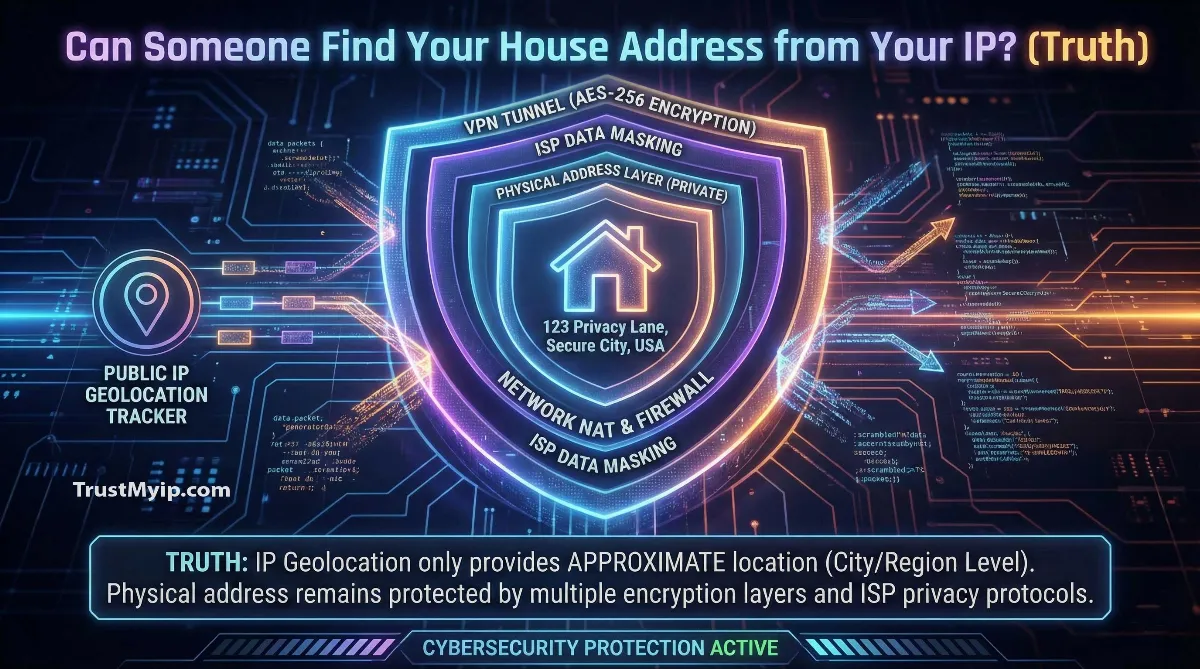
No, a private individual cannot find your exact house address using just your IP address. Standard geolocation data only reveals your general vicinity (City or Region) and your authorized provider (ISP). To get a physical street address, an attacker would need a court-ordered subpoena to access your ISP’s private logs, which are protected by data privacy laws.
3. The Forensic Truth: What Geolocation Data Actually Reveals
When you visit a website, the server logs your Public IP. This triggers a lookup in a geolocation data registry. In 2026, these databases have become very fast, but they have a technical limit.
The Resolution Limit
- • City-Level Accuracy: Databases can accurately identify your metropolitan area.
- • ISP Mapping: The IP points to the network path managed by your provider, not your home router.
- • The Exchange Point: Often, the location seen is the ISP's regional hub, which could be 5 to 10 miles away from your house.
Step 0: Privacy Check. See exactly what a website sees when you land on it. Use our IP Identity Tool to audit your exposure.
4. ISP Confidentiality: The Legal Wall Between Your IP and Your Door
Your authorized provider (Comcast, AT&T, or Starlink) maintains a private database of which customer was assigned which numeric IP at a specific time. This information is a "locked vault."
Data Privacy Laws (GDPR/CCPA)
Under laws like GDPR or CCPA, your home address is considered PII (Personally Identifiable Information). An ISP cannot release this data to a regular person. It requires a legal subpoena from law enforcement during a criminal investigation. Without a court order, your network identity remains decoupled from your street address.
5. Real-World Risks: How Doxing Actually Works
If an IP isn't enough, how do people get doxed? Attackers use OSINT (Open Source Intelligence) to combine your numeric IP with other data points.
| Method | Forensic Technique | Result |
|---|---|---|
| Social Engineering | Matching IP city with Facebook location. | Narrowing down to a neighborhood. |
| BSSID Mapping | Using Wi-Fi signal names to trilaterate. | Identifying the specific street. |
| Phishing | Tricking you into entering your address. | Direct theft of home address data. |
Worried about your Wi-Fi being used to track you? Read our MAC Address vs IP Address Guide.
6. Privacy Protocols: How to Completely Mask Your Home Location
To stay invisible in 2026, you must break the link between your public data and your physical geography.
- • Use a VPN Tunnel: A professional VPN replaces your Public IP with one from a data center. For high-speed options, see our Top 5 VPN Guide.
- • Residential Proxies: For a more authentic but masked identity, read our guide on Best Residential Proxies.
- • Disable Location Services: Ensure your browser doesn't have GPS permissions, which provide 10x more accuracy than an IP address.
7. Troubleshooting: What to Do if You Think You're Being Tracked
If you suspect an attacker has identified your general area and is trying to narrow it down, follow these forensic SOP (Standard Operating Procedure) steps.
- Force an IP Change: Power cycle your router for 5 minutes. Most ISPs will assign you a new numeric IP. Check our IP Change Guide.
- Check for IP Conflicts: Malicious local attacks can cause IP address conflicts. Follow our Conflict Resolution Manual.
- Scan for Malware: Some spyware can bypass the IP-to-Address wall. Run a deep system scan for malware prevention.
Conclusion: Reclaiming Your Physical Anonymity
The forensic answer to can someone find your house address using just your IP is a definitive "No"—at least not without a badge or a warrant. However, in the interconnected web of 2026, your public data is a puzzle. Your IP is just one piece. By mastering your network identity, using encrypted VPN tunnels, and auditing your DNS Resolution for leaks, you turn that puzzle into a dead end for attackers. Your physical home should be your sanctuary; keep it that way by keeping your digital footprint masked and resilient.
Is Your House Safe?
Stop the track before it reaches your door. Use our forensic toolkit to audit your DNS health, detect proxy leaks, and verify your 2026 IP reputation in one click.